
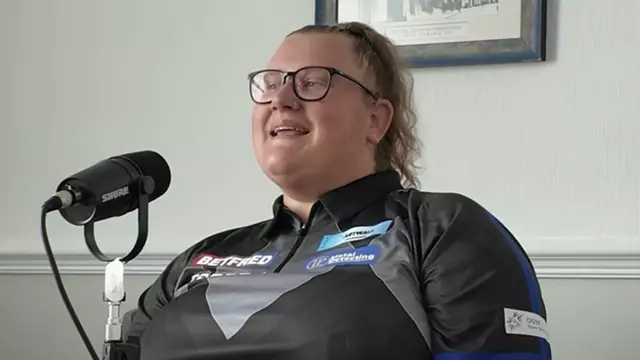
In the electrifying world of professional darts, where precision meets passion under the glare of spotlights, few stories capture the thrill of the game quite like that of Beau Greaves. The 21-year-old sensation from Doncaster, affectionately dubbed “Beau ‘n’ Arrow” for her unerring accuracy, has been rewriting the script of women’s darts with a dominance that’s as inspiring as it is intimidating. But as she stands on the cusp of even greater heights—potentially earning a coveted PDC Tour Card—Greaves finds herself staring down a controversial rule that could sideline her from key events, sparking a debate about fairness, growth, and the future of the sport.
Greaves’ journey to stardom reads like a dartboard dream. Bursting onto the scene as a teenager, she claimed her first World Darts Federation (WDF) Women’s World Championship title in 2022 at the historic Lakeside venue, a nod to the golden era of darts when legends like Eric Bristow ruled the oche. She didn’t stop there. Defending her crown in 2023 and again in 2024, Greaves has now etched her name into the annals as a three-time champion, each victory more emphatic than the last. In her most recent triumph last December, she dismantled Scotland’s Sophie McKinlay 4-1 in the final, reeling off 12 of the next 14 legs after dropping the opener, complete with six maximum 180s that left the crowd roaring. The £25,000 prize money was sweet, but for Greaves, it’s the legacy that lingers—the chance to be a beacon for young girls dreaming of throwing for glory.
Yet, this success has come at a steep price, one enforced by the Professional Darts Corporation (PDC), the powerhouse governing body that stages the glitzy World Darts Championship at London’s Alexandra Palace. Under PDC regulations, players without a Tour Card—those elite credentials granting access to the ProTour circuit—are barred from competing in both the PDC’s mixed-gender showcase and the WDF’s dedicated women’s event in the same season. The rule, a holdover from the bitter 1990s schism between the PDC (then the WDF) and the British Darts Organisation (BDO), stems from a legal settlement known as the Tomlin Order. It was designed to prevent crossover chaos but now feels like an outdated anchor dragging down progress. For Greaves, it meant skipping Ally Pally in both 2023 and 2024 to defend her WDF title, denying fans the sight of her arrow-like throws amid the men’s elite.
The frustration boiled over after her latest Lakeside masterclass. “The ladies’ game is massive to me,” Greaves declared, her voice steady but laced with passion. “As well as the PDC do, they don’t do a ladies’ World Championship and that’s a big thing for me when I was younger. I wanted to be a women’s world champion and I got that at Lakeside and I wanted to defend it, I did that, so I can’t not go back.” She paused, the weight of the choice evident. “It’s a difficult decision. I would love to go and play [at Ally Pally]. I’ve enjoyed playing this year more than I did last year here.” But the rule’s rigidity chafes. “It’s a shame they make you choose. I don’t understand that. I don’t know why they do. I think it’s stupid,” she added bluntly, echoing sentiments that have rippled through the darts community. “I wouldn’t go on and win Ally Pally. I’d give it a good crack and see if I played well. But, ultimately, I want to be a ladies’ champion and we’ll see if I can do that again.”
Greaves’ candor isn’t just personal—it’s a rallying cry for change. The PDC has poured resources into women’s darts, launching the Women’s Series in 2022 to boost female participation. Events like these have produced trailblazers: Fallon Sherrock’s historic run to the third round at Ally Pally in 2019, and Noa-Lynn van Leuven’s recent breakthroughs. Greaves herself has been a force, winning nine straight Women’s Series tournaments and an astonishing 58 consecutive matches. Her latest feat? A stunning semi-final victory over teenage prodigy Luke Littler at the World Youth Championship earlier this month. In a match that had pulses racing, Greaves edged out the 18-year-old world No. 1 with an 11-dart decider, her 105 average just shy of his 107 but enough to secure her spot in the final against Netherlands’ Gian van Veen on November 24 in Minehead. Littler, gracious in defeat, hailed her as “some talent,” a testament to her growing menace against the men.
This win wasn’t a fluke; it’s part of a pattern. As a reserve in PDC Development Tour events—where rankings fill spots left by absent Tour Card holders—Greaves has proven she belongs. Observers predict she’ll thrive on the full ProTour if she accepts a card in 2026. “I predict that she’ll flourish playing in it,” says one insider close to the circuit. “She’s been a really great player on the secondary tours this year… She’ll be a real threat going forward for all the players… I believe she will be top 64 within the two years for sure.” Even world champion Luke Humphries, who edged her 10-7 in the UK Open fourth round this March after she led 7-5, was effusive: “She belongs in big-time darts.” Humphries stormed back with five straight legs, capitalizing on her relative inexperience, but the near-upset turned heads.
If Greaves snags that Tour Card, however, the PDC’s rules twist the knife further. Holders are outright banned from WDF events, including her beloved Lakeside Worlds, potentially erasing her from the women’s calendar she cherishes. “I love WDF darts. It’s the only tour that gives you a world championship for women,” she emphasized. The timing exacerbates the issue: The WDF final ends just a week before the PDC Worlds kick off on December 15, leaving scant recovery time. For a player who’s self-admittedly realistic about her odds against top men—”I just don’t think we will ever be good enough to play against the likes of Luke Humphries, Michael van Gerwen or Littler”—the forced binary feels punitive rather than protective.
The darts world is abuzz with calls for reform. Greaves’ ascent mirrors Littler’s meteoric 2023-24 rise, which swelled PDC crowds and TV ratings. Her presence at Ally Pally could do the same for women’s visibility, drawing families and inspiring the next generation. Why not carve out exceptions for non-Tour Card women, or even launch a dedicated PDC women’s Worlds? The Women’s Series order of merit already secures two Ally Pally spots—currently held by Mikuru Suzuki and Lisa Ashton since Greaves opted out—proving the framework exists. As Greaves eyes the youth final and beyond, her story underscores a broader truth: Darts is evolving, with women like her firing on all cylinders. But rules forged in factional fires must adapt, or risk extinguishing the spark of stars who could light up the oche for years to come.
For now, Greaves remains undeterred, her focus laser-sharp. Whether she challenges the status quo or carves her path around it, one thing’s clear: This arrow is aimed high, and it’s not veering off course. As she prepares for Minehead, the question lingers—will the PDC bend, or will Greaves force their hand? In darts, as in life, the best throws come from those who refuse to miss.
Leave a Reply