
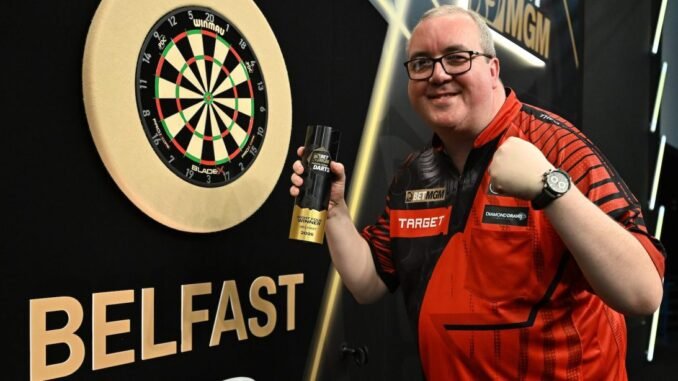
In the electrifying world of professional darts, where precision meets passion under the bright lights of packed arenas, Stephen Bunting has once again proven his mettle. Known affectionately as ‘The Bullet’ for his sharp, unyielding style on the oche, the Liverpudlian star recently turned heads with a triumphant performance in Belfast. There, he clinched Night Four of the Premier League Darts, dispatching young challenger Gian van Veen with a convincing 6-2 victory in the final. This win not only pocketed him a handsome £10,000 prize but also propelled him to fifth place in the league standings, a testament to his enduring skill in a sport that demands nerves of steel.
Yet, behind this glittering success lies a darker chapter that Bunting has bravely confronted: a barrage of online abuse that has tested his resolve in recent weeks. As the World No. 6, Bunting has faced relentless scrutiny from trolls on social media, with some even questioning his very place in the Premier League lineup. These keyboard warriors, often hiding behind anonymous profiles, have hurled insults and doubts, creating a toxic cloud over what should be a celebration of his achievements. The darts community, known for its vibrant and supportive fans, has been marred by these incidents, highlighting a growing issue in sports where athletes’ personal lives become fodder for digital vitriol.
Amid this storm, Bunting has found solace in unexpected corners—messages of encouragement from legendary figures in English football. Former England captains John Terry and Michael Owen, both icons of the beautiful game, reached out with words of wisdom that lifted his spirits during his lowest moments. “It’s amazing, to be honest, the people that reach out to you on social media,” Bunting shared, reflecting on the impact of these interactions. “I’ve had Michael Owen giving me some words of wisdom as well. Obviously John Terry, so that can make you feel better in yourself.” These endorsements from cross-sport superstars underscore the camaraderie that exists among elite athletes, reminding Bunting that he’s not alone in facing the pressures of public life.
The abuse hasn’t been isolated to Bunting himself; it has spilled over into his personal world, affecting his family in ways that cut deep. Just months earlier, following a disappointing exit from the PDC World Championship at Alexandra Palace, where he was seeded fourth but fell in the third round to James Hurrell, Bunting revealed that his 13-year-old son, Toby, had become a target of hateful comments online. Toby, who was in the crowd cheering on his father, endured messages from trolls that left the family reeling. “They see the negative comments and do their best to make sure I don’t see them and even Toby has had some hate from some of the trolls online which really is hurtful for us as a family,” Bunting posted at the time, his words laced with raw emotion. This incident amplified the pain, turning what should have been a moment of pride into one of protection and recovery.
Bunting’s journey in darts is one of perseverance and popularity. Hailing from St Helens, he transitioned from the British Darts Organisation to the Professional Darts Corporation, where he has built a reputation as a crowd favorite. His entrance music, the upbeat “Titanium” by David Guetta featuring Sia, often gets arenas pumping, and his approachable demeanor has earned him legions of loyal supporters. But the flip side of fame in the digital age is the unrelenting negativity. After an emotional win earlier in the World Championship against Sebastian Bialecki, Bunting referred to himself as the “People’s Champion” in a post-match interview—a lighthearted nod to his fanbase that was twisted by critics into accusations of arrogance. Social media erupted with backlash, prompting Bunting to step back and reflect. “Sometimes you can look too much at social media and there’s been quite a few negatives,” he admitted, breaking down in tears during one interview as the weight of it all surfaced.
Despite these challenges, Bunting remains defiant, vowing not to let the detractors redefine him. “They’re the genuine fans. The people who are doubting are the people who hide behind fake profiles and call abuse,” he stated firmly. “They don’t even deserve my breath, to be honest. I’ve pulled away from social media.” He emphasizes that his personality—warm, approachable, and consistent whether he’s on stage, in the street, or grabbing a bacon butty at Tesco— is integral to who he is. “That is part of my characteristics and who I am, whether you see me in the street or in an interview or on the stage. In Tesco, shopping and getting a bacon butty, I’m always the same person and I am the most approachable darts player on the planet,” he explained. “I always have time for the fans but sometimes idiots do creep into your DMs and on socials. It can affect you and get you down to the point where you feel worthless. Luckily, I have managed to block them out. I have a fantastic family and management around me.”
This resilience shone through in Belfast, where the crowd’s energy fueled his comeback. “You saw tonight I have an unbelievable fanbase. I’d like to thank all of them tonight because they were truly special,” he said, his voice carrying the gratitude of someone who has weathered the storm. Bunting’s story is emblematic of a broader struggle in modern sports: the mental toll of online harassment. Athletes across disciplines, from football to darts, are increasingly vocal about the need for better protections against cyberbullying, which can erode confidence and even impact performance. For Bunting, the support from figures like Terry and Owen serves as a beacon, illustrating how solidarity can counter the isolation that abuse breeds.
As the Premier League Darts season progresses, with high-stakes nights in cities across Europe, Bunting is focused on channeling this energy into his game. His recent victory isn’t just a scoreline—it’s a statement of defiance against the doubters. With his family by his side and a global fanbase rallying behind him, ‘The Bullet’ is reloaded and ready to aim higher, proving that true champions rise not just from wins, but from overcoming the unseen battles off the stage. In a sport where every throw counts, Bunting’s journey reminds us that strength comes in many forms, and sometimes, the greatest victories are the ones fought in silence.
Leave a Reply