
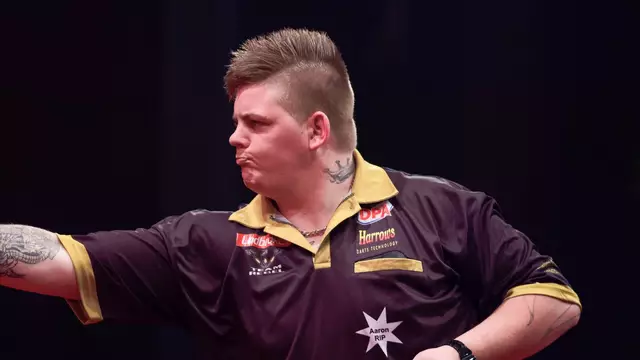
In the electrifying world of professional darts, where precision meets bravado under the glare of arena lights, few stories capture the highs and lows quite like that of Corey Cadby. Once hailed as the prodigy who could redefine the sport, Cadby’s journey from oche-side glory to courtroom drama reads like a cautionary tale of untapped potential and self-inflicted ruin. Just days ago, on December 4, 2025, a jury in Burnie Magistrates Court delivered a verdict that sealed another dark chapter: guilty of aggravated burglary in a shocking home invasion that targeted his own family. Cleared of the more severe charge of causing grievous bodily harm, Cadby nonetheless faces a looming sentence that could keep him far from the dartboard for years. As the gavel fell, whispers echoed through the darts community—”the biggest waste of talent”—a heartbreaking refrain that has shadowed this 27-year-old Australian for nearly a decade.
Cadby’s ascent was nothing short of meteoric. Picture a lanky teenager from the sleepy suburbs of Melbourne, gripping a set of darts like a lifeline to something greater. In 2016, at just 19, he stormed the World Youth Championship in Minehead, England, clinching the title with a display of ruthless accuracy that left seasoned pros in awe. The victory wasn’t just a win; it was a coronation. He dismantled opponents with 180s that seemed to defy gravity, his cool demeanor masking a fire that promised dominance in the big leagues. But it was his audacious upset against Phil Taylor—the 16-time world champion, a living legend known as “The Power”—that etched his name into darts folklore. In a PDC event that year, Cadby toppled the giant, a feat that sent shockwaves through the sport. “He memorably recorded a win over 16-time world champion Phil Taylor,” fans still marvel, replaying clips of that electric moment when youth triumphed over experience.
The darts world buzzed with excitement. Sponsors lined up, endorsements flowed, and Cadby was fast-tracked into the PDC’s elite ranks. He soared to world number 26 by 2019, rubbing shoulders with icons like Michael van Gerwen and Gary Anderson. His throw was poetry in motion—smooth, unerring, with a flick of the wrist that could pin a treble 20 from 50 feet. Commentators dubbed him the “next big thing,” a player whose potential rivaled the greats. Yet, beneath the spotlight, cracks were forming. Personal demons—rumors of anxiety, substance struggles, and mounting pressures—began to erode his focus. Withdrawals from major tournaments became routine, and his ranking plummeted. By 2020, the boy wonder was a ghost of his former self, his once-bright trajectory veering into obscurity.
The burglary case, rooted in the early hours of a fateful night in 2022, peels back the layers of this unraveling life. It unfolded at the quiet home of Cadby’s uncle and aunt in Burnie, Tasmania—a place that should have symbolized safety, not violation. According to trial testimony, three intruders smashed their way inside, their shadows moving with desperate intent through the darkened rooms. The couple awoke to chaos: drawers ransacked, valuables snatched in a frenzy that spoke of addiction’s grip rather than calculated crime. Cadby’s aunt later recounted the terror in a voice steady with resolve, describing how she recognized a familiar silhouette in the dim light. “They believed they recognised their nephew by his voice and posture during the burglary,” the court heard, a detail that twisted the knife deeper into family bonds already strained.
The violence escalated when Cadby’s uncle confronted the intruders. What followed was a brutal assault, leaving the 60-year-old man with a fractured skull and injuries so severe he required hospitalization. Blood spattered the walls, a grim tableau that prosecutors painted as the work of a trio “raining blow after blow.” Cadby, now 25 at the time, stood accused alongside two unnamed accomplices. The defense argued identity was murky—shadows and panic clouding eyewitness accounts—but the jury saw through the haze on the burglary count. They deliberated swiftly, just hours, before convicting him of breaking and entering with intent to steal, an aggravated offense due to the residential nature and companionship. On the assault charge, however, doubt prevailed; evidence linking Cadby directly to the blows was deemed insufficient. “A former darts champion has been found guilty of aggravated burglary but cleared of causing grievous bodily harm to his uncle during a home invasion in 2022,” the headlines blared, capturing the split decision’s bitter nuance.
As Cadby was led from the courtroom, stone-faced and flanked by legal aides, the weight of the moment hung heavy. Sentencing looms in the coming weeks, with prosecutors pushing for a term that reflects the breach of trust—burglarizing kin, after all, strikes at the heart of human decency. Legal experts whisper of years behind bars, a far cry from the adrenaline-fueled roar of a packed Ally Pally. For Cadby, it’s not his first brush with the law; prior convictions for driving offenses and minor scrapes had already dimmed his star. But this? This is seismic. “The conviction for aggravated residential burglary represents another severe blow to Cadby, who was once seen as a future world champion,” observers note, their words laced with sorrow.
The darts fraternity, a tight-knit clan of throwers and tipplers, has watched this saga with a mix of pity and frustration. Phil Taylor himself, now retired but ever the sage, once praised Cadby’s raw gift during a post-match interview, calling his style “electric, like watching lightning strike the board.” Yet, as Cadby’s absences grew, so did the laments. Rivals and fans alike have murmured about squandered promise—nights lost to vice, opportunities frittered away. One anonymous PDC insider confided, “It’s criminal, really. The kid had the arm of a god and the nerve of a lion. Now? Just echoes.” Even Cadby’s family, fractured by the trial, grapples with the fallout. His aunt’s testimony wasn’t vengeful but laced with grief: “We woke up to our own blood, but it’s the boy we raised we can’t unsee in that doorway.”
What drives a talent like Cadby to this precipice? Experts point to the dart world’s double-edged sword: the glory of adulation clashing with isolation’s toll. The sport demands monk-like discipline—hours honing that perfect release—yet its pub roots foster a culture of pints and bravado. For Cadby, the pressure cooker boiled over. Mental health advocates now spotlight his case as a rallying cry, urging the PDC to bolster support for young guns navigating fame’s minefield. “For the darts world, the case is yet another painful reminder of a career that began with exceptional talent and ended in personal and legal problems,” they say, a sentiment that resonates from Minehead to Melbourne.
As 2025’s World Championship looms without him, Cadby’s story lingers like a missed double-out. Could redemption await? Parole programs, therapy, a return to the board—darts has seen comebacks before, from Adrian Lewis’s battles to Gerwyn Price’s reinvention. But for now, the oche stands empty, a silent monument to what might have been. In a sport where every throw counts, Corey’s final dart has landed wide, leaving fans to wonder: was it ever about the game, or the ghosts chasing the player? One thing’s certain—the bullseye of regret is a tough one to hit.
Leave a Reply