
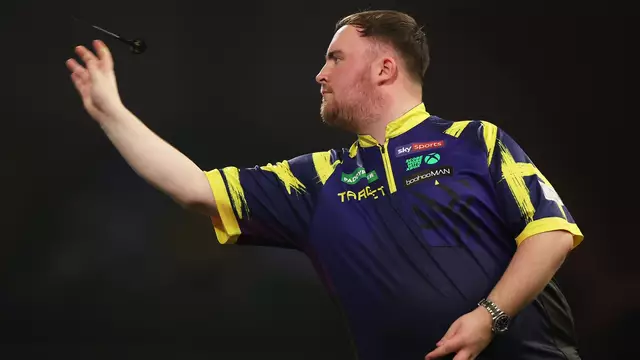
In the high-stakes world of professional darts, where every throw can shift momentum in an instant, few players demand as much from the behind-the-scenes team as Luke Littler. The reigning world champion, known for his blistering pace and inventive style, has become a sensation on the oche—but for the spotters responsible for guiding television coverage, working his matches can feel downright overwhelming.
Spotters play a crucial, often unseen role in broadcasting darts events. Positioned in the production truck, they communicate directly with directors and camera operators, predicting where a player’s next dart will land based on remaining scores, preferred routes, and patterns observed throughout the match. This allows cameras to zoom in seamlessly on the exact segment of the board—whether it’s a treble 20, double 16, or an unconventional bullseye—ensuring viewers at home never miss the action. In most matches, this process flows smoothly, built on years of player habits and standard checkout paths.
But Littler, with his lightning-quick throws and unorthodox finishing choices, throws a wrench into that well-oiled machine. “Er, horrendous,” one experienced spotter laughed when describing the challenge of keeping up with the young star. Littler’s brain seems to operate on a different wavelength; he doesn’t always stick to conventional routes. While many players follow predictable patterns—repeating a favored path when faced with the same checkout later in the game—Littler often improvises. “When someone’s gone for a shot in a match and you’ve called it and, a few legs later, he’s left the same finish, you automatically think he’s going to go that way,” the spotter explained. “But Luke sometimes doesn’t, he’ll go the way he feels comfortable. If he wants to go a fandangled way, he’ll go that way.”
This unpredictability stems from Littler’s fearless approach to the board. He embraces quirky setups, much like players such as Simon Whitlock or Rob Cross, opting for routes that feel natural to him in the moment rather than the textbook options. Add to that his extraordinary speed—darts fly from his hand in rapid succession—and spotters barely have time to calculate possibilities before calling shots. During major tournaments, teams of seasoned professionals rotate duties, adapting on the fly to Littler’s quirks. Yet even veterans find themselves second-guessing, as his novel finishes keep evolving.
Littler’s style isn’t just a headache for spotters; it’s a testament to his genius. At just 18, he’s already rewritten records, becoming the youngest world champion and dominating the sport with a blend of raw talent and mental sharpness. His preference for high-risk, high-reward checkouts—like the crowd-pleasing 170 “Big Fish” (treble 20, treble 20, bullseye)—or backups on double 10 rather than more common doubles, forces everyone around him to stay razor-sharp. Spotters must intimately know each player’s tendencies, but with Littler, those tendencies shift mid-match, demanding split-second recalculations.
“That’s the life of being a spotter in championship darts,” the spotter acknowledged with a shrug. And with Littler’s youth and creativity, more surprises are inevitable. “He’s not afraid of using the dartboard, that’s what it’s all about,” they noted. The younger generation, led by Littler, brings fresh ways to navigate finishes, and nine times out of ten, it pays off spectacularly.
While Littler’s rise has been a boon for darts—drawing record audiences and injecting excitement into the sport—it highlights the unsung challenges faced by production crews. Their quick thinking ensures flawless coverage, even as players like Littler push boundaries. In an era where the teenager is chasing back-to-back titles and cementing his legacy, spotters are adapting too, turning “horrendous” moments into part of the thrill that makes darts unmissable.
Leave a Reply