
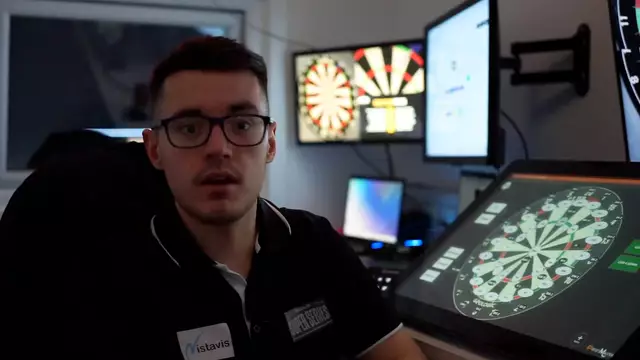
Watching a high-stakes darts match on television feels almost supernatural at times. As a player steps up to the oche, the camera seamlessly zooms in on a specific section of the board—like the treble 19 or double 16—mere moments before the dart even leaves their hand. Viewers at home see the impact up close, capturing every thrilling “thunk” as the dart embeds itself. But how does this happen without any delay or guesswork? The answer lies not in advanced AI or hidden sensors, but in a crucial behind-the-scenes role known as the “spotter”—a human expert whose quick thinking and deep knowledge make the broadcast feel effortless.
The spotter operates from the production truck or gallery, working closely with the director and camera operators. Their job is to anticipate exactly where the next dart will land, guiding the team to position cameras in advance. “I’m in charge of telling the cameras where the next dart’s going to land,” one experienced spotter has explained. This involves lightning-fast mental calculations: assessing the player’s remaining score, possible checkout routes, and personal preferences—all in seconds.
At major events like the PDC World Darts Championship at Alexandra Palace, multiple spotters rotate shifts to maintain sharpness during the intense tournament. Often former players or referees themselves, they combine mathematical prowess with an intimate understanding of the pros’ habits. For instance, many players favor certain doubles—tops (double 20) or double 16—based on comfort or past success. But preferences can shift; one young star, previously reliable on tops or double 10s, has recently surprised everyone by switching to double 16s and 8s, occasionally throwing spotters off track.
The process starts with basic strategy. In the early legs, players often chase high scores, piling into the treble 20 bed. Spotters know this instinctively, keeping cameras locked there. But tension builds during checkouts, where options multiply. On a finish like 121, a spotter might rattle off routes faster than most people can add: treble 19 to leave double 12, or treble 20 followed by bullseye. They guide operators verbally—”down first” for the bottom half of the board—or through presets on specialized touchscreens that instantly frame the target segment.
One spotter, who also serves as a match referee, described the role’s intensity: “It’s certainly a lot harder than being a referee. Then you have the answer right in front of you and usually a few seconds to think about it. Then it’s mostly good math. But as a spotter, I have to think faster than the darters themselves.” Mistakes happen—players might adjust for a blocked bed or go unconventional—but skilled spotters minimize them by reading body language, eye direction, or subtle stance shifts.
This human element adds pressure. “With the spotting you’re very conscious of the fact that you’re an integral part of what everybody at home and in the crowd can see, and you really don’t want to go wrong once,” another spotter noted. TV directors, often unfamiliar with darts intricacies, rely heavily on these experts. “TV directors often have no idea what darts is about, so they follow what we say. So we have some power, but we are also under a lot of pressure. Because you are responsible.”
Broadcasting a darts tournament is a massive undertaking, involving dozens of cameras, hidden microphones in the board for authentic sound, and hundreds of crew members working tirelessly. Yet the spotter remains the unsung conductor, orchestrating the visual symphony. Without them, viewers might miss those heart-pounding moments—the near-miss on bullseye or the perfect checkout.
As darts continues to surge in popularity, with packed arenas and millions tuning in, this blend of human intuition and technical precision keeps the sport captivating. Next time you marvel at a perfectly timed close-up, remember the spotter in the shadows, predicting the unpredictable one dart at a time. It’s a role that demands nerves of steel, encyclopedic knowledge, and split-second decisions—proving that even in an era of high-tech sports coverage, the human brain remains the ultimate predictor.
Leave a Reply