
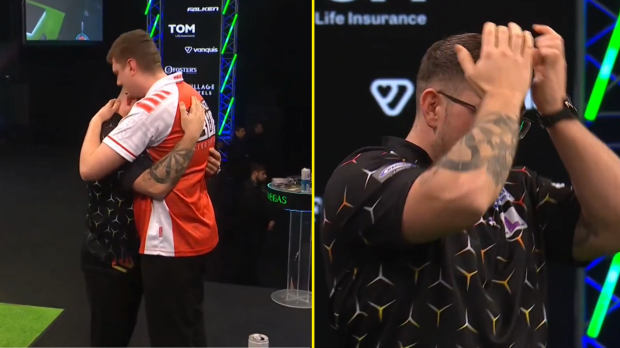
In the electrifying arena of the Mr Vegas Grand Slam of Darts, where the air hums with anticipation and the thud of darts hitting the board echoes like thunder, Michael Smith stood victorious yet vulnerable. The 35-year-old Englishman, affectionately known as “Bully Boy” for his bulldog tenacity, had just scraped through a nail-biting 5-3 victory over world number one Nathan Aspinall. It wasn’t a masterclass—his average hovered at a modest 88.21, far from the blistering form that once crowned him world champion—but it was a lifeline. As the crowd’s roar faded and the spotlight dimmed, Smith fought back tears on stage, his voice cracking with the weight of a journey that had nearly broken him. This wasn’t just a win; it was the biggest of his life, a defiant roar against the shadows that had sidelined him for months.
The Grand Slam, one of darts’ crown jewels held annually in the West Midlands’ Aldersley Village, brings together the sport’s elite in a high-stakes group format where every leg can make or break a tournament dream. For Smith, stepping onto that oche— the throw line that separates warriors from spectators—felt like reclaiming lost ground. Eight long months had passed since his last televised triumph, a quarter-final exit at the UK Open in March where he fell to Jonny Clayton. In between? A grueling exile enforced by a cocktail of injuries that would test the resolve of any athlete. Crippling shoulder pain shot through his throwing arm like fire, foot issues hobbled his stance, and worst of all, arthritis gnawed at the very hand that had propelled him to glory. As a father of two, balancing family life with the relentless demands of professional darts, Smith confessed the toll was immense. “It’s been a long road, it’s been a battle,” he would later say, his words heavy with the exhaustion of someone who’d stared down defeat from the sidelines. “Just everything. Injuries, life itself.”
Picture the scene: Smith, glued to his sofa, remote in hand, as rivals like Aspinall and others hoisted trophies under the bright lights he once dominated. The 2023 PDC World Darts Championship victor—where he outdueled Michael van Gerwen in a final for the ages—watched helplessly as the PDC calendar unfolded without him. Premier League nights, European Tour showdowns, the World Matchplay’s summer spectacle—all blurred into a frustrating montage on the screen. “I’m sick of sitting at home watching people win tournaments and I’m sat at home,” Smith admitted, the raw edge in his voice betraying a fire that injuries couldn’t fully extinguish. “It p***** me off.” That competitive fury, the kind that turns pain into fuel, had simmered beneath the surface. Darts isn’t just a game of precision; it’s a mental marathon, and Smith’s absence had been a forced sabbatical from the chaos he thrives in—the roar of 3,000 fans chanting his name, the electric tension of a decider leg.
Saturday’s clash with Aspinall was no fairy-tale redemption. The Stockport thrower, Aspinall, entered as the form horse, his recent Premier League title a testament to his silky smoothness. Legs swung back and forth in a gritty affair, with Smith admitting post-match that his opponent “should have won that 5-0, easy.” Aspinall’s darts flew true, punishing any lapse, yet Smith hung in there, leg by leg, refusing to yield. A crucial 180 here, a double snatched there—moments of vintage Bully Boy resilience pulled him across the finish line. As he shook hands at the board, Smith’s eyes betrayed the storm inside; walking off stage, he caught Aspinall’s disappointed glance in the practice room upstairs, a silent nod to the fine margins that define their world. “I can’t go worse than that,” Smith reflected with a wry smile, even as tears welled. “Nathan should have won that. I saw his reaction… I just hung in there and I got the job done in the end.”
What followed was pure, unfiltered emotion. In a hasty Dutch TV interview mere moments after descending from the stage, the dam broke. Tears streamed down his face as he poured out the pent-up anguish, the interviewer gently guiding him through the haze. It was a poignant reminder that behind the bravado of professional sport lies a human story—of doubt, determination, and the quiet victories that rebuild a shattered spirit. Smith’s vulnerability resonated, drawing applause from peers and fans alike. This wasn’t the first time he’d clawed back from the brink. At 19, he shattered both hands in a freak accident, enduring five months in casts before storming to his first ProTour win just two weeks after the bandages came off. Years later, nursing a literal hole in his leg, he dragged himself to the UK Open semi-finals. “I’ve always been a fighter,” he declared, wiping his eyes. “I think I made the semis of the UK Open once with a hole in my leg… I broke both my hands when I was 19… I’m a fighter, that’s it. I’ll be back, don’t worry.”
For Smith, this Grand Slam win is more than points on the board—it’s a beacon in Group G, where advancement to the knockout stages hinges on topping the standings or snatching a runner-up spot. With matches against Gerwyn Price and Rob Cross still to come, the road ahead twists with possibility. A strong finish could propel him toward another deep run, perhaps even a tilt at the £250,000 top prize. Yet beyond the stats and silverware, it’s the personal stakes that burn brightest. As a family man, Smith has spoken of how his children ground him, their innocent cheers a balm against the sport’s brutality. His wife, ever the pillar, has weathered the late-night practices and the emotional lows. In reclaiming the stage, he’s not just fighting for himself; he’s showing his kids what grit looks like up close.
The darts world, a fraternity of fierce competitors, rallied around him in the aftermath. Whispers of support from van Gerwen and Gary Anderson underscored the respect Smith commands—not as a fallen star, but as an enduring force. His average may have dipped, but his spirit soared, a testament to why he’s etched his name among the greats. As the Grand Slam barrels toward its climax, all eyes will be on Bully Boy. Will he channel this catharsis into a surge? History suggests yes. In a sport where legends are forged in fire, Michael Smith’s tears weren’t defeat—they were the spark of an unbreakable comeback. The oche awaits, and the fighter is ready.
Leave a Reply