
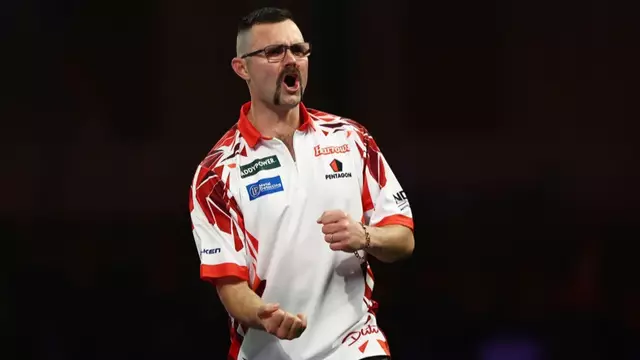
In the electrifying world of professional darts, where a whisper of wind can derail a 180 and a single double can etch a legacy, few stages loom larger than London’s Alexandra Palace. As December’s chill settles over the city, the 2025/26 Paddy Power PDC World Darts Championship beckons like a siren’s call, drawing 128 of the sport’s fiercest talents to its hallowed halls. From December 11 to January 3, the iconic venue—affectionately dubbed “Ally Pally”—will pulse with the roar of crowds, the clink of arrows hitting the wire, and the raw drama of dreams either forged or shattered. But amid the glitz of multimillion-pound prize pots and nine-dart perfection chases, one player’s story cuts deeper than most: a once-unstoppable force now teetering on the brink, described by those closest to him as “vulnerable” and “falling apart.”
The protagonist in this poignant tale is Adam Hunt, a 30-year-old Englishman whose journey from pub leagues to the professional circuit embodies the gritty underbelly of darts’ ascent to global spectacle. Hunt, known to fans as “The Ally Pally Assassinator” for his early breakthroughs at the venue, steps into his fourth World Championship appearance not as a conqueror, but as a gladiator fighting for survival. The stakes couldn’t be higher. In the PDC’s unforgiving ecosystem, where Tour Cards grant access to the lucrative Pro Tour and its constellation of events, Hunt finds himself in the crosshairs of relegation. To retain his professional status, he must navigate the treacherous bracket to at least the fourth round—a feat that eluded him in previous outings, where he’s bowed out earlier, each exit a dagger to his confidence and career.
Hunt’s path to this precipice has been a slow unraveling, marked by flashes of brilliance overshadowed by mounting pressures. A former qualifier who once stunned the field with a last-16 run in 2022, he’s battled inconsistency like a shadow he can’t outrun. Recent months have seen him scrape through qualifiers on sheer willpower, but his form on the oche— that sacred 7-foot-4-inch throwing line—has faltered. Averages dipping below the 90-mark in key matches, missed doubles that once seemed routine, and a string of early exits in Players Championship events have painted a picture of a man wrestling demons invisible to the naked eye. Insiders whisper of sleepless nights, the weight of financial strain from a sport that rewards the elite but starves the stragglers, and the psychological toll of knowing one poor tournament could relegate him to the brutal Q-School grind—a do-or-die lottery for second chances.
What makes Hunt’s plight so compelling is the raw honesty he’s brought to it. In a candid reflection shared ahead of the Worlds, Hunt laid bare the fragility beneath his steely exterior. “I’m vulnerable right now, more than I’ve ever been,” he admitted, his voice carrying the tremor of someone who’s stared into the abyss. “It’s like everything’s falling apart—my game, my head, the whole lot. You throw a dart and it just… doesn’t go where it should. It’s not the board; it’s me.” Those words echo the confessions of darts’ haunted greats, from the dartitis that gripped a young finalist years ago, forcing him to vow, “I’ll never throw another dart again,” to the broader epidemic of mental fatigue in a sport that demands machine-like precision under mob-like scrutiny.
Yet, vulnerability breeds unlikely heroism, and Hunt’s opening gambit offers a sliver of redemption—or ruin. The draw, that capricious darting deity, has pitted him against none other than Gary Anderson, the two-time world champion and “Flying Scotsman” whose arsenal of power and guile has felled giants. At 55, Anderson remains a colossus, his 2025 campaign laced with deep runs in majors like the World Matchplay and Grand Slam of Darts. For Hunt, who once trained under Anderson’s wing during his formative PDC days, this is poetic torment: a mentor turned executioner on the grandest stage. “Gary’s like family, but on that board, he’s the storm I have to weather,” Hunt said, a wry smile masking the dread. “If I can just hold my nerve for one match, maybe it’ll spark something. Otherwise… well, Q-School awaits.”
The PDC World Championship itself amplifies the drama, evolving into a behemoth that mirrors darts’ explosive growth. This edition boasts an expanded 128-player field, scrapping byes for seeded stars to ensure every arrow counts from round one. Defending champion Luke Littler, the teenage phenom who toppled Michael van Gerwen 7-3 last January with a blistering 102.73 average, headlines as the top seed. The 18-year-old “Nuke” enters on a tear, fresh off triumphs in the World Grand Prix and Players Championship Finals, his quest for back-to-back glory fueling feverish betting odds. Challengers abound: Humphries, the reigning world No. 1 with his metronomic 180s; Aspinall, the bulldog from Stockport hungry for majors; and van Gerwen, the Green Machine plotting a record-extending fifth crown.
Women’s representation adds another layer of intrigue, with trailblazers like Fallon Sherrock— the “Queen of the Palace,” who once felled Ted Evetts in a historic upset—and Beau Greaves, the prodigy who bested Littler en route to the World Youth final. Greaves, armed with a fresh two-year PDC Tour Card, faces Daryl Gurney in round one, her silky smooth release a wildcard in a male-dominated fray. The schedule unfurls like a holiday feast: opening-night fireworks on December 11, Littler defending against Lithuania’s Darius Labanauskas; afternoon sessions blending veterans like Chisnall against Sherrock; evenings alive with undercard clashes such as Wattimena versus Gruellich. All sessions beam live on Sky Sports, with Ally Pally’s West Hall—capacity 3,200—swelling to bursting under chants of “Stand up!” and the scent of beer and bravado.
For Hunt, though, the tournament transcends spectacle. It’s a referendum on resilience. As he eyes that unforgiving first-round clash, the echoes of his own words linger: “Falling apart” isn’t an epitaph—it’s a battle cry. In darts, where a 1001-1 outsider once stormed to the final only to see his world crumble under dartitis and complacency, Hunt’s story warns of the sport’s double-edged sword. Success can elevate you to stardom, but one slip, and you’re back to flea-ridden flats and faded dreams. Yet, in the cauldron of Ally Pally, miracles happen. A clutch 180, a doubled 16 under lights, and suddenly the vulnerable become invincible.
As the field assembles—128 souls, one £500,000 winner’s cheque—the air crackles with possibility. Littler may chase history, Anderson enforce it, but Hunt? He’s fighting for tomorrow. In a sport built on precision, his messy, human struggle reminds us why we watch: not just for the scores, but for the souls behind them. Will he summon the spark to defy the draw, or will the oche claim another casualty? Ally Pally holds the answers, and in 10 days, the tungsten will tell.
Leave a Reply