
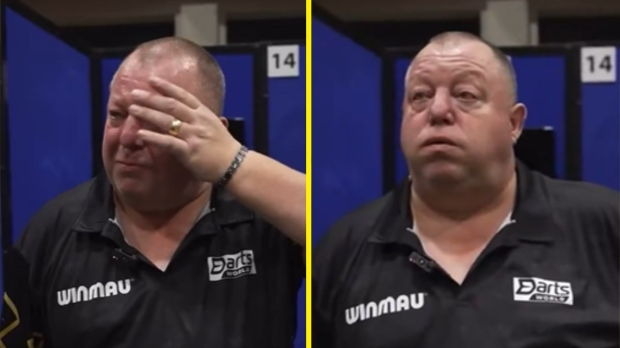
In the high-stakes world of professional darts, where precision meets passion, few stories resonate as deeply as that of Mervyn King. Just days ago, at the UK Qualifying School in Milton Keynes, the 59-year-old veteran stood on the oche, his hands trembling not from nerves but from the weight of a remarkable comeback. As the final scores confirmed his semi-final berth and secured his place on the PDC Tour Rankings List—finishing second overall with an impressive 10 wins—King could no longer hold back. Tears streamed down his face, a raw display of emotion that spoke volumes about the battles he had fought off the stage. “If you don’t know now, you never will,” he said, wiping his eyes and taking a deep breath, encapsulating the relief and vindication of a man who had stared into the abyss and emerged stronger.
King’s journey to this pivotal moment is a testament to resilience amid adversity. A cult hero in the darts community, he first rose to prominence as a two-time BDO World Champion, showcasing his skill with unflinching accuracy and a competitive edge that saw him climb to fourth in the PDC Order of Merit. Over a career spanning decades, he amassed around £2 million in prize money, competing in high-profile events like the World Darts Championship semi-finals at Alexandra Palace. Yet, beneath the glamour of tungsten-tipped triumphs lay a hidden struggle that nearly derailed everything.
The trouble began with a fundamental misunderstanding about his finances. King, like many in the sport during its earlier days, believed his winnings were exempt from taxation, viewing them not as earnings but as rewards for skill. “For want of a better word, I was quite naive when it came to tax,” he reflected candidly. “Believe it or not, I actually thought that with it being winnings, I didn’t have to pay tax on it, because it wasn’t earnings as such.” This oversight accumulated over 20 years, leading to a staggering debt of over £500,000 owed to HM Revenue and Customs (HMRC). When the reality hit, it was overwhelming. “When I found out I should be paying tax, I was already x-number of pounds in debt to HMRC,” he explained. “It gets to a couple of years down the line, and I’m in even more debt to HMRC. You think, ‘How the hell am I going to be able to pay this?’. It has been a very scary thing.”
The situation escalated in March 2025, when King was officially declared bankrupt. The fallout was personal and profound. He grappled with sleepless nights, haunted by the fear of losing his home and the custody of his three beloved dogs. His wife, Tracey, shared his anxiety: “Tracey is worried that we’re going to lose the house. But if we do, we do. There’s nothing I can do about that,” he said. To make ends meet during the COVID-19 pandemic, King took on work as an Amazon delivery driver, a humbling shift from the spotlight of televised tournaments. Rather than evade responsibility, he proactively reached out to authorities. “I made the move to contact them. I knew this was coming,” he noted. “It was better than them finding me and saying, ‘Excuse us Mr King, why haven’t you paid tax for 20 years?’ Because I think I’d have been straight inside.” He had hoped for one last “big win” to settle the debts: “I was then waiting for that big win, that really big win, so I could square everything up. Obviously, that was not the case.” Over the past four or five years, the worry had been relentless: “I haven’t slept a lot at night, worrying about this. The trouble is you think the gravy train will last forever, and it doesn’t. I cannot turn back time, unfortunately.”
King’s professional life mirrored this turmoil. He held his PDC Tour Card from 2011 until 2024, when he slipped out of the top 64 in the Order of Merit, forcing him to step away from the elite circuit. But at nearly 60—his birthday just two months away—he refused to fade into retirement. Entering Q-School, a grueling competition where hundreds vie for a handful of spots, was his last-shot saloon. The event, held at Arena MK, demanded perfection under pressure. King delivered, navigating a field that included rising talents like Charlie Manby, who bested him in the semi-final. Yet, his consistent performance across the days—only surpassed by Stephen Burton’s 14 wins—earned him the coveted card.
The emotional peak came post-victory, as King reflected on his perseverance. “It means the world to me. I fought hard every day. Everything had to go today. I wouldn’t say everything went my way. It was slightly easier. Some shots went my way when I really needed them,” he said through tears. “Even though I’m shedding a few tears I’m the happiest guy you’ll ever see at the moment. It’s hard work regardless. To actually make that step and get back on tour is something really serious for me. It’s fantastic.” Looking ahead, King’s fire remains undimmed. “I still think I’ve got something to offer the game. So that’s why I’m here and that’s why I’ve been crying because I don’t think I’m finished yet. I think I’ve got some great games to offer on TV. That’s why I keep going. I don’t think I’m done yet.”
This comeback isn’t just a personal triumph; it’s a beacon for the darts world. King, now back among the pros, will share stages with stars like Luke Littler, Michael van Gerwen, and Luke Humphries. His story underscores the fragility of success in sports, where glory can coexist with unforeseen pitfalls. From bankruptcy’s brink to the tour’s embrace in under a year, King’s tears were not of defeat but of defiance—a reminder that true champions rise, dart by dart, no matter the odds. As he steps back into the arena, fans eagerly await the next chapter of this enduring legend’s tale.
Leave a Reply