
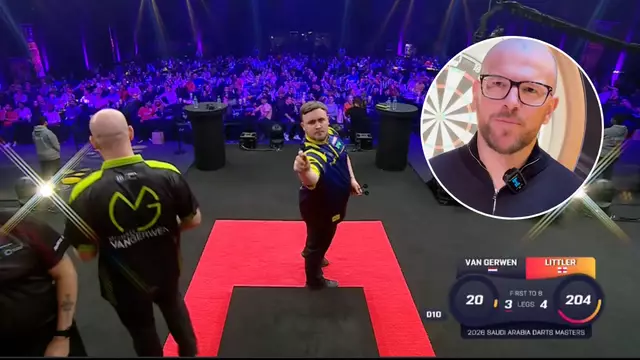
The PDC’s decision to take top-level darts to Saudi Arabia marked a significant step in the sport’s ongoing global expansion. When the world’s elite players arrived in Riyadh for the Saudi Arabia Darts Masters, curiosity was high — not just about the darts on stage, but about how the event would be received in a completely new market. While the tournament delivered high-quality action and a memorable final, it was the atmosphere inside the arena that became one of the most talked-about aspects afterward.
Reigning world champion Luke Littler headlined the event and ultimately walked away with the trophy after an impressive run that culminated in an 8–5 victory over Michael van Gerwen. For Littler, the win represented another landmark moment in a rapidly accelerating career, adding a prestigious World Series title to his growing list of achievements. However, despite the standard of play on the oche, the mood in the venue sparked widespread debate among players and fans alike.
Unlike the loud, costume-filled crowds commonly seen at major darts events in the UK and Europe, the atmosphere in Riyadh felt noticeably different. Applause was frequent, but chants were limited, and the overall energy was far more restrained than what players are accustomed to on the PDC circuit. That contrast quickly caught the attention of several competitors.
One former world champion described the crowd as attentive but quiet, noting that the audience appeared more focused on the match play itself than on creating a party-style atmosphere. From that perspective, the crowd’s behaviour was seen as respectful and engaged, even if it lacked the chaos and colour typically associated with darts nights elsewhere.
Others were more blunt in their assessment. One top player openly questioned whether the atmosphere truly reflected organic interest, suggesting that the crowd felt unusual and that the event still had “a long way to go” before it could replicate the intensity of more established tournaments. His remarks hinted at the possibility that some spectators may not have been there purely as passionate darts fans, a comment that quickly gained traction online.
The reaction across social media was immediate and divided. Some fans defended the Saudi audience, pointing out that darts is still new to the region and that expecting instant Premier League-style chaos was unrealistic. Others joked about polite applause for missed doubles and subdued reactions to big moments, highlighting just how ingrained European darts culture has become.
Tournament organisers were quick to push back against criticism, stressing that all spectators were legitimately in attendance and that building a darts culture in a new territory naturally takes time. They emphasised that every emerging market experiences a learning curve and that early events are about exposure, education, and laying foundations rather than instant replication of long-standing traditions.
The Saudi Arabia Darts Masters was only the second World Series event of the year and the first of its kind in the country. As such, players were stepping into unfamiliar territory, both literally and atmospherically. Several competitors acknowledged that while the crowd felt different, that difference was not necessarily negative — just unfamiliar.
For Littler, the discussion surrounding the crowd did little to overshadow his achievement. The teenager continued to demonstrate remarkable composure and maturity, handling the occasion with ease and delivering when it mattered most. His ability to perform consistently regardless of setting has become one of his defining traits, and the Riyadh triumph only reinforced his reputation as the sport’s brightest star.
Looking ahead, the mixed reactions from players underline a broader conversation about darts’ future. As the PDC explores new regions and audiences, questions about atmosphere, authenticity, and fan engagement will inevitably arise. What works in London, Manchester, or Rotterdam may not translate instantly elsewhere — and that may be part of the challenge as well as the opportunity.
The Saudi event showed that elite darts can travel, but it also highlighted how central crowd culture is to the sport’s identity. Whether future editions of the tournament grow louder and more familiar, or develop their own unique atmosphere, remains to be seen. What is clear, however, is that darts’ global journey is well underway — and conversations like this are simply part of the process.
Leave a Reply