
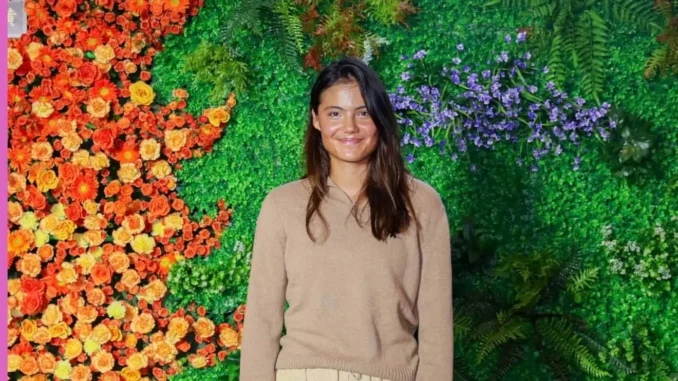
In the high-stakes world of professional tennis, where every serve can swing the momentum of a match and rankings are forged in the fires of relentless competition, Emma Raducanu is scripting a comeback tale that’s equal parts grit and glamour. The 22-year-old British sensation, whose name exploded onto the global stage with her improbable 2021 US Open triumph as a qualifier, has endured a rollercoaster of injuries, highs, and humbling defeats. Yet, as the 2025 season beckons, Raducanu is laser-focused on transformation—not just in her game, but in her mindset. Speaking candidly ahead of a packed Asian swing, she revealed her determination to elevate one of her most scrutinized shots: the serve. “Training for next year, I do want to work on my serve and make that a bit more of a weapon,” she declared, her words carrying the quiet confidence of someone who’s stared down adversity and emerged sharper.
Raducanu’s journey since that fairy-tale Grand Slam victory has been anything but straightforward. Plagued by wrist and ankle surgeries that sidelined her for much of 2023, she plummeted outside the top 300 in the WTA rankings. The 2024 season marked a tentative resurgence: starting from the shadows, she clawed her way back to a year-end position inside the top 60, thanks to standout semifinal runs at the Miami Open and Citi Open. These breakthroughs weren’t flukes; they showcased a player rediscovering her rhythm on hard courts, her favored surface, where her blistering forehand—long her go-to shot—dances with precision and power. But it’s the serve, that elusive first strike, which has haunted her in clutch moments, often betraying her with inconsistency under pressure. No longer content to let it be a vulnerability, Raducanu is enlisting elite guidance to turn it into an ace factory.
Enter Francisco Roig, the respected Spanish coach who once shaped Rafael Nadal’s formidable game. Joining Raducanu’s team full-time after a fruitful trial with Mark Petchey earlier in the year, Roig has zeroed in on her delivery. Under his tutelage, the improvements have been palpable. At the US Open in August 2025, Raducanu stormed through her opening two rounds without dropping a single service game, a stark contrast to past tournaments where double faults piled up like unforced errors. Her first-serve percentage climbed to a reliable 63% in key matches, and the velocity behind it has spiked, turning what was once a tentative lob into a thunderbolt that skids off the line. “The improvements she has made in her game over the course of the last few months have been impressive and especially on her serve, which was a troublesome shot for her in the past,” observers have noted, echoing the buzz around her training sessions.
This serve overhaul isn’t happening in isolation; it’s the cornerstone of a broader blueprint to shatter her ranking ceiling. Raducanu’s immediate target? Cracking the top 32 by the close of 2025—a milestone that would lock in a seeded spot at the Australian Open come January 2026, shielding her from early knockout punches against the elite. Currently hovering around 36th, she’s on the cusp, with two pivotal Asian tournaments on the horizon: the Dongfeng · Voyah Wuhan Open, where she’s already turning heads, and a follow-up event that could catapult her over the line. “Raducanu has set her sights on ending 2025 in the top 32 of the WTA Rankings and if she were to stay in that position in the opening weeks of the new year, it would secure her a seeded position for the Australian Open,” the tennis grapevine hums. But her vision stretches further. Tim Henman, the former British No. 1 and a keen watcher of her arc, pegs top 30 as “completely realistic” for 2025, provided she builds “physical resilience” to weather the tour’s grueling demands. Martina Navratilova, the 18-time Grand Slam champion, chimes in with tough love: Raducanu must seize full ownership of her career, tuning out the noise to focus on consistency.
The road to those heights demands more than technical tweaks; it’s a mental and physical marathon. Raducanu’s 2025 campaign has been a testament to her resilience, blending flashes of brilliance with hard lessons. She pushed world No. 1 Aryna Sabalenka to the brink at Wimbledon before a straight-sets exit, and tested six-time major winner Iga Swiatek at the Australian and French Opens, only to fall short in lopsided affairs. Her third-round demolition by Elena Rybakina at the US Open—a 6-1, 6-2 rout—stung, underscoring the chasm between her potential and the top tier. “I’ve lost to Iga twice, Aryna, and Elena, so it’s tough,” Raducanu admitted post-match, her voice laced with resolve rather than defeat. “I think when the very top players play against me, they have a point to prove that they’re at the top, and they’re there for a reason.” It’s this underdog fire that fuels her: opponents dread drawing her name, knowing her flat, penetrating groundstrokes can dismantle defenses on a dime.
To bridge that gap, Raducanu is doubling down on strategy. She’s eyeing a slate of WTA 250 events early in 2025—smaller fields where she can rack up wins, hone her endurance, and pad her points without the burnout of mandatory majors. “There is no substitute for stringing wins together in professional tennis,” experts agree, emphasizing how these tournaments build the match toughness she’s craved. “The rhythm of playing day after day… is invaluable.” Pair that with a new fitness trainer on the horizon, and Raducanu is arming herself against the injury gremlins that have dogged her. Her Billie Jean King Cup exploits earlier in the year, partnering with Katie Boulter to propel Great Britain to the quarterfinals, offered a glimpse of team synergy boosting her singles edge. “For me to be able to captain the team of incredible women… I feel like I’m in a very fortunate position,” said Britain’s captain Anne Keothavong, praising Raducanu’s return amid personal hurdles.
As the Wuhan lights gleam and the autumn air carries whispers of what’s next, Raducanu’s story feels like a phoenix rising. She’s no longer the wide-eyed teen who stunned Flushing Meadows; she’s a battle-hardened contender, hungry to rewrite her narrative. That serve, once a whisper, could roar into a symphony of aces, propelling her past the top 30 and into seeding contention Down Under. “I know I’m a dangerous player. I know no one wants to pull my name in the draw. I take pride in that, and I’m looking forward to hopefully staying on court longer next year,” she affirmed, her eyes alight with possibility. In a women’s game evolving faster than ever—where power serves and mental fortitude reign supreme—Raducanu’s weaponization quest isn’t just ambition; it’s inevitability. The top seeds beware: the Nuke of British tennis is arming up, and 2025 could be her detonation.
Leave a Reply