
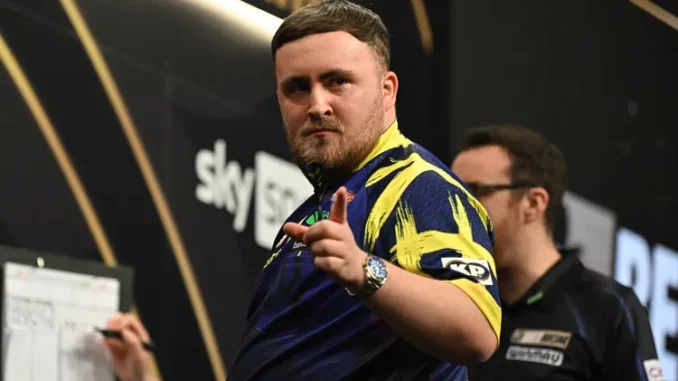
In the electrifying arena of professional darts, where razor-sharp focus meets thunderous crowd energy under glaring lights, every decision on and off the oche carries profound weight. Gerwyn Price, the fiery Welshman affectionately known as the Iceman, has delivered a passionate and unflinching verdict on a proposed revival of the Premier League Challengers system—one that he believes could fundamentally undermine the fairness of the prestigious competition.
The debate has reignited following a chaotic sequence of events in the 2026 BetMGM Premier League Darts. On Night Seven in Dublin, rising Dutch star Gian van Veen was forced to withdraw at the eleventh hour due to severe kidney stones, necessitating surgery. The disruption led to an entire quarter-final being scrapped, leaving fans shortchanged and the night’s proceedings feeling incomplete. Van Veen, dubbed ‘The Giant,’ made a swift return for Night Eight in Berlin’s Mercedes-Benz Arena (also referred to as the Uber Arena in some reports). There, he faced a merciless Gerwyn Price, who dismantled him with a commanding 6-1 victory in the quarter-finals, showcasing the world No. 8’s trademark power and precision.
Yet even as Price advanced—before falling in the semi-finals to a rampant Luke Littler—the Welshman’s thoughts extended far beyond his personal performance. Speaking openly about the broader structural challenges facing the Premier League, Price zeroed in on suggestions of reintroducing one-night challengers or contenders as a contingency for player absences. These would see local talents or wildcard entrants stepping in to face the elite eight, injecting fresh drama but, in Price’s eyes, creating inherent inequities.
“I think that would be totally unfair,” Price declared emphatically. “When you had the challengers, it was a good idea but unfair to the players that are playing the challengers. Every player is a different standard, and one person could play Fallon Sherrock, someone could play Chris Dobey, someone could play Luke Humphries, like I did.”
His point strikes at the core of competitive integrity. In a league where the top players grind through a grueling schedule of weekly nights across global venues, facing opponents of wildly varying skill levels could skew results unpredictably. A lucky draw against a less experienced challenger might hand out easy points, while another player battles a seasoned campaigner. Such variance, Price argues, disrupts the level playing field that defines elite darts.
Price didn’t stop at criticizing the challenger idea. He candidly addressed flaws in the current Premier League format itself, which features a repetitive nightly structure of best-of-11 knockout matches among the eight invited stars. Points accumulate toward a league table that determines qualification for the dramatic Play-Offs at London’s O2 Arena. “I think if you’re looking at the problems with the format, at the minute where it is probably a little bit repetitive and if someone is ill, then there’s no way of trying to get those points back,” he explained. “If they miss a week, somebody gets gifted points, which is a little bit unfair but I’m not sure what they’re going to do about it.”
This admission highlights the unforgiving nature of the competition. Illness, injury, or unforeseen circumstances—like van Veen’s kidney stone ordeal—can create ripple effects that alter standings without recourse. In previous seasons, similar disruptions proved decisive. Former Lakeside world champion and darts analyst Mark Webster reflected on these issues with seasoned insight, recalling how Michael van Gerwen suffered a 6-0 walkover defeat in Berlin last year due to his own inability to compete. That result, Webster noted, ultimately cost the Dutch legend a coveted Play-Off spot.
“It happened last year and it’s happened a couple of times this year and it could be pivotal come the Play-Offs,” Webster observed. He acknowledged the appeal of having a reserve or challenger to ensure full quarter-finals: “In an ideal scenario, you want to see all the players play in the opening quarter-finals and if you get a reserve in it does get that player fine-tuned.” However, he was realistic about the difficulties. “I get the idea, but I just don’t know how you do it. Who you get and obviously the players are going to be of a different level… It’s not an equal contest anyway so it’s tricky.”
Webster also touched on player psychology in such scenarios. Many competitors, he suggested, would gladly accept a bye and the automatic points it brings rather than risk a tough matchup. “There’s an argument some people say the player would rather play but that’s rubbish. They’ll take the bye any day of the week in the Premier League and take two points.” From a spectator’s perspective, though, an empty slot diminishes the spectacle that packs arenas night after night.
The Premier League Darts stands as the PDC’s flagship event, a glittering showcase that blends elite talent, intense rivalries, and theatrical atmospheres. Since its evolution, it has moved away from the earlier challenger format that once delivered memorable upsets and home-crowd heroics. While those nights created unforgettable stories—underdogs clashing with superstars—they also introduced the very inconsistencies Price now warns against.
As the 2026 season progresses, with stars like Luke Littler, Michael van Gerwen, Luke Humphries, and others locked in a tight battle for Play-Off positions, the conversation around format tweaks gains urgency. The schedule’s demands—constant travel, high-pressure matches, and physical toll—test even the hardiest athletes. Price, a former Premier League champion and one of the sport’s most charismatic and controversial figures, has built his career on raw talent and unfiltered opinions. His latest comments reflect not just personal frustration but a deeper concern for the sport’s competitive balance.
Fans crave excitement, and the prospect of fresh faces could add thrill. Yet as both Price and Webster illustrate, any solution must navigate complex trade-offs between entertainment, equity, and logistical realities. Bringing back challengers might solve the occasional missing quarter-final, but at what cost to the integrity that makes the Premier League so compelling?
In the end, darts thrives on precision under pressure, where the smallest edge—or misfortune—can decide titles. Price’s blunt assessment serves as a rallying call for thoughtful evolution rather than quick fixes. Whether the PDC opts for reserves, adjusted scheduling, or another innovative approach, the goal remains clear: preserve the fairness that lets the world’s best darts players settle their rivalries on merit alone. As the nights roll on toward the climactic Play-Offs, the Iceman’s voice echoes loudly in a debate that could shape the future of one of darts’ greatest spectacles. The tension, the drama, and the quest for perfection continue—on the board and behind the scenes.
Leave a Reply