
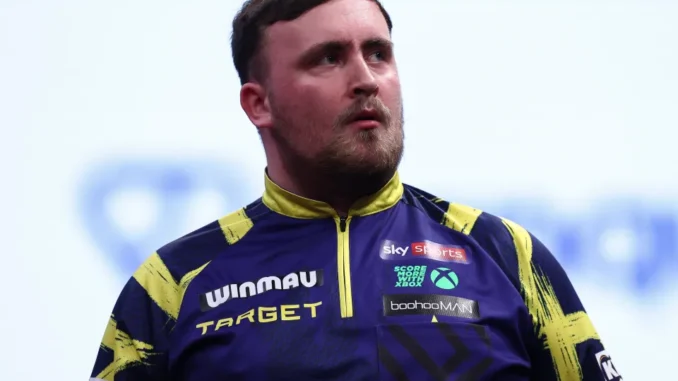
In the high-stakes world of professional darts, where precision meets passion under the glare of arena lights, young sensation Luke Littler has found himself at the center of a brewing storm. At just 19 years old, the World No.1 has transformed from a crowd darling to a target for jeers, prompting him to open up about the boos echoing through venues and draw parallels to a legendary football moment involving Wayne Rooney. This shift in fan sentiment highlights the double-edged sword of success in sports, where dominance can breed resentment as quickly as admiration.
Littler’s meteoric rise began when he burst onto the scene as a teenage prodigy, captivating audiences with his unflappable composure and arrow-sharp accuracy. Hailing from Warrington, England, he quickly became a household name, especially after his stunning run to the World Darts Championship final in 2024, where he fell just short but won hearts worldwide. His Manchester United fandom added a relatable layer, endearing him to sports enthusiasts beyond the oche. However, as victories piled up—claiming titles like the World Championship and establishing himself as the top-ranked player—the cheers have sometimes given way to boos. It’s a phenomenon that’s left the young star reflecting on the nature of fandom and the pressures of being at the pinnacle.
The latest chapter unfolded during the Winmau World Masters, where Littler faced a tense battle against Mike De Decker. In a nail-biting encounter, he survived a match dart to edge out a 3-2 victory in sets, advancing his quest for yet another trophy. But the post-match atmosphere was anything but celebratory for everyone. Amid a chorus of mixed reactions—boos interspersed with cheers—Littler addressed the elephant in the room with candid insight. He suggested that the negativity stems from fans craving variety in the winners’ circle. “I think people want to see new winners,” he explained. “People are getting bored of me, Luke Humphries and Gian van Veen winning. Obviously, people can pick who they support, who they want to boo, but I am not going to do anything during the game or after it, I am just going to do my darts.”
This wasn’t the first time Littler had encountered such hostility. Earlier, during a fiery clash with Rob Cross at the World Darts Championships, he lashed out at a vocal minority in the crowd. In a moment of raw frustration, he retorted, “You pay for my prize money,” a sharp reminder of the symbiotic relationship between players and spectators. That outburst, however, served as a learning curve. Littler has since adopted a more measured approach, vowing not to let the noise disrupt his focus. “Everything was going on tonight—boos, cheers—and I just had to do my thing,” he reflected after the De Decker match. “Learn from the World Championship, don’t react too much, and just play my darts.”
To put his experiences into perspective, Littler drew a striking comparison to one of English sport’s most iconic figures: Wayne Rooney. The former Manchester United and England striker, whom Littler admires, faced similar backlash during the 2010 World Cup in South Africa. After a disappointing 0-0 draw against Algeria in the group stage, Rooney was captured on camera venting his frustration at the booing fans. “Nice to see your home fans booing you,” he said sarcastically as he exited the pitch, a clip that went viral and sparked widespread debate. Rooney later issued an apology, acknowledging the heat of the moment, but the incident became a symbol of the intense scrutiny top athletes endure.
Littler stumbled upon that very clip on TikTok mere hours after his own confrontation with the crowd during the Rob Cross game. “You’ve seen it with Wayne Rooney,” he noted. “That clip at the World Cup. I seen that on my TikTok literally a few hours after the Rob Cross game, which was pretty crazy. I’ve learned from the Worlds, don’t react and just play my darts.” This connection underscores a broader truth in sports: even heroes like Rooney, who scored over 200 Premier League goals and captained his country, aren’t immune to fan discontent. For Littler, it’s a reminder that success often invites criticism, especially in a sport like darts, where the intimate venue settings amplify every cheer and jeer.
As Littler looks ahead, his resolve remains unshaken. His next challenge comes against Ross Smith on Saturday night, a matchup that promises more drama in his pursuit of World Masters glory. Beyond the immediate tournament, this episode reveals the maturing mindset of a young champion navigating the highs and lows of fame. In darts, a game of millimeters and mental fortitude, handling external pressure is as crucial as hitting a double top. Littler’s ability to channel adversity into focus could define his legacy, much like Rooney’s resilience turned early controversies into a storied career.
The boos may continue, but Littler is tuning them out, embracing the role of the dominant force that fans both love and loathe. It’s a testament to the evolving dynamics of modern sports, where yesterday’s underdog becomes today’s villain simply by winning too much. As the arrows fly and the crowds roar—or jeer—Littler is proving he’s built for the long haul, one dart at a time.
Leave a Reply