
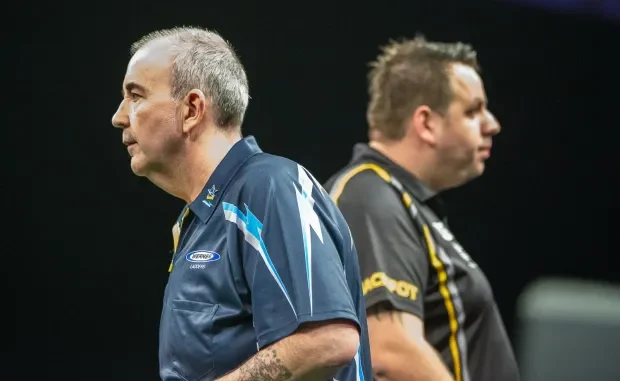
In the high-stakes world of professional darts, where precision meets intense psychological pressure, few players have dominated like Phil Taylor. Nicknamed ‘The Power’, the 16-time world champion built an unparalleled legacy not just through his unmatched skill at the oche, but also through a mastery of mind games that left opponents rattled and frustrated. Now, one of his closest rivals and former protégés, two-time world champion Adrian Lewis, has opened up about the shameless tactics Taylor employed to gain an edge, painting a vivid picture of the lengths to which the legend would go to unsettle his foes.
Lewis, known as ‘Jackpot’ for his explosive scoring ability, shared candid insights into Taylor’s playbook during a recent interview. He described how Taylor would deliberately break wind while standing at the oche, right in the heat of a match, as a calculated distraction. “He would be standing there and farting on the oche doing all sorts,” Lewis recalled with a mix of amusement and exasperation. “Oh God, he is awful for it!” These incidents weren’t rare occurrences but part of a consistent pattern, often unfolding in front of packed arenas and millions watching on television.
But the flatulence was just one arrow in Taylor’s quiver of psychological warfare. Lewis revealed that Taylor’s tricks extended to more covert sabotage, such as making opponents’ darts cases mysteriously disappear during tournaments. Players would suddenly realize their equipment was missing, forcing them to scramble and lose focus at critical moments. “Things like: All of a sudden your darts bag has gone missing,” Lewis explained, noting how these incidents left competitors thinking, “Hang on a minute?!” Such maneuvers, he suggested, happened frequently enough to become a hallmark of facing Taylor.
This revelation comes from a player who knows Taylor better than most. Both hailing from Stoke-on-Trent, Lewis was once seen as Taylor’s heir apparent. In his early career, he trained extensively with the darting icon, who mentored him and helped shape his game. Initially, Taylor dominated their practice sessions, routinely thrashing the young up-and-comer. But as Lewis improved, closing the gap, their relationship evolved into one of fierce rivalry on the biggest stages. They clashed in epic battles, including back-to-back World Championship finals in 2011 and 2012, where Lewis claimed his titles by overcoming his mentor.
Despite the mentorship turning into competition, Lewis’s stories carry a tone of reluctant admiration mixed with hindsight frustration. He acknowledged biting at provocations more than he should have, admitting, “I do bite when I shouldn’t bite. I don’t think I’ve always had as stable a mind as I should have.” Unlike some players who ignore distractions, Lewis prefers direct confrontation. “Listen, there’s no point telling someone later if they’re doing something wrong,” he said. “I’m going to tell them there and then while they’re here.” This approach, he believes, is the right way to handle gamesmanship, even under the glare of cameras and crowds.
Taylor’s tactics highlight a broader era in darts when mind games were as crucial as averaging 100-plus. In a sport where mental fortitude can make or break a leg, disrupting an opponent’s rhythm—whether through audible distractions, equipment tampering, or subtle intimidation—could swing a match. Taylor, with his record-breaking haul of titles, perfected this art, turning potential weaknesses in rivals into his strengths. Opponents who couldn’t beat him fairly often found themselves outpsychologized before the darts even flew.
Lewis’s disclosures add color to the storied rivalry between the two Stoke legends. Their head-to-head encounters produced some of the most memorable moments in PDC history, filled with tension, high scores, and undeniable drama. While Taylor’s dominance is undisputed, Lewis’s back-to-back world triumphs in Taylor’s prime stand as a testament to overcoming not just skill, but the full arsenal of ‘The Power’s’ intimidations.
Today, as darts evolves with a new generation of stars rising, stories like these remind fans of the gritty, unfiltered edge that defined the sport’s golden age. Taylor’s methods may raise eyebrows now, but they contributed to his invincible aura. For Lewis, reflecting on those days brings a smile—he’s seen it all up close, survived it, and emerged a champion in his own right. In the end, these tales of shameless mind games only burnish the legend of a player who stopped at nothing to win.
Leave a Reply