
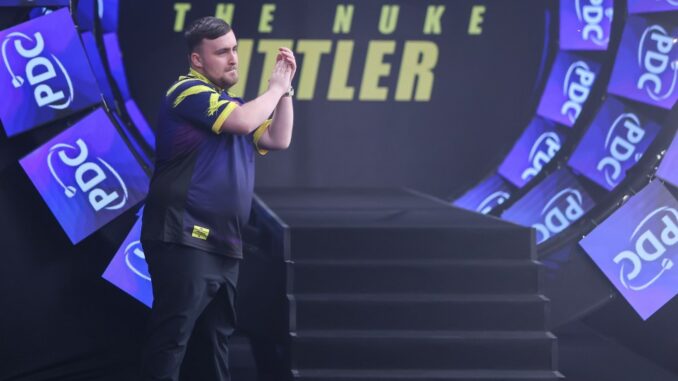
The Saudi Arabia Darts Masters brought an unexpected twist to the sport’s high-stakes world, as top players including teenage sensation Luke Littler found themselves thrown off by the audience’s unusual reactions during play.
In what marked darts’ debut in the kingdom, the event unfolded in a subdued venue at the Global Theatre in Riyadh. Unlike the raucous, beer-fueled crowds that energize tournaments in Europe—where cheers erupt for 180s and groans follow misses—this gathering maintained a remarkably quiet and respectful demeanor. Alcohol is prohibited in Saudi Arabia, contributing to an atmosphere far removed from the boisterous scenes players are accustomed to at Alexandra Palace or other PDC staples.
Littler, the 18-year-old double world champion fresh off defending his title, cruised through his first-round match against the veteran Singaporean Paul Lim. The Nuke dominated with powerful scoring, racing to a 4-0 lead with legs in 14, 14, 16, and another quick one, before Lim held serve in the fifth. Both players then missed opportunities at doubles in a tense moment, yet Littler recovered to seal the sixth leg in 21 darts and break again to close out a convincing 6-1 victory in 17 darts for the final leg.
What caught everyone off guard wasn’t the result, but the crowd’s response to those very misses. When darts veered off target or players faltered at the outer ring, the audience responded with polite applause rather than the usual silence or sympathetic murmurs. The gentle clapping greeted errors as if acknowledging effort or sportsmanship, creating a surreal contrast to the competitive intensity on stage.
“It’s a very weird atmosphere, that’s all new to us players,” Littler reflected afterward. “It is a very different environment but as long as you play well you are going to win 90 per cent of the time.”
Fellow competitors shared the bewilderment. The shift from the electric, sometimes hostile energy of recent events—where Littler had faced boos during heated matches—to this near-silent, almost studious setting left the pros feeling disoriented. One player described the experience as baffling, noting how the applause for mistakes flipped the script on what typically motivates or distracts darts stars. In Europe, precision is rewarded with roars; here, even slip-ups drew encouragement, as if the crowd was cheering participation over perfection.
The tournament itself carried extra intrigue beyond the cultural novelty. As part of the World Series of Darts, it featured a lucrative twist: a special “Golden Bullseye” incentive. Any player achieving a nine-darter could claim $100,000, with the prize doubling to $200,000 if a bonus dart then struck the bullseye. Littler, ever the competitor, admitted he had his eyes on that massive payout, adding pressure to an already high-profile lineup that included Michael van Gerwen (fresh from winning the Bahrain Darts Masters), Luke Humphries, Gerwyn Price, Nathan Aspinall, Stephen Bunting, Danny Noppert, and Gian van Veen.
Littler’s win set up a compelling quarter-final rematch against Van Veen, the runner-up from the recent World Championship final where Littler had dominated 7-1 to become the first back-to-back champion in a decade. That clash promised fireworks, even in the quieter surroundings.
The subdued vibe stemmed partly from cultural differences and the event’s inaugural status. Players like Humphries had anticipated a “respectful” crowd, sober and attentive, which proved accurate—but the applause for errors added an layer of strangeness that no one quite anticipated. It turned routine misses into moments of unexpected positivity, leaving the stars chuckling in post-match interviews about how “I didn’t expect it.”
As the tournament progressed into its decisive stages, the focus shifted back to the oche, where skill and nerve would decide the £30,000 top prize. Yet the lingering memory for Littler and his peers was the peculiar reception: a crowd that clapped when things went wrong, turning the familiar pressure of professional darts into something oddly heartening and utterly unfamiliar. In a sport built on razor-sharp focus amid chaos, this quiet, supportive twist proved refreshingly strange—and a reminder of how darts continues to evolve on the global stage. (Word count: 728)
Leave a Reply