
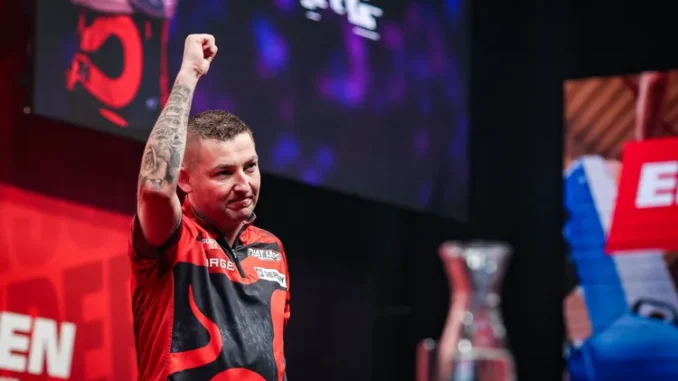
In the high-octane world of professional darts, where bright lights, roaring crowds, and razor-sharp precision define the moments that make champions, Nathan Aspinall—affectionately known as ‘The Asp’—has always worn his heart on his sleeve. The Stockport native, celebrated for his fiery on-stage persona and emotional displays that often ignite arenas, recently delivered a raw and honest glimpse into his current struggles. Following a hard-fought victory at the German Darts Grand Prix, Aspinall opened up about feeling flat, disconnected from the joy that once fueled his throws, and a deep yearning to simply stay home with his loved ones.
The admission came after Aspinall battled past German player Ricardo Pietreczko in a tense second-round clash at the event in Munich, securing a 6-5 win that propelled him into the later stages. It was a charged encounter that showcased not just his class on the oche but also his fighting spirit, something that had felt elusive in recent outings. “Yeah, it was a big game tonight,” Aspinall reflected afterward. “Obviously, after the disappointment in Belgium, I was very, very upset with my game, and I didn’t play very well in the Players Championship event midweek.”
Those words hinted at a broader dip in form that had left the former Premier League contender searching for answers. Aspinall has been working quietly behind the scenes to reignite his spark, but the road has been anything but smooth. “I’m working on something behind the scenes to try and get myself fired up,” he explained. “I’m a bit flat at the moment.” For a player whose energy and crowd interaction have long been trademarks of his success, this flatness represents a significant shift. “I’m very flat when I’m playing. I’m not enjoying playing darts at the moment,” he continued candidly. “I don’t want to travel — I just want to be at home with my family at the moment. So I’m trying to find some motivation, and a lot of that comes from enjoying myself on stage.”
This emotional honesty sheds light on the hidden toll of life on the PDC tour. Constant travel, airport delays, lost luggage, and the loneliness of hotel rooms far from home can wear down even the most resilient athletes. Aspinall described how these factors compound when results are not going his way. “If I’m playing really well, I’ll sit in an airport for three hours — I’m not bothered,” he noted. “If I’m playing rubbish, I don’t want to do it.” The grind of passports, flights, and disrupted routines—exacerbated by broader issues like Brexit-related airport chaos—has made the nomadic lifestyle increasingly burdensome. His luggage, for instance, only arrived in the afternoon on the day of his match, adding another layer of frustration to an already demanding schedule.
Yet, in the heat of battle against Pietreczko, Aspinall found a way to tap into his old self. He leaned on the familiar ritual of engaging with the crowd and letting natural emotion flow, rather than forcing it. “When I used to give it a little bit of something, that used to get me pumped up and I used to enjoy that,” he recalled. “That’s what I tried to do today. I don’t want to force it — I want it to be natural.” His opponent played a surprising role in sparking that fire. Pietreczko, known for his own lively stage presence, brought an intensity that mirrored Aspinall’s usual approach. “Ricardo was a perfect opponent because he likes to give it a little bit on stage, and that obviously fired me up,” Aspinall said. “He played well, he battled — kind of like playing myself, really.”
The German crowd, far from the hostility one might expect in such a matchup, showed Aspinall genuine appreciation. “Yeah, of course. There’s not many places I go where I get booing or anything like that,” he observed. “When you play a German, you expect it — but the German fans really, really appreciate me and like me.” He attributes this respect partly to his off-stage efforts, including numerous exhibitions across Germany where he makes time for fans. “I do a lot of work in Germany, a lot of exhibitions, and I give everyone their time of day,” he added. “I think that’s why I get a lot of respect.”
Looking ahead, Aspinall faces Martin Schindler in the third round, another tough test on home soil for the German. Beyond the immediate tournament, he is making conscious choices about his schedule to protect his well-being. “I’m in Sindelfingen — I’m not in Graz,” he confirmed, signaling a more selective approach. “I’ve got no idea,” he said about the broader travel challenges. “Obviously, I’m going to keep playing — it’s just hard work.” He has hinted that in particularly tough stretches, he might opt to pull out of events to recharge, prioritizing long-term sustainability over a packed calendar.
Aspinall’s openness resonates deeply because it humanizes the high-pressure existence of a professional darter. Once driven by pure passion and the thrill of the stage, he now navigates a phase where darts feels more like a demanding job than a beloved pursuit. The sacrifices—missing family weddings, key life events, and simple time at home—loom large, especially as a devoted father and husband. His motivation has increasingly centered on providing the best possible life for his family, turning performances into a means of financial security amid the emotional strain.
This candid moment at the German Darts Grand Prix comes amid a career filled with highs, including multiple European Tour titles, Premier League nights, and memorable runs that have endeared him to fans worldwide. Aspinall has never shied away from discussing mental health, injuries, or personal challenges, and this latest admission only strengthens that connection. Supporters appreciate his authenticity; in a sport where mental fortitude is as vital as darting accuracy, his willingness to voice struggles offers comfort and relatability.
As he prepares for the next leg of the tournament, the focus remains on rediscovering enjoyment on stage. That natural pump, the interaction with the crowd, and the satisfaction of a hard-earned win—like the one against Pietreczko—could be the catalysts for a turnaround. “Yeah, great win, very happy,” Aspinall concluded. “It was a good game of darts… it was a big win.”
In the end, Nathan Aspinall’s story at this juncture is one of quiet vulnerability meeting professional determination. The desire to be home with family is universal, yet for elite athletes chasing global success, it creates a profound internal conflict. Whether through selective scheduling, behind-the-scenes work on his mindset, or leaning into emotional moments during matches, Aspinall is fighting to balance the demands of the tour with what truly matters most. Fans will be watching closely, not just for the checkouts and averages, but for the return of that signature fire that has made ‘The Asp’ one of the most compelling figures in darts. For now, every throw carries extra weight—a reminder that even in victory, the search for motivation and joy continues, one stage at a time.
Leave a Reply