
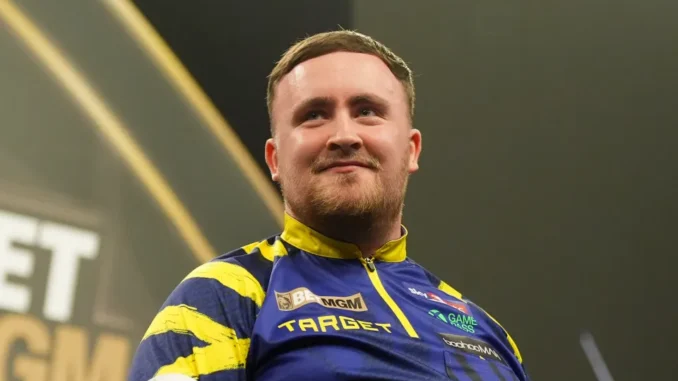
In the smoky, energetic atmosphere of a modest Riley’s club in Chester, where the clink of glasses mixed with the sharp thud of darts hitting the board, an amateur player named Dan Stapleton found himself facing a moment that would later feel like a glimpse into sporting destiny. It was 2023, and the darts world was just beginning to whisper about a teenage sensation from nearby Warrington. Luke Littler, still a few months shy of his explosive debut on the big stage, had recently turned 16. To most in the room, he was a promising young talent already racking up nine-darters on smaller tours. To Stapleton, a dedicated local competitor from North Wales, he was about to become an unforgettable lesson in raw, unrelenting talent.
Stapleton had made the short 20-minute journey across the border for what seemed like a standard local tournament. These events were the lifeblood of grassroots darts—competitive enough to sharpen skills, but far from the bright lights and roaring crowds of Alexandra Palace or the Premier League. “It was just a Riley’s in Chester,” Stapleton later recalled. The venue sat conveniently between their homes; Littler lived just 20 or 25 minutes away in the other direction. Little did Stapleton know that this ordinary afternoon would etch itself into his personal darts folklore.
He had unknowingly crossed paths with Littler before. About a year earlier, in 2022, Stapleton had competed in the same tournament and even warmed up in the same practice area as the then-15-year-old. “I was practising with him before that 2022 tournament,” he explained. “I didn’t interact with him or anything because, you know, I’m not being funny, it was a 15-year-old boy—why would I go up to him? But like, I sort of vaguely knew him as a name.” Even then, whispers followed the youngster. At 14 or 15, Littler was already landing nine-darters on the WDF circuit, turning heads with a maturity and precision that belied his age.
On the day of their showdown, the two arrived almost simultaneously. “I remember we literally turned up at the same time,” Stapleton said. “He must have been dropped off or he got the train like I had. And then I saw him coming in, and by that point he was starting to get real buzz.” The tournament followed a group-stage format, with three or four players advancing from each section. Littler dominated his group, while Stapleton secured second place in his. When the draw for the round of 16 was made, fate paired them together.
Stapleton approached the organizer with a mix of disbelief and dark humor. “I remember going up to the guy running it and saying, like, ‘Cheers for that. How has that happened?’ Normally when someone’s first, if you’ve got three or four people going through, you’d have thought that they’d play the third or fourth players in that group.” He felt a pang of disappointment—facing the group winner so early wasn’t ideal—but excitement bubbled underneath. This was his chance to test himself against the rising star everyone was talking about.
What unfolded next highlighted the stark contrast in their approaches to the game, a difference that has since become part of Littler’s legendary aura. Stapleton, like many dedicated amateurs chasing improvement, put in serious graft. He’d often dedicate three full hours to practice before important matches, honing his technique, building stamina, and mentally preparing for every possible scenario. Darts, after all, rewards consistency and mental fortitude as much as natural ability. The hours spent alone with the board were his investment in getting better, grinding through repetition to iron out flaws.
Littler, by contrast, operated on a different frequency. The teenager would casually rock up just five minutes early, seemingly unfazed by the occasion. No lengthy warm-up marathons, no visible signs of intense pre-match ritual. He simply stepped up when called, darts in hand, and delivered. “He’d rock up 5 mins early & smash me,” Stapleton would later sum it up with a chuckle that mixed admiration and lingering astonishment. It wasn’t arrogance or laziness—it was the hallmark of extraordinary natural talent, the kind that allows someone to perform at elite levels with minimal visible preparation.
The match itself was a masterclass in efficiency and punishment. Littler took the first leg comfortably on his throw, setting an immediate tone. In the second leg, Stapleton held the advantage of the throw and mounted a fightback. Littler raced ahead initially, but Stapleton clawed his way level, creating a genuine opportunity to level the match at one-all. “I actually missed two darts to make it one-all,” he admitted candidly. “I missed double 16 and double 8 because obviously I just bottled it, to be honest with you.” Nerves got the better of him in that critical moment—the pressure of sharing the oche with a prodigy who seemed destined for greatness.
That miss proved costly. Stapleton had nine more darts at the leg but couldn’t convert. Littler seized control, closing it out ruthlessly. The third leg saw Littler produce an 11-darter, a breathtaking display of finishing that left Stapleton shaking his head in appreciation. “I was just like, ‘Oh, yeah, that’s great, yeah.'” The final score was a 3-0 whitewash in Littler’s favor. His average for the match stood at 88.41, the highest recorded in the round of 16 that day. His first-nine darts average soared around 111—an astonishing figure against an opponent who was no slouch in local circles.
Stapleton later reviewed the stats with fresh eyes. “It was his best average that day apart from maybe the final. It’s just like ‘Cheers. I’m just some amateur player trying to get by and you’ve produced this against me.'” Despite the defeat, there was no bitterness, only respect. Littler didn’t coast through the smaller event; he relished it. “He completely relishes [even the smaller tournaments],” Stapleton noted. “Even when he played me, I think he must have known he was almost certain to win it that day, even though there was a really good standard of players there.”
This encounter was no fluke. Littler had already shown flashes of brilliance that set him apart. While other teenagers his age balanced school, hobbies, and typical adolescent distractions, he was laser-focused on the sport he loved. Stories from his early years painted a picture of a boy who picked up darts almost as soon as he could walk, throwing with uncanny accuracy. During the 2020 lockdown, while much of the world sought distractions in baking or streaming shows, young Littler reportedly spent hours daily in front of his board, refining every element of his throw. That foundation of purposeful repetition, combined with prodigious talent, created a player who could turn up with minimal fuss and still dismantle seasoned opponents.
Stapleton had always sensed the potential. “I always thought he’d be a world champion eventually because like, no one could be that good at such a young age without…” he trailed off, the implication clear. Comparisons to greats like Michael van Gerwen, who claimed his first PDC world title in his mid-20s, or even earlier BDO champions like Jelle Klaasen around age 21 or 22, only underscored how exceptional Littler’s trajectory was. Just months after this local clash, Littler burst onto the PDC scene at the 2024 World Championship as a 16-year-old debutant, reaching the final in a fairytale run that captivated fans worldwide before falling to Luke Humphries.
The story didn’t end there. Littler continued his ascent with relentless drive, winning major titles and proving his early promise wasn’t hype. In January 2025, he made history by becoming the youngest world darts champion, defeating the legendary Michael van Gerwen in the final at just 17 years old. That record, Stapleton firmly believes, “will never be broken.” The Nuke—Littler’s explosive nickname—had arrived, transforming from a local wonderkid into a global phenomenon who filled arenas, dominated rankings, and inspired a new generation to pick up darts.
For Stapleton, the memory remains a badge of honor rather than a sore point. Playing against Littler offered a rare window into what pure sporting genius looks like up close. The contrast in preparation styles only amplified the tale: one player grinding through long, focused sessions to chase marginal gains, the other arriving with breezy confidence, relying on God-given ability honed by quiet dedication away from the spotlight. “I’d practice for 3 hours before games, he’d rock up 5 mins early & smash me,” Stapleton reflected, capturing the essence with humorous resignation.
In the broader tapestry of darts, this anecdote humanizes the superstar’s rise. It reminds enthusiasts that behind the television highlights and record-breaking averages lies a journey rooted in local venues like Riley’s in Chester, where dreams are tested on worn boards under fluorescent lights. Littler’s casual arrival and devastating performance weren’t signs of disrespect to the game or his opponents; they revealed a player so in tune with his craft that the stage—whether grand or humble—never intimidated him.
Today, as Littler continues to rewrite record books and thrill crowds with his trademark power scoring and clinical finishing, stories like Stapleton’s add depth to the legend. They illustrate how a teenager who barely needed a lengthy warm-up could humble experienced players while barely breaking a sweat. For amateurs everywhere, it’s both inspiring and humbling: talent like Littler’s is rare, but the dedication to show up and compete, no matter the odds, is what keeps the sport alive at every level.
Darts has always thrived on such contrasts— the grinder versus the natural, the veteran versus the prodigy. In this case, the prodigy won decisively, but the grinder walked away with a story worth telling for years. As Littler collects trophies and smashes records, players like Stapleton can proudly say they faced him when the world was still catching on. And in the process, they witnessed firsthand why “The Nuke” was destined to explode onto the scene and stay there.
Leave a Reply