
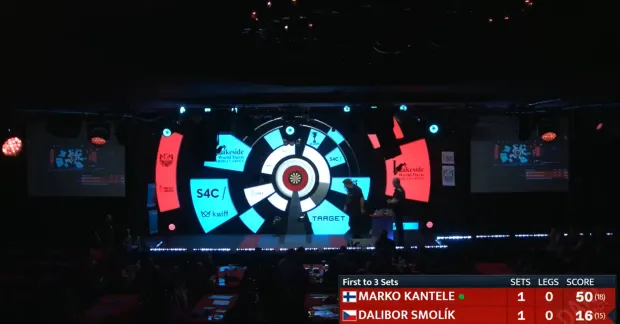
In the electrifying world of professional darts, where precision meets psychological warfare under blinding spotlights, few moments capture the raw vulnerability of the sport quite like a player’s sudden unraveling. The Grand Slam of Darts, one of the game’s most prestigious tournaments held annually in Wolverhampton’s Aldersley Village, is a cauldron of high stakes and higher emotions. This year, as the group stages unfolded amid roaring crowds and the familiar hum of electronic scoreboards, Belgian sensation Martijn van Peer delivered a scene straight out of a sports drama gone awry. Midway through a tense match, the 29-year-old phenom abruptly walked off the stage, clutching his darts like a lifeline, leaving opponents, officials, and thousands of spectators in a state of bewildered silence. The delay stretched on, turning what should have been a routine leg into a bizarre interlude that highlighted the mental minefield lurking behind every throw.
Van Peer’s clash was against darts royalty: Scotland’s Gary Anderson, a two-time world champion known for his ice-cool demeanor and a throwing arm that has felled giants. The pair were locked in Group G, a pool that also featured Australia’s Simon Whitlock and Northern Ireland’s Daryl Gurney. Van Peer had entered the fray on a high note, having dispatched Whitlock in his opening encounter with a display of clinical finishing that saw him average over 95—numbers that whispered of a breakout performance. But darts, for all its mathematical elegance, is as much a battle of the mind as the body. As the second match ignited, something snapped in the young Belgian’s rhythm.
It started subtly, the way these things often do in high-pressure environments. Van Peer, standing at the oche—the throwing line that separates dream from disaster—gripped his darts with an uncharacteristic ferocity. The crowd, a sea of chanting fans decked in colorful scarves and waving flags, fell into an expectant hush. He raised his arm, sighted the board, and… nothing. His hand trembled, frozen in mid-motion, as if an invisible force had welded his fingers to the flight. Attempts to release followed—one, two, three futile jerks—each more agonizing than the last. Finally, on the fourth try, the dart flew, but it was a shadow of his earlier form, embedding harmlessly in the single-score zone. The subsequent throws fared no better, his average plummeting as the tension coiled tighter. Whispers rippled through the arena: Was it fatigue? A rogue breeze from the air conditioning? No, this was something deeper, more insidious—a affliction as old as the sport itself, known colloquially as “dartitis.”
For the uninitiated, dartitis isn’t mere stage fright; it’s a neurological gremlin that strikes at the heart of performance. Imagine the yips in golf, where a seasoned pro’s putter betrays them at the crucial moment, or the choke in tennis that turns an ace serve into a double fault. In darts, it manifests as an inability to let go, a nervous twitch that sabotages the fluid release honed over thousands of practice hours. Experts describe it as a form of focal dystonia, where the brain’s signals to the muscles glitch under stress, often triggered by the weight of expectation. Van Peer, whose meteoric rise has seen him climb from pub leagues to PDC Pro Tour contention, later confessed the toll it exacted. “I was nervous,” he admitted in a raw post-match interview, his voice laced with the exhaustion of someone who’d stared down their own demons on live television. That simple phrase—”I was nervous”—belied the storm raging inside, a confession that humanized a sport often glamorized for its unflappable stars.
The walk-off itself was a spectacle of quiet desperation. With the score tied and the clock ticking toward a potential upset, Van Peer lowered his arm, shook his head, and strode purposefully toward the wings, his trademark black shirt clinging to a frame taut with frustration. Officials huddled, the referee’s whistle silent as medics and coaches conferred. Anderson, ever the professional, paced calmly, chatting with the umpire to ease the awkwardness. The big Scot, with his wry humor and unflinching honesty, would later reflect on the incident with empathy rather than exasperation. “I’ve seen it before; it’s a tough gig up there,” he said, drawing from his own brushes with the mental side of the game. The delay lasted nearly five minutes—a lifetime in darts, where legs can turn on a single dart—but it felt like an eternity to the fans, many of whom had traveled hours to witness not just throws, but triumphs over adversity.
When Van Peer returned, the crowd greeted him with a thunderous ovation, a wave of solidarity that washed over the stage like a balm. He managed to complete the leg, though the match ultimately slipped away, ending in a hard-fought defeat. Yet in defeat, there was dignity. Van Peer’s candor in the aftermath painted a fuller picture of resilience. “It’s part of the game, the nerves—they creep in when you least expect,” he elaborated, his eyes meeting the camera with a mix of defiance and vulnerability. This wasn’t his first skirmish with dartitis; whispers from the tour suggest he’s battled it in quieter venues, honing techniques like breathing exercises and visualization to reclaim his throw. Fellow pros rallied around him online and in the players’ lounge, sharing stories of their own dark nights. Gerwyn Price, the Welsh powerhouse, recounted his own infamous walkout during a 2021 match, where frustration boiled over into a mid-game exit. “We all get it; the stage amplifies everything,” Price noted, underscoring the camaraderie that binds this tight-knit circuit.
This episode at the Grand Slam underscores a broader truth about darts’ evolution. Once a smoky pub pastime fueled by pints and bravado, it’s now a global spectacle broadcast to millions, with prize pots swelling into the millions. The pressure cooker has intensified, birthing not just superstars like Luke Humphries and Michael van Gerwen, but also these poignant reminders of the human element. Dartitis, once a whispered curse, is gaining traction in sports psychology circles, with coaches advocating mindfulness apps, hypnotherapy, and even biofeedback training to combat it. Van Peer’s moment, bizarre as it was, sparked conversations in pubs and podcasts alike: How does one armor the mind against the oche’s unforgiving gaze?
As the tournament progresses, with knockout stages looming and underdogs eyeing glory, Van Peer’s story lingers like an unfinished leg. He’s already bounced back in practice sessions, his throws regaining that signature snap. For fans, it’s a tale of tenacity—a young gun who didn’t just survive a stage implosion but used it as fuel. In a sport where millimeters separate ecstasy from agony, his admission of nerves isn’t weakness; it’s the spark that could ignite a comeback. After all, darts isn’t just about hitting doubles; it’s about daring to throw in the first place. And as the lights dim on another Grand Slam night, one thing’s clear: Martijn van Peer, nervous or not, has the crowd—and the game—hooked on his next move.
Leave a Reply