
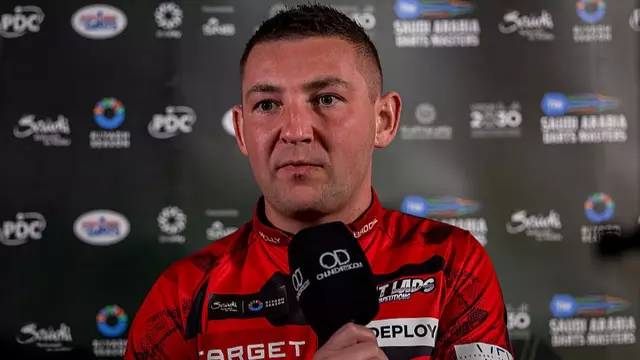
In the electrifying world of professional darts, where precision meets passion under the glare of arena lights, Nathan Aspinall has emerged as a resilient force, captivating fans with his gritty comebacks and unfiltered honesty. The two-time PDC major winner recently made headlines not just for his on-stage triumphs but for his candid revelations about the sport’s underbelly—the personal rivalries, mental health struggles, and inexplicable fan animosities that simmer beneath the surface. As darts surges in popularity, drawing massive crowds and turning players into household names, stories like Aspinall’s highlight the human element that makes the game so compelling.
It all unfolded during the 2025 Premier League Darts season, a high-stakes tournament that pits the world’s top talents against each other in a grueling series of nightly battles. Aspinall, hailing from Stockport, England, delivered a stunning performance in Manchester, his hometown. Trailing 3-0 against the formidable world number one, Luke Humphries, Aspinall mounted an epic comeback to clinch a 6-4 victory. This marked his first nightly win of the season, a moment of pure exhilaration that propelled him up the leaderboard. Reflecting on the win, Aspinall opened up about his own battles, admitting he had nearly walked away from the sport entirely due to dartitis—a debilitating condition that disrupts a player’s throwing motion and confidence. “I’ve got a few issues, and sometimes it doesn’t look pretty on TV or whatever, but I found a way to cope with it,” he shared. “It affects me, but I’m winning, and I’m winning tournaments, and it’s one of them, either quit and give up and go home, or you own it, and you make it part of the game and that’s what I’ve decided to do.” His words resonated with many, underscoring the mental fortitude required to excel in a sport where every throw is scrutinized.
But Aspinall’s night wasn’t solely about personal glory. In a post-match interview, he shifted the spotlight to defend Humphries, who had faced a barrage of online criticism after speaking openly about his mental health challenges. Humphries, a former world champion known for his cool demeanor and consistent dominance, had revealed how his relentless schedule left him feeling “emotionless.” This vulnerability was met with backlash from some fans, prompting Humphries to express his frustration publicly: “Considering the comments, people not understanding what I meant… Will be the last time I ever confess my real feelings to the public. Everything I say or ever do just never seems to be good enough for anybody… as long as no one complains when we all give the same answers in interviews like robots and not our true feelings. Then everyone, I guess, will be happy, or usually will still find a way to moan at us.”
Aspinall, appalled by the vitriol, didn’t hold back in his support. He described the abuse as “disgusting” and expressed bewilderment at its source. “He is an absolute credit to the sport,” Aspinall emphasized, praising Humphries’ character and contributions to darts. Yet, in a surprising twist, Aspinall revealed a personal angle: even among his own circle of darts enthusiasts, Humphries isn’t universally adored. “I have no idea. You know what, I have a lot of mates that love darts, and no one likes Luke. Honestly, I can’t give you that answer. A lot of my mates can’t stand him. I don’t know what it is,” he confessed. Aspinall attributed this disconnect to a lack of personal acquaintance, adding, “People don’t know him. People don’t know the real people. I just don’t understand it, and you know, hopefully, it will change at some point, because he’s a great guy.”
This admission adds a layer of intrigue to the darts landscape, where rivalries on the oche often spill into off-stage perceptions. Humphries, from Newbury, has risen meteorically, capturing the world championship and maintaining his top ranking through sheer skill and dedication. In the 2025 Premier League, he finished second with 34 points, just behind the teenage sensation Luke Littler, who topped the table with 45 points. Aspinall secured third place with 26 points, edging out Welsh star Gerwyn Price (24 points) and Dutch legend Michael van Gerwen (20 points). The playoffs at London’s O2 Arena saw Humphries defeat Aspinall in the semi-finals before claiming the overall title by besting Littler in the final. Such achievements highlight Humphries’ prowess, yet the lingering dislike from some quarters— including Aspinall’s friends—suggests that success can sometimes breed envy or misunderstanding in the passionate darts community.
Aspinall’s friendship with Littler offers a contrasting glimpse into the camaraderie that also defines the sport. As a close tour companion, Aspinall has shared light-hearted insights into Littler’s life since turning 18, noting how the young prodigy navigates newfound freedoms like enjoying a drink responsibly amid the pressures of fame. These bonds remind fans that behind the competitive edge, players like Aspinall and Humphries are navigating the same emotional highs and lows.
The broader context of darts’ explosive growth amplifies these stories. Once viewed as a pub pastime, the sport now fills arenas worldwide, with the Premier League drawing record viewership. Mental health discussions, once taboo, are becoming more common, thanks to players like Humphries who dare to speak out. Aspinall’s defense serves as a call for empathy, urging fans to look beyond the scoreboard and appreciate the individuals fueling the game’s excitement. As the darts calendar marches on, with major tournaments like the World Championship on the horizon, Aspinall’s words linger: perhaps it’s time for perceptions to shift, allowing talents like Humphries to be celebrated not just for their throws, but for their humanity. In a sport where every point counts, fostering understanding off the board could be the ultimate win.
Leave a Reply