
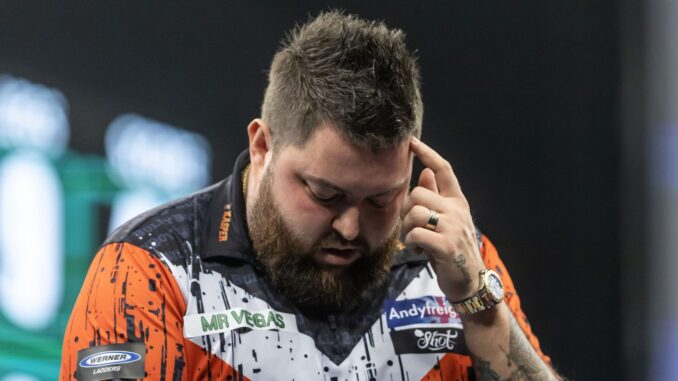
In the high-stakes world of professional darts, where precision and stamina collide under bright lights, Michael Smith—affectionately known as ‘Bully Boy’ and a former world champion—has proven once again that true grit can overcome even the toughest personal battles. Fresh off a hard-fought victory at the German Darts Grand Prix, Smith opened up about a grueling week that left him drained, yet determined to push forward on the biggest stages.
The 31st-ranked player took to the oche in a first-round clash against James Hurrell at the Kulturhalle Zenith, delivering a 6-2 win in what both men would later describe as a strangely disjointed affair. Smith’s average dipped to a modest 86.40, far from his usual blistering standards, as the pair traded erratic shots in a match that lacked the rhythmic flow fans have come to expect from elite-level darts. Yet, amid the scrappiness, Smith found a way to prevail, capitalizing on crucial moments when it mattered most. It was the kind of resilient performance that speaks volumes about a player’s character, especially when battling unseen hurdles away from the board.
Post-match, Smith didn’t shy away from the truth behind his subdued showing. He admitted the contest spiraled into an odd back-and-forth dynamic, saying, “James was struggling and I started to follow him struggling. He started hitting 140s and then so did I. It was a weird game, everything just went wrong but at the last minute everything went right at the same time.” The candor revealed a deeper issue: a “dreadful” stretch of illness that had sapped his vitality for days. “This last week has been dreadful,” Smith confessed. “I have had no energy whatsoever, feeling sick and bloated. I have not been playing the greatest because I have had to have a little time away from practice.”
Those words painted a vivid picture of a champion operating on fumes. The low energy wasn’t just a fleeting distraction—it had ripple effects on his recent outings. Smith noted how the sickness had visibly impacted his form in the ProTours and the qualifiers leading into events in Graz and Sindelfingen. For a player of his caliber, stepping back from the practice board isn’t ideal, especially in a sport where muscle memory and mental sharpness are everything. Darts demands not only pinpoint accuracy but also the endurance to withstand multi-day tournaments, where matches can stretch late into the night and the pressure never lets up.
Despite the setbacks, there are glimmers of a comeback in the air for the former world champ. Smith has shown flashes of his old magic, most notably by reaching the quarterfinals of the Poland Masters recently. That run hinted at a resurgence, a reminder of the talent that once carried him to the pinnacle of the PDC circuit. At his best, Smith is a formidable force: explosive scoring, clinical finishing, and an unshakeable competitive edge that has earned him legions of supporters worldwide. But consistency has been the elusive prize lately, and this latest illness has only amplified the challenge as he hunts for that elusive big-stage rhythm.
Looking ahead, the plot thickens in round two, where Smith will square off against one of his longest-standing rivals, Dave Chisnall. The matchup carries extra weight, rooted in shared history from their roots in St Helens. “We used to live literally five minutes apart, especially in St Helens where we grew up,” Smith reflected warmly. “He was one of the main lads I started practising with when I started my career. It has always been like that.” Their bond goes beyond the board—they’re genuine friends who know each other’s games inside out. “We are really good friends,” he added. “I know what Chizzy can do and he knows what I can do. It doesn’t matter how bad we have been playing, we can get the best out of each other. Hopefully we can have another amazing game tomorrow.”
This next encounter promises fireworks. Chisnall, with his own explosive style and deep experience, often brings out the fire in Smith, turning their clashes into memorable spectacles that elevate both players. For Smith, it’s more than just another match; it’s a chance to channel his lingering fatigue into focus and reclaim the momentum that’s been slipping through his fingers. Fans will be watching closely, eager to see if the ‘Bully Boy’ can shake off the fog of illness and deliver the high-octane performance that defined his championship runs.
In the broader tapestry of Smith’s career, this moment underscores a universal truth in sports: even legends face valleys of vulnerability. Illnesses like this—sapping energy, disrupting routines, and clouding judgment—test the limits of dedication. Yet Smith’s willingness to compete through it all, to step onto the stage when many might have withdrawn, highlights the unyielding spirit that has defined his journey from local hopeful to global icon. As the German Darts Grand Prix unfolds, his story serves as an inspiring beacon for athletes everywhere: setbacks are temporary, but the drive to overcome them is what forges legacies.
Whether he advances further or not, Smith’s honesty about his struggles humanizes the high-pressure world of professional darts. It reminds supporters that behind the averages and checkouts lies a man grappling with the same everyday frailties as anyone else—only under the unforgiving glare of arena spotlights and live broadcasts. As he prepares for Chisnall, one thing is certain: the former world champion isn’t just battling an opponent tomorrow. He’s waging a quiet war against his own body’s limits, emerging stronger with every throw. The darts community will be rooting for a full recovery and a return to the form that once made him unstoppable. For now, though, every point scored in Sindelfingen feels like a hard-won triumph over adversity itself.
Leave a Reply