
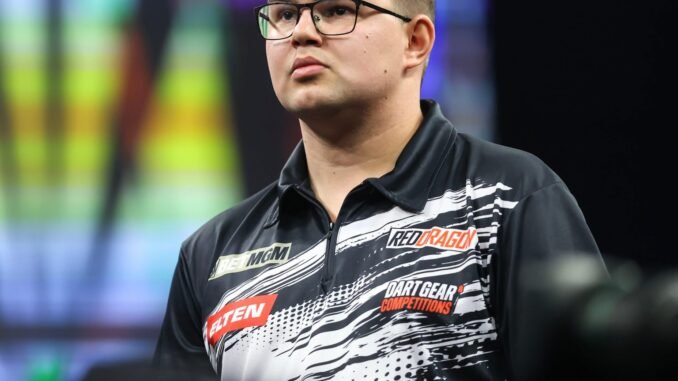
In the relentless spotlight of the 2026 Premier League Darts, where consistency and mental fortitude separate the contenders from the also-rans, rising Dutch star Gian van Veen is facing a growing shadow over his explosive start to the season. The 23-year-old sensation, already making waves in his debut campaign in the elite weekly competition, has reached an impressive three nightly finals in the opening four weeks—yet each time, the coveted £10,000 top prize has slipped through his fingers.
The latest heartbreak unfolded on Night Four in Belfast at the SSE Arena, where van Veen powered through to the decider once more. He dispatched local hero Josh Rock 6-2 in the quarter-finals, shrugging off the electric atmosphere and Rock’s stunning nine-darter that sent the home crowd into frenzy. Van Veen then edged a tense semi-final against Gerwyn Price 6-5, showing composure under pressure to set up a clash with Stephen Bunting. But in the final, things unraveled dramatically. Bunting, fresh off silencing doubters with a dominant run—including a 6-0 semi-final demolition of league leader Jonny Clayton—took control early, building a commanding lead before closing out a convincing 6-2 victory on double top. The result marked Bunting’s first nightly win of the season and inflicted a third Premier League final defeat on van Veen in quick succession.
This pattern of near-misses has now extended beyond the Premier League. Van Veen has lost his last six PDC finals in a row, a streak that includes a heavy 7-1 defeat to Luke Littler in the World Championship final on January 3, the Bahrain Masters, Nights One and Three of the Premier League, the Poland Darts Open, and now Belfast. The frustration is palpable, and the young ‘Giant’ is openly grappling with the psychological toll.
Speaking after the Belfast loss via a video link, van Veen didn’t hide his disappointment. “The quarterfinal was fine, the semifinal was good and then you think in the final: now it has to happen, and then it’s again—feels to me—dramatic,” he reflected. The recurring theme weighed heavily on him. “People know that I keep losing finals lately. Then you get Bunting and you play so poorly. I hoped it was a one-off, but now it’s becoming a pattern and you don’t want that. You just need to win one. Then hopefully it’s done.”
Earlier, following his Poland Darts Open runner-up finish, van Veen had voiced similar weariness: “I’m getting a bit tired of losing finals now.” The comments reveal a player acutely aware of the narrative building around him—one where his undeniable talent gets him to the big stage, but something elusive prevents the breakthrough victory that could unlock everything.
Despite the setbacks, van Veen’s performances showcase why he’s considered one of darts’ brightest prospects. His quarter-final against Rock included a spectacular 167 checkout that highlighted his finishing prowess, and his ability to navigate high-pressure matches speaks to his maturity. In the Premier League table, he sits strongly in second place with nine points after four nights, trailing only Clayton, a testament to his consistent deep runs. Fans and pundits alike praise his sportsmanship—such as his gracious reaction to Rock’s nine-darter—and his composure in big moments.
Yet the mental side of the game is now under scrutiny. In a format as grueling as the Premier League, where players face weekly roadshow pressure across Europe, the inability to convert finals into wins can erode confidence. Van Veen’s raw honesty about the “pattern” signals self-awareness, a crucial step toward breaking the cycle. He knows the level is there; the flashes of brilliance—high averages, clutch checkouts, and fearless darting—prove he’s capable of dominating.
As the competition heads into its next phase, with Night Five looming and the race for Play-Off spots intensifying, van Veen has another golden opportunity to snap the streak. The darts world watches eagerly: one decisive win could shatter the doubts, boost his momentum, and cement his status as a future major champion. For now, though, the frustration lingers, a reminder that in elite sport, reaching the summit is only half the battle—claiming the trophy is what defines legacies. Van Veen’s journey is far from over; if anything, these painful lessons may forge the resilience needed for greater triumphs ahead.
Leave a Reply