
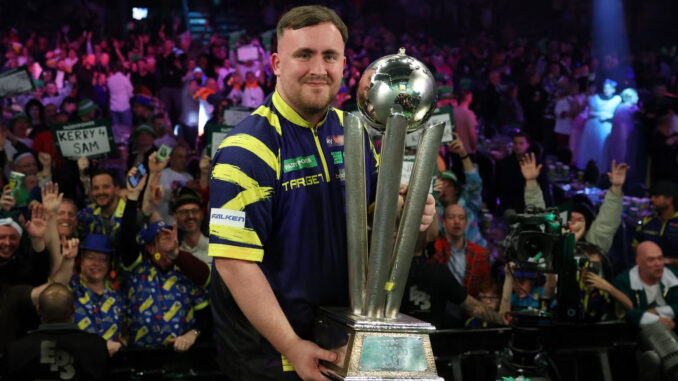
In the electrifying atmosphere of London’s Alexandra Palace, the 2026 PDC World Darts Championship culminated in a showdown that captivated fans worldwide. Eighteen-year-old sensation Luke Littler, already a household name in the darts community, defended his title with a commanding 7-1 victory over 23-year-old Dutch challenger Gian van Veen. This triumph not only solidified Littler’s status as a prodigy but also highlighted the stark disparity in earnings between the champion and the runner-up, with Littler pocketing a life-changing sum that dwarfed his opponent’s haul.
Littler, nicknamed “The Nuke” for his explosive scoring power, entered the tournament as the top seed and defending champion. His journey to the final was a masterclass in consistency, dispatching opponents with averages often exceeding 100. He started with a 3-0 win over Darius Labanauskas, followed by another clean sweep against David Davies. In the third round, he averaged 107.09 against Mensur Suljović, and continued his dominance with victories over Rob Cross (4-2), Krzysztof Ratajski (5-0 in the quarterfinals), and Ryan Searle (6-1 in the semifinals). This marked his third consecutive appearance in the world final, a remarkable feat for someone so young. Littler’s year had been nothing short of dominant; he completed darts’ triple crown in 2025 by winning the World Matchplay, alongside the UK Open, Grand Slam of Darts, and World Grand Prix, amassing five major titles. His ability to handle pressure, combined with pinpoint accuracy, has drawn comparisons to legends like Phil Taylor.
On the other side, Gian van Veen, known as “The Giant,” was making his mark in his first World Championship final. Qualifying as the PDC World Youth Championship winner, van Veen had an impressive run, starting with a 3-1 win over Alan Soutar where he posted a staggering 108.28 average. He followed up with victories against Madars Razma (4-1), Charlie Manby (4-1), a stunning 5-1 upset over Luke Humphries in the quarterfinals, and a hard-fought 6-3 semifinal win against Gary Anderson. This performance propelled him to a career-high ranking of world number three and earned him a spot in the Premier League for the first time. Van Veen, who had previously lost to Littler in the 2023 World Youth Championship final, represented the rising tide of Dutch talent in darts, following in the footsteps of Raymond van Barneveld and Michael van Gerwen.
The final itself was a rollercoaster that quickly tilted in Littler’s favor. Van Veen struck first, claiming the opening set 3-2 with a 12-darter capped by a 116 checkout, sending shockwaves through the crowd. But Littler, unfazed, roared back. He leveled the match in the second set with impressive checkouts of 145 and 127, then added his own 116. The third set featured a highlight-reel moment: Littler’s 170 checkout, the maximum finish, to take a 3-1 lead. From there, it was one-way traffic. Littler swept the fourth set 3-0, powered through the fifth despite a brief interruption from the infamous Ally Pally wasp, and closed out the match with a 147 checkout, averaging 106.02 overall. He fired 16 maximum 180s, while van Veen managed nine, with averages of 99.94. The combined age of the finalists—41—made this the youngest World Championship decider in history.
Beyond the glory of the Sid Waddell Trophy, the financial rewards were unprecedented. The PDC had boosted the total prize fund to a record £5 million, doubling the winner’s share to £1 million—a massive leap from previous years. Littler walked away with this top prize, a sum that underscored his dominance and set him further apart from rivals like Luke Humphries at the top of the world rankings. Van Veen, as runner-up, earned £400,000, a respectable amount but paling in comparison to Littler’s windfall. The tournament’s structure ensured escalating rewards: semifinalists took home £200,000 each, quarterfinalists £100,000, and even first-round participants received £15,000. This escalation reflected the sport’s growing popularity and the PDC’s commitment to rewarding excellence.
However, the reality of such earnings isn’t as straightforward as it seems. Littler’s £1 million prize is subject to significant deductions, including a 45% income tax rate that could claim around £450,000, plus National Insurance contributions. This means he might retain less than £550,000 after all is said and done—a reminder that even in victory, the taxman takes a hefty cut. Reflecting on the financial aspect before the final, Littler downplayed the money’s allure: “It’s a massive prize, but it’s the trophy on the stage, it’s not the money… I’m repeating myself, but ever since the Grand Slam I have just said I want to go back-to-back. So hopefully I can lift the trophy again and think about the money after.” After the win, he added, “It is life-changing for anyone. Even the first round was doubled. It’s life-changing, this win has just increased that gap from Luke Humphries and I’m in the clear as world number one.”
Van Veen, gracious in defeat, acknowledged Littler’s superiority: “The scoring maybe tonight wasn’t my greatest game in the whole tournament. Luke wasn’t in the mood to give me any more chances. He played phenomenally. I missed too many chances to make it an even game. That’s why he’s world number one by a margin now and back-to-back world champion.” Experts echoed this sentiment. Former PDC professional Matt Edgar praised Littler’s potential: “He just keeps improving and getting better and I still don’t think we’ve seen the best of Luke Littler yet. I think we’re playing him down, I think he’s better than what everyone says.” Commentator Wayne Mardle drew lofty comparisons: “There’s nothing he can’t do on a dartboard. It was like Phil Taylor, when he played well, he won. When he plays well, he’s winning. It really is about him at the moment. The format doesn’t matter any more. He’s just the best.”
Littler’s emotional reaction—tears streaming as van Veen congratulated him—captured the human element of the sport. At just 18, he became the fourth player to win back-to-back PDC titles, joining icons like Taylor, Adrian Lewis, and Gary Anderson, and the seventh multiple-time winner overall. For van Veen, the loss stung, but his breakthrough ensures a bright future, including Premier League exposure. This championship wasn’t just about darts; it was a testament to youthful ambition, resilience, and the evolving landscape of a sport once dominated by veterans. As Littler himself put it, “It’s very special. We’ve got to keep going, we’ve got to keep adding more titles. We can’t stop here. We’re still on this rollercoaster.” With records shattered and earnings that redefine success, the 2026 Worlds will be remembered as the dawn of the Littler era.
Leave a Reply