
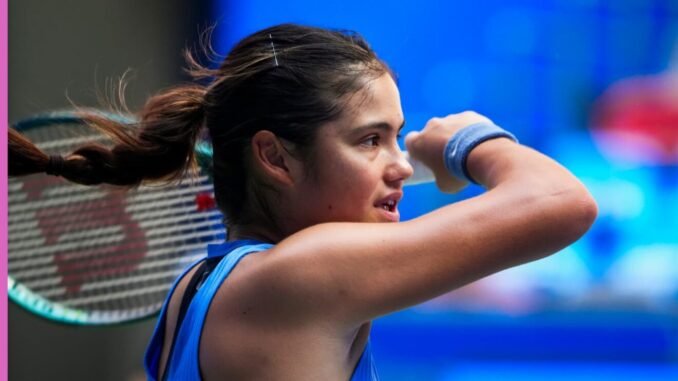
In the relentless rhythm of professional tennis, where every swing of the racket can echo triumph or trial, Emma Raducanu has long been a symbol of unfiltered brilliance laced with unyielding adversity. The 22-year-old British sensation, whose fairy-tale 2021 US Open victory at just 18 years old catapulted her from a wildcard wonder to global icon, has spent the years since navigating a labyrinth of physical setbacks that would test the resolve of even the hardiest competitor. But amid the humid haze of China’s Ningbo Open on October 14, 2025, Raducanu’s story took another poignant turn—not with a dramatic retirement this time, but with a gritty, three-set defeat marred by a fresh lower back scare. What could have been a quiet exit instead ignited a chorus of solidarity from the tennis world, reminding us why her journey resonates so deeply.
The Ningbo Open, a WTA 500 event perched on China’s eastern coast, promised Raducanu a chance at redemption after a bruising Asian swing. Just days earlier, in the sweltering cauldron of the Wuhan Open, she had been forced to abandon her first-round clash against American Ann Li, trailing 1-6, 1-4 in 32-degree heat and crippling humidity that left her dizzy and drained. “I suppose you’re proud out there, you don’t want to give anything away to your opponent, you don’t want to let anyone know that you’re not feeling great but the bottom line is health has to be the utmost priority,” Raducanu reflected post-Wuhan, her words a raw admission of the mental tug-of-war between warrior spirit and self-preservation. She spent the weekend under medical supervision, emerging with a Threads post that captured her vulnerability and vim: “Last day at the doctor’s in Wuhan… feeling better now. Shame I couldn’t continue there but thank you for the messages.” It was a snapshot of resilience, the kind that has defined her since those early whispers of prodigy status.
Arriving in Ningbo, Raducanu carried the weight of expectations as the tournament’s marquee draw, especially after world No. 4 Amanda Anisimova withdrew with a calf strain and defending champion Daria Kasatkina opted to end her season early. Her opponent in the first round: Zhu Lin, a 31-year-old Chinese wildcard whose ranking had plummeted from a career-high 31 to 219 after her own injury-plagued hiatus. On paper, it was Raducanu’s match to claim—a stepping stone toward reclaiming the form that saw her climb to No. 29 in the world just weeks prior. The air was thick with 89 percent humidity, milder than Wuhan’s inferno but still a stealthy foe, turning the court into a test of endurance as much as skill.
Raducanu burst out of the gates, channeling the fire that felled Leylah Fernandez in that unforgettable Flushing Meadows final. She snagged the first set 6-3 in a break-filled frenzy, converting her fifth set point after 55 minutes of scrappy, serve-swapping drama. Frustration flickered across her face—doubles faults and unforced errors hinting at lingering rust—but her groundstrokes hummed with authority, her forehand slicing through the muggy air like a declaration of intent. The crowd, a mix of local enthusiasts and expat fans, sensed a fairy tale redux. Yet, as the second set unfolded, the script faltered. Raducanu dropped serve early, her movement stiffening, and at 3-4 down, she summoned the physio for the first medical timeout. Courtside, her blood pressure was checked, a scene eerily reminiscent of Wuhan’s woes. Whispers rippled through the stands: Was the heat reclaiming its toll?
She fought back valiantly, leveling at 4-4 and forcing the decider, but the third set exposed the cracks. Trailing 1-2, Raducanu clutched her lower back between points, stretching gingerly as if each twist threatened to unravel her. Another timeout followed, this one for extensive treatment on the nagging injury that had crept in unannounced. “It’s a special feeling,” she had confided ahead of the match, speaking to the electric buzz of Asia’s hard-court circuit—a nod to her love for these high-stakes swings. But now, barely mobile, she opted not to retire, embodying the stubborn grace that has endeared her to so many. Zhu, sensing vulnerability, pounced with ruthless efficiency, reeling off five straight games to seal a 3-6, 6-4, 6-1 victory in 2 hours and 27 minutes. The final tally: Zhu claiming 16 of the last 19 points, a testament to her opportunistic grit and Raducanu’s fading fight.
As the handshake sealed the upset, the tennis community—players, coaches, and fans alike—rallied around Raducanu like a protective net. Social media lit up with messages of empathy, transforming potential pity into a powerful affirmation of her place in the sport. One prominent voice urged, “Emma, prioritize that body—you’ve got the talent to light up courts for years; don’t let the grind dim it.” Another fan, echoing the sentiment of many, pleaded, “Skip the next one, rest up. We’ve seen what happens when you push too hard.” Tim Henman, the two-time Wimbledon finalist and Raducanu mentor figure, weighed in with measured wisdom: “She’s incredibly tough, but these conditions are brutal. The smart move is listening to her body now.” Even across the net, Zhu offered post-match props, calling Raducanu “a fighter who inspired me today,” a rare bridge of respect in the heat of defeat.
This Ningbo setback caps a turbulent October for Raducanu, whose Asian odyssey has been a microcosm of her career’s highs and heartaches. Earlier, she squandered match points against Barbora Krejcikova in Seoul and Jessica Pegula in Beijing, her left foot sprain from the Korea Open quarterfinal retirement still a fresh scar. That injury, a ligament tweak against Kasatkina, forced her to skip initial plans for a full swing, yet she persisted, climbing 28 spots in the rankings this season through sheer match-hardened mettle. Skipping the French Open to rebuild post-Wimbledon, Raducanu’s selective schedule—her first deep grass-court run in years—has been a deliberate dance with durability. Now, with the WTA Finals looming and a potential Hong Kong tilt next, questions swirl: Will she heed the call for caution, or chase the court time she craves?
Raducanu’s saga transcends stats; it’s a narrative of a young woman rewriting her blueprint in a sport that chews up dreams. From those halcyon days of New York glory—becoming the first British woman to win a major since Virginia Wade in 1977—to the quiet surgeries and strategic pauses, she’s evolved into a beacon for aspiring talents grappling with the game’s physical demands. Her post-Wuhan candor—”health has to be the utmost priority”—strikes at the core of modern tennis, where climate-controlled stadiums clash with outdoor extremes, and recovery rooms rival practice courts in importance. As she packs her bags from Ningbo, perhaps nursing that back with ice and intention, the outpouring of support underscores a truth: Emma Raducanu isn’t just playing for titles; she’s pioneering a path where vulnerability fuels victory.
In the end, this health hiccup isn’t a full stop—it’s a comma in her unfolding epic. With the off-season beckoning, Raducanu has time to recalibrate, to transform these trials into the tensile strength that could propel her back to the summit. The tennis world watches, not with doubt, but with the fierce faith of those who’ve seen her arrows find their mark before. After all, in a game of infinite rebounds, Emma Raducanu’s next serve is always just one breath away.
Leave a Reply