
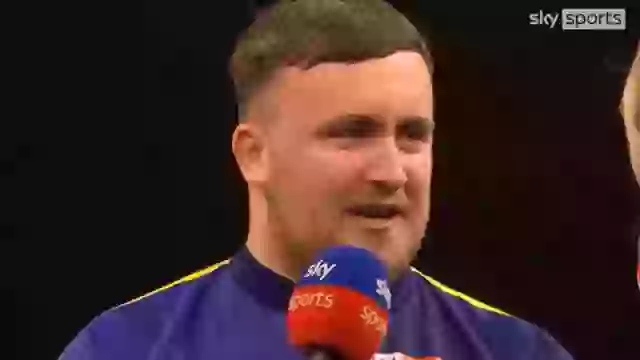
The electric atmosphere inside Glasgow’s OVO Hydro Arena was meant to be one of the Premier League Darts season’s standout nights, featuring a high-stakes final between two of the sport’s brightest talents. Instead, the evening unfolded as a tense 6-5 thriller between teenage sensation Luke Littler and his arch-rival Luke Humphries, overshadowed by persistent crowd disruption. Sections of the audience repeatedly whistled and jeered in attempts to unsettle the players at the oche, transforming what should have been a celebratory display of elite darts into a chaotic and frustrating spectacle. Some observers later described it as one of the worst crowds in the tournament’s recent history, triggering widespread criticism throughout the darts community.
Littler, the 19-year-old world champion affectionately known as “The Nuke,” has become familiar with intense receptions during his rapid rise to the top. He has encountered hostile treatment in venues such as Leeds, Liverpool, and Brighton, where incidents have included booing linked to his Manchester United support and more extreme disruptions, like a pint being thrown at Nathan Aspinall during a walk-on. Earlier in the season, Littler had even considered skipping certain German events because of similar negative crowd behaviour. However, nothing quite matched the sustained interference that dominated this particular Premier League night in Scotland.
The match itself delivered high-quality entertainment. Humphries, the reigning world champion and a strong Premier League title contender, pushed Littler right to the edge in a gripping decider. Both players exchanged powerful scoring and dramatic finishes with impressive accuracy. Yet the on-stage action was constantly interrupted by whistling that visibly affected their concentration. Missed checkouts and brief lapses in focus became more common, especially when one player prepared to throw. The continuous background noise eroded the razor-sharp attention required at the highest level of professional darts, where even minor distractions can prove decisive.
The disruption intensified in the closing stages when veteran match referee Kirk Bevins took the unusual step of speaking directly to the crowd over the microphone. In a firm, clear tone, he instructed, “Stop whistling, thank you.” The intervention aimed to restore order, but according to Littler, it produced the opposite result. Speaking openly after the match, the young champion recounted the sequence: “There was a few in particular that were doing it when Luke [Humphries] was throwing. Kirk told them to be quiet and it got even worse, and then I missed doubles and Luke breaks at 5-4. I’m just like, ‘Kirk, you’ve made it worse for me there, I’m 5-4 down.’ But I broke back and held my throw very strongly again.”
Littler accepted that officials must eventually intervene when behaviour crosses acceptable limits, but he believed the timing and impact of Bevins’ request only increased the pressure on him personally. “If it’s the same outcome as what it was when Kirk said it, then obviously just leave it,” he reflected. “They’ve got to step in at some point and say something. But yeah, that was pretty bad, but I got the win.” His capacity to regroup immediately, break back, and then hold throw with authority in the decisive legs demonstrated remarkable mental strength for a player who is still only 19 years old.
Commentators and pundits in the broadcast booth shared the frustration felt by many within the darts world. Legendary commentator Wayne Mardle openly wondered why persistent disruptors were not ejected from the arena, while Sky Sports reporter Abigail Davies suggested that the fans “actively contributed” to both players falling short of their peak performance by creating an environment filled with unnecessary interference. The whistling was not limited to the final; it had already impacted earlier matches that evening, including Gerwyn Price’s contest, adding to the perception that crowd conduct was getting out of hand.
This episode was not an isolated case for the PDC. Similar issues had surfaced on previous Premier League nights, with reports of whistling and jeering in Glasgow and other venues. The notorious Brighton incident, where a pint was thrown, remained fresh in everyone’s memory and was labelled “crazy” by Littler himself. Such events threaten to harm the sport’s reputation at a time when darts is experiencing record global popularity, sold-out arenas, and substantial broadcasting contracts. The passionate nature of darts crowds has always formed part of the sport’s unique appeal, with loud chants, colourful outfits, and energetic noise. However, when that energy shifts into deliberate attempts to disturb players during their throws, it enters unsportsmanlike territory that undermines the professionals’ efforts and the enjoyment of genuine supporters.
In response to the growing criticism and Littler’s frank comments, the PDC released a strong statement condemning the behaviour. The organisation made it clear that whistling or booing while a player is at the oche is completely unacceptable. They emphasised that every competitor steps onto the stage with the intention of delivering high-level performances and entertainment for audiences both inside the venue and watching at home. The PDC reminded spectators that inappropriate actions breach the terms and conditions of entry and can lead to immediate removal from the arena. They also committed to working more closely with venues to enforce these rules more effectively, sending a firm message that such disruptions would not be tolerated in future.
Despite the difficult atmosphere, Littler’s victory highlighted his increasing maturity and mental toughness. Coming from behind after the referee’s intervention appeared to backfire, he displayed the composure expected of an experienced champion rather than a teenager still adjusting to life at the elite level. His post-match reflections showed a player who recognises the importance of balance: crowds generate valuable energy and atmosphere, but that passion must support rather than hinder the competition.
As the Premier League Darts season continues across various cities in the UK and Europe, responsibility now rests with several groups. Players need to develop stronger strategies for blocking out distractions, just as Littler managed to refocus and perform when it counted. Organisers and officials must improve crowd management, perhaps through clearer pre-event communication, enhanced stewarding, or better methods to identify repeat offenders. Fans themselves also have a duty to celebrate the exceptional skill on display without resorting to tactics that ruin the experience for everyone involved.
Darts has flourished because of its distinctive mix of top-class sporting ability and lively entertainment. The sport’s swift expansion has attracted larger crowds, louder venues, and fresh audiences, but it has also created new challenges regarding behaviour that require attention to safeguard the game’s integrity. Littler’s experience in Glasgow acts as a timely warning: when whistles overpower the sound of darts, the true losers are the players, the dedicated supporters, and the sport as a whole.
In the end, Littler secured the win and important Premier League points, yet the night carried a disappointing aftertaste. Looking ahead, the hope is that future events will be remembered for spectacular 180s, thrilling checkouts, and positive crowd energy, rather than interventions that only worsen the situation. The Premier League remains one of darts’ premier competitions, and maintaining its status as a platform for sporting excellence, rather than crowd chaos, will be essential for its ongoing success. Littler and his fellow professionals deserve arenas that enhance their talent, not distract from it.
True Darts fans know how to respect the players and will be quiet when the players are throwing. I think alcohol plays a part in unruly behavior and this is very difficult to control. It would be interesting to see if these disrespectful so called “fans” turned up if the venue’s did not sell alcohol.
If the crowd can’t be controlled when its really bad take the players off stage to finish the game.back stage. Those fans not causing mayhem will soon sort them that are.The lady above thoughts are a good idea no alcohol