
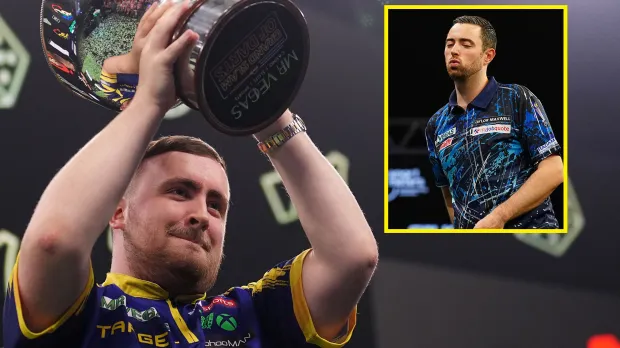
In the pulsating afterglow of the Aldersley Leisure Village, where the echoes of roaring crowds still lingered like smoke from a fired cannon, two titans of darts stood shoulder to shoulder under the glare of spotlights. Luke Humphries, the 30-year-old maestro from Newbury whose cool demeanor belies a firestorm of ambition, had just tasted defeat for the third consecutive major final. Across from him was Luke Littler, the 18-year-old wunderkind from Warrington, fresh off a commanding 16-11 victory in the Mr Vegas Grand Slam of Darts final—a win that not only defended his crown but catapulted him to the summit of the PDC world rankings as the youngest number one in history. As confetti swirled and the Eric Bristow Trophy gleamed in Littler’s grasp, the pair’s joint interview with broadcasters unveiled a riveting saga of rivalry, respect, and unbridled determination. In a candid exchange that crackled with electricity, Humphries laid bare his soul, proclaiming that he and Littler operated “in a league of our own,” while issuing a bold vow to reclaim glory at the impending World Darts Championship.
The final itself had been a chess match of razor-sharp precision, a best-of-31 legs epic that twisted and turned like the flight path of a perfectly thrown dart. Littler, arriving as the defending champion with an impeccable 14-match unbeaten streak at the event, dispatched Humphries with a tournament-high average hovering over 100—punctuated by blistering 180s and a clinical 96 checkout that sealed the £150,000 prize. For Humphries, it was a gritty performance marred by the lingering fatigue from his earlier semi-final marathon against Gerwyn Price, a draining affair that sapped his reserves just as the decider demanded peak ferocity. Yet, even in loss, Humphries’ spirit burned bright. “I’m really proud,” he admitted, his voice steady amid the arena’s fading hum. “It is three finals on the trot I’ve lost. I’m ready for the Worlds now. I am going to win the Worlds.” The words hung heavy, a declaration not of despair but of defiance, as he turned the spotlight on their shared dominance. “Yeah, I do [feel we’re in a league of our own]. I don’t feel arrogant saying that. What can us two do? We’re on opposite sides of the draw and people can’t stop us. I am trying to stop him and I can’t. It is up to everyone else to stop us.”
Littler’s triumph was more than a personal milestone; it was a seismic shift in darts’ power dynamics. In under two years since his professional debut—specifically 19 to 20 months of meteoric ascent—the teenager had amassed eight PDC premier event titles, including back-to-back Grand Slams, the UK Open, World Matchplay, and World Grand Prix. By merely stepping onto the oche for the final, he had overtaken Humphries’ 23-month reign at the top, amassing over £1.85 million in earnings to Humphries’ £1.689 million. As the second-place cheque of £70,000 was handed over, Littler couldn’t suppress his exhilaration, hoisting the trophy with a jubilant roar and a signature dance that sent ripples of delight through the Wolverhampton faithful. “I am the best in the world,” he proclaimed, the words tasting sweet after years of chasing shadows. “I can finally say it, world No 1. You are the best in the world and obviously to top it off, going back-to-back here makes it even more special.” His unbeaten run at the Grand Slam now stretched to 18 matches, a fortress of form that underscored his predatory prowess—11 maximums in the quarter-final alone against Josh Rock, where he staged a seven-leg comeback from 9-6 down.
But beneath the celebrations simmered a narrative far richer than statistics: a bromance forged in the furnace of competition, where admiration fuels the flames of rivalry. Humphries, who had toppled a then-16-year-old Littler in the 2024 World Championship final to claim his first global crown, now found himself dethroned yet undeterred. Their head-to-head ledger stood even at three major finals apiece, a testament to the parity that elevates the sport. “I am declaring war on him,” Humphries continued, his eyes locking with Littler’s in a moment of raw intensity. “I’m playing good. Tiredness just crept in at the end there. We’re going to go to war at the World Championships—me and him in the final. We’re going to see who is the number one there.” He paused, then added with a nod of genuine respect, “I said to him he deserves everything he gets. He’s a massive advocate for darts. I’ve never really felt like world number one, I’ve never felt like I’ve got the attention I deserve. He’s such an incredible player.” Littler, ever the quick-witted prodigy, met the challenge head-on. “It definitely is war because if someone obviously takes it off you, then you want it back. You don’t want to be second,” he replied. “It’s taken me 19 to 20 months to get to world No 1, so now I want to stay there for a few years. Luke was an incredible world No 1. He won plenty of titles along his way and he kept that gap from me. But I won many more to close the gap and now I’ve finally closed the gap. I’ve overtaken him, but now he wants it back and I’ve got to make sure that I’m on my game if we ever do meet in another final.”
This verbal joust wasn’t mere post-match bluster; it painted a vivid portrait of darts’ golden era, one where two Lukes have ascended to stratospheric heights, leaving the peloton in their dust. As Sky Sports pundit Wayne Mardle observed, their duels have “elevated” the game, creating showdowns that blend surgical accuracy with theatrical flair—Humphries’ wry on-stage “attack” after Littler’s monstrous 160 checkout being a prime example. Littler echoed the sentiment with boyish candor: “The finals show it, the stats show it and if everyone’s getting bored of me and him, then someone needs to stop us, otherwise we’re going to keep winning. We’re always going to meet in the final if we get past our opponents and we’ll make it continue.” Humphries, not one to shy from the hype, leaned in: “Honestly, I do [agree we’re in a different class]. I’m not being arrogant when I say that. I feel like a lot of people get a little bit just complacent and say it’s another Luke v Luke final or it’s rubbish. But what can we do? We’re opposite sides of the draw and we keep meeting each other. I mean, people can stop us, it’s up to them. It’s up to everyone else to stop us, and if they do, good luck to them. But at the moment, me and Luke are playing a level of this sport that’s better than everyone else. We’re going to keep competing finals. Regardless of what happens with the world No 1, I want to be in the world final with him. We want to go again, toe to toe and see what we got, baby.”
The horizon beckons with promise and peril. Before the £1.5 million World Darts Championship ignites at Alexandra Palace from December 11 to January 3, the duo will clash paths at the Players Championship Finals in Minehead next weekend—though draw mechanics shield them from an early encounter. There, Humphries defended his title last year with a final win over Littler, a reversal he savors as fuel for the fire. At Ally Pally, fate has positioned them on opposite halves of the bracket, priming the pump for a potential rematch of their 2024 epic, where Humphries’ 7-4 victory halted Littler’s fairy-tale debut run. Littler’s vow to hold the throne? Unwavering. “Now I’ve got that No 1 spot, obviously he wants it back, but now we’re going to be battling even more. I think we’re going to keep playing well because he wants it back and obviously I don’t want to give it away. You’re going to see many more great games.”
In this duel of darting destinies, Humphries and Littler aren’t just rivals—they’re architects of an era, their banter a bridge between generations, their throws a symphony of supremacy. As the oche awaits its next chapter, one thing rings clear: in the league they’ve forged, only one can wear the crown. But for fans, the war promises spectacles that will echo through darts lore for years to come. The boy wonder and the seasoned sage, locked in eternal pursuit—may the best Luke prevail.
Leave a Reply