
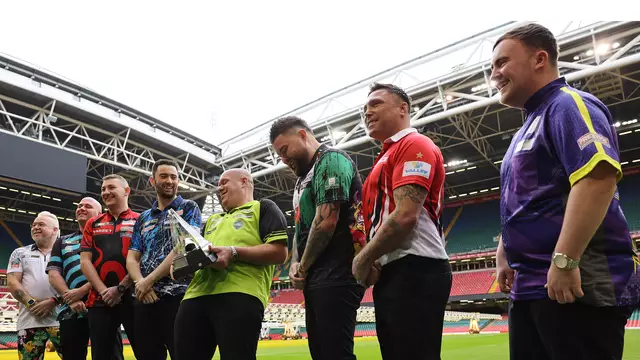
Under the glaring spotlights of the Wolverhampton Civic Hall, where the air crackles with tension and the faint clink of beer glasses echoes like distant applause, the 2018 Grand Slam of Darts final unfolded not just as a battle of arrows, but as a powder keg of passion and provocation. It was November, the kind of crisp evening that draws crowds craving spectacle, and on that stage stood two titans: the unflappable Scottish veteran Gary Anderson and the fiery Welsh upstart Gerwyn Price. What began as a high-stakes showdown for a £250,000 prize pot spiraled into one of the most infamous clashes in darts history, culminating in a penalty so staggering it etched Price’s name into the sport’s annals as the recipient of its largest fine ever. This wasn’t merely a match; it was a seismic event that tested the boundaries of sportsmanship, ignited a firestorm of public outrage, and forced the darts world to confront its growing pains as a global phenomenon.
Gerwyn Price, then a 33-year-old former rugby enforcer with a physique built for the scrum and a temperament to match, entered the Grand Slam as a wildcard hungry for majors. Nicknamed “The Iceman” for his steely demeanor—though skeptics might argue it was more molten lava than frozen resolve—he’d already clashed with Anderson earlier that year in Scotland, a loss that stung like a poorly aimed treble 20. Fast-forward to the final: Price, trailing early, mounted a ferocious comeback, his throws landing with the precision of a sniper. But as the scoreline tightened, so did the atmosphere. Anderson, the chain-smoking Scot known for his deadpan wit and unyielding focus, began to unravel under Price’s relentless energy. What Price described as “animated celebrations” to fire himself up—pumping fists, roaring to the crowd, and occasionally lingering a beat too long at the oche—struck Anderson as deliberate disruption. “I’m throwing my darts, he needs to wait for his turn,” Price would later defend, his voice carrying the gravelly edge of a man unapologetic in victory. “He doesn’t like it when it’s a little bit up him, so unlucky.”
The breaking point came in the 16th leg, with Price edging ahead 10-6. Anderson, visibly seething, shoved Price away from the board in a moment of raw frustration that stunned the arena. The crowd gasped; commentators froze mid-sentence. Price, unfazed, channeled the chaos into fuel, clinching the match 16-12 to claim his first televised major. Jubilation erupted from the Welsh corner, but outside the hall, a digital deluge was brewing. Social media lit up with thousands of complaints— an “unprecedented number,” according to the Darts Regulation Authority (DRA)—accusing Price of gamesmanship, bullying, and dragging the sport’s gentlemanly image through the mud. Anderson, too, faced scrutiny for the push, but his penalty was a mere formal warning, a slap on the wrist compared to what awaited Price.
Weeks later, in the sterile confines of a DRA hearing, the hammer fell. Price was slapped with a record-breaking £21,500 fine—the largest in darts history at the time, dwarfing previous sanctions for on-stage scuffles or off-color remarks. Broken down, it included £12,000 for “bringing the sport into disrepute and gamesmanship” in the final against Anderson, £8,000 for similar antics in his quarter-final demolition of Simon Whitlock, and a sharp £1,500 for inflammatory social media posts post-victory. Those tweets, laced with barbs like jabs at Anderson’s composure—”He can’t handle playing me. He just moans every time that I’m doing this, doing that. Concentrate on your own game”—poured salt into the wound, amplifying the backlash. To cap it off, a three-month suspension hung over Price like a storm cloud, deferred for six months on good behavior. The DRA’s verdict was unequivocal: Price’s actions had crossed from competitive fire into outright interference, defined in their rulebook as “any action carried out by a Player during an Event that is intended to gain an advantage by putting off an opponent.”
Price, ever the fighter, didn’t slink away. He appealed the decision, arguing that his exuberance was passion, not provocation— a release valve for a career spent clawing from rugby fields to dartboards. “It only seems to become a problem when you start winning or start beating people you are not expected to beat,” he shot back in a post-hearing statement, referencing his earlier defeat to Anderson in the player’s backyard. “For example, I played Gary in the Masters, in Scotland in his own backyard in the World Series Finals and I lost to him.” The appeal partially succeeded: the £12,000 and £8,000 fines were halved to £6,000 and £4,000 respectively, trimming the total to £11,500, while the social media penalty stood firm. The suspended ban? Lifted entirely, a nod perhaps to Price’s contrition or the sport’s reluctance to sideline a rising star. “I’m loving it playing on that stage against the best players in the world,” he reflected afterward. “Five, six years ago I was a rugby player, and now I’m pinching money from the professionals’ pockets.” It was classic Price: defiant, humorous, and utterly unbowed.
This saga wasn’t born in a vacuum. Darts, once a smoky pub pastime, had ballooned into a multimillion-pound spectacle by 2018, with the PDC’s prize funds soaring and global audiences tuning in via Sky Sports. The Grand Slam, pitting group winners from other majors against each other, embodied this evolution—a melting pot of styles and stories. Price’s background added layers: a Welsh international rugby league prop who’d traded tackles for trebles, he brought a physicality to the oche that thrilled some and terrified others. His quarter-final against Whitlock had already simmered with tension, Price’s crowd-hyping antics drawing grumbles of favoritism. By the final, it boiled over, exposing fault lines in a sport grappling with its identity. Was Price a villainous agitator, eroding the decorum of legends like Eric Bristow? Or a trailblazer injecting WWE-level drama into a game often criticized as staid? Fans were split: some hailed him as the anti-hero darts needed, others decried him as a bully who’d cheapen the bullseye.
The fallout rippled far beyond the fine. Anderson, nursing grudges and a reputation for straight talk, later quipped that Price’s antics were “like playing darts with a mosquito in the room.” Their rivalry simmered, flaring in subsequent encounters, but it also humanized the pros—reminding viewers that beneath the averages and checkouts beat hearts prone to snap. For Price, the episode was a crucible. He channeled the infamy into redemption, storming to the 2021 PDC World Championship title at Alexandra Palace, dethroning Gary Anderson in a poetic twist of fate. That victory—his first world crown—silenced many doubters, with averages north of 100 and a composure that earned “Iceman” its chill. Today, at 40, Price ranks ninth globally, a three-time world number one whose haul includes the 2019 European Championship and multiple Pro Tour triumphs. Yet, that 2018 fine lingers as a cautionary asterisk, a reminder that in darts’ gilded age, where £5 million prize pots beckon at the 2025/26 Worlds, the line between passion and penalty is thinner than a wire dart.
As the current World Darts Championship unfolds at Ally Pally, with young guns like Luke Littler dazzling and veterans like Michael van Gerwen plotting comebacks, Price’s story resonates. The sport has toughened its code since—stricter social media guidelines, zero-tolerance for physical altercations—but the drama endures. In an era of viral moments and packed arenas, fines like Price’s underscore a truth: darts isn’t just about hitting doubles; it’s about hitting nerves. And for Gerwyn Price, that seismic swing at the Grand Slam didn’t just win him a trophy—it forged a legend, fine and all.
Leave a Reply