
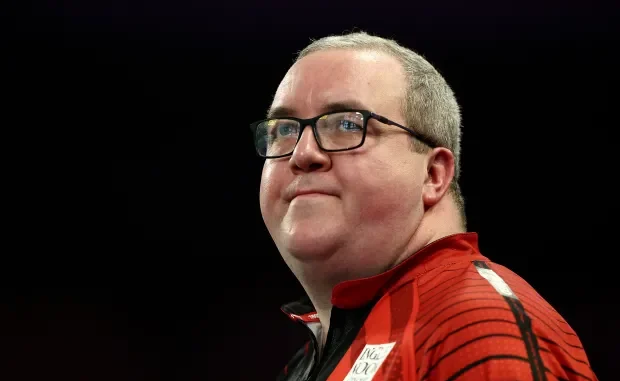
In the electrifying world of professional darts, where precision meets passion under the glare of spotlights, few players embody the raw, unfiltered drive of Stephen Bunting. Known to fans as “The Bullet,” the 40-year-old Liverpudlian has spent two decades hurling arrows at the oche with a blend of surgical accuracy and unyielding grit. But as he stands on the cusp of what could be his crowning glory—the PDC World Darts Championship—Bunting has dropped a bombshell that has the darts community buzzing: he’d walk away from the sport in a heartbeat if it guaranteed him the ultimate prize.
This isn’t idle chatter from a player content with mediocrity. Bunting, who clinched the BDO World Championship back in 2014 at the iconic Lakeside, has long been a figure of redemption and resurgence. That early triumph, a 7-4 victory over Alan “Chuck” Norris in the final, catapulted him to global fame and prompted his bold switch to the PDC circuit later that year. Yet, the transition wasn’t seamless. What followed was a rollercoaster of highs and harrowing lows, testing the very core of his resolve.
Picture this: a once-celebrated champion stepping into arenas feeling the weight of invisible judgment. Five or six years ago, during a brutal three-year drought at the World Championship where he couldn’t even advance past the early rounds, Bunting hit rock bottom. “I was walking into venues feeling like people were laughing at me and I just didn’t want to be there anymore,” he confessed in a raw moment of vulnerability. The frustration boiled over at home, straining relationships with his family as the man who once dreamed of glory grappled with self-doubt. Darts, his lifelong love, had become a tormentor, whispering failures with every missed double.
It was in this darkness that Bunting turned to an unlikely savior: a sports psychologist and hypnotist. Skeptical at first—”I was against it,” he admitted—he soon found the sessions transformative. “He trained my brain to think about the positives, because every time I was playing darts it was all negative,” Bunting explained. The therapy wasn’t just about darts; it delved deeper, urging him to cherish life’s anchors—family, home, the simple joys beyond the board. “I know they say in Peter Pan you think about happy stuff and you can fly but it is the same sort of logic in darts. If you turn up and are feeling happy and good then you can win anything.” Suddenly, the oche became a canvas for possibility rather than punishment. The Bullet was reloaded.
The revival was nothing short of spectacular. In 2024, Bunting stormed to his first PDC major title at The Masters in Milton Keynes, a tournament that showcased his unshakeable form. He edged out Ross Smith 6-5 in a nail-biter, then dismantled reigning world champion Luke Humphries 10-7, followed by a commanding quarterfinal demolition of two-time Ally Pally king Peter Wright. Nathan Aspinall fell in the semis, setting up a revenge-fueled final against Michael van Gerwen, whom Bunting had lost to in the World Championship fourth round just weeks earlier. With the crowd roaring to the infectious beats of his walk-on anthem “Titanium” by David Guetta, Bunting sealed an 11-7 victory, his smooth throw and mental fortitude proving unbreakable. “As you can see I am a champion now, so I’m just happy,” he beamed post-match, the weight of a decade lifting from his shoulders.
But 2024 was merely the appetizer. The 2025 season has seen Bunting evolve into a juggernaut, rewriting his legacy with ruthless efficiency. He shattered records by becoming only the third player in PDC history to snag at least two Players Championships, two European Tour events, and two World Series titles in a single year. His maiden World Series crown came in Bahrain, where he outclassed Gerwyn Price 8-4 in the final, pocketing a handsome payday and silencing doubters. April brought another gem: the International Darts Open in Germany, where he toppled compatriot Nathan Aspinall 8-5 for a £30,000 haul. Then came the Nordic Darts Masters, another World Series scalp that underscored his global dominance.
Statistically, Bunting is firing on all cylinders. He closed out the ProTour season with the highest average of any player— a blistering 99.02—edging out the likes of Luke Littler and Michael van Gerwen. His highest recorded average hit an eye-watering 117.12, a testament to the precision that earned him the nickname “The Bullet.” At the PDC World Darts Championship, he’s no stranger to the deep runs: semifinals in 2021 and again in 2025, quarterfinals at the World Matchplay that same year, and a semifinal berth at the Grand Slam in 2023. Even as a final substitute in the Premier League, he made his mark, proving he’s no mere wildcard but a genuine contender.
Now, as the Alexandra Palace lights beckon for the 2026 showdown—though the echoes of 2025’s semi-final heartbreak still linger—Bunting’s declaration carries extra weight. “I would quit darts instantly if it meant winning the ultimate prize,” he stated flatly, his eyes alight with that familiar fire. It’s a sentiment born not from burnout, but from an insatiable hunger. The PDC world title, with its £500,000 winner’s check and eternal bragging rights, represents the missing piece in a career already brimming with silverware. Bunting, who estimates his net worth at around £1.8 million from prize money and endorsements, isn’t chasing cash—he’s chasing immortality.
For fans, this is the thrill of darts distilled: a sport where a 40-year-old from Merseyside can hypnotize his way back from the brink, average triple-digits like it’s child’s play, and rally crowds with his #LetsGoBuntingMental mantra. Bunting’s journey isn’t just about arrows hitting the wire; it’s a narrative of mental metamorphosis, family-fueled comebacks, and a refusal to settle. As he prepares to lace up for another assault on Ally Pally, one thing is clear: The Bullet isn’t slowing down. Whether he claims that elusive PDC crown or not, his story reminds us that in darts—and in life—the greatest finishes often come after the toughest misses.
Leave a Reply