
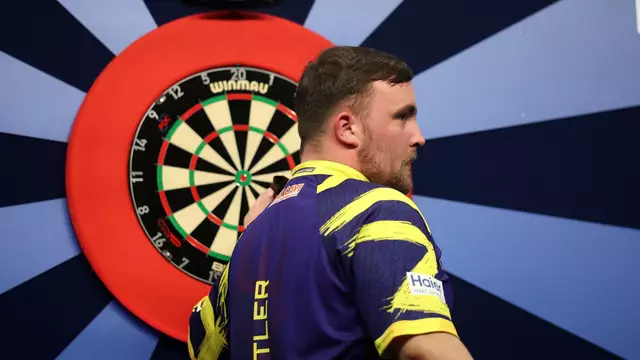
In the electrifying world of professional darts, where precision meets unyielding pressure and every throw can rewrite a player’s destiny, few stories capture the imagination quite like that of Luke Littler. At just 17 years old, the Warrington wonder boy has already etched his name into the sport’s glittering hall of fame. His latest triumph—a stunning victory over three-time world champion Michael van Gerwen in the 2025 PDC World Darts Championship final at London’s Alexandra Palace—has solidified his status as the youngest ever winner of the prestigious title. Lifting the Sid Waddell Trophy after a nerve-shredding showdown, Littler avenged his heartbreaking runner-up finish from the previous year against Luke Humphries, pocketing a cool £500,000 in prize money and cementing his place as darts’ brightest supernova.
But behind this meteoric rise lies a chapter of raw, unfiltered ambition that began not in the spotlight of global arenas, but in the modest confines of a local youth academy in St. Helens. It was here, under the watchful eye of coach Karl Holden, that Littler’s prodigious talent first sparked to life. Joining the St. Helens Darts Academy at the tender age of nine, the young Littler quickly outgrew his peers, his arrows finding the board with a consistency that bordered on the supernatural. By 13, he wasn’t just competing—he was dominating. Yet, in a decision that might seem counterintuitive to outsiders, Holden made the bold call to “get rid” of his star pupil, banishing him from the very club that had nurtured his early skills. It was a moment of tough love, one that Holden later described as essential for the boy’s evolution from promising junior to world-beater.
Reflecting on that pivotal juncture, Holden didn’t mince words. “It might sound bad but we sort of got rid of him out of the academy,” he admitted, his tone laced with the affection of a mentor who knew the stakes. “He knows we didn’t mean that in a nasty way, but it was more like ‘Don’t come here no more, you’re just too good’.” The reasoning was starkly pragmatic: Littler had surpassed the Under-21 level so emphatically that staying would stifle his growth. “When he was 13 he was just too good for the Under-21s. He was never going to achieve anything there so we were saying ‘Go and beat all the men in the world’. And that’s what he’s doing, hopefully tonight, every one of them.” This wasn’t rejection; it was propulsion. Kicked out to “pursue pastures new,” Littler was thrust into the unforgiving senior circuit, where county players and seasoned pros awaited, ready to test his mettle.
The impact of this bold move cannot be overstated. Darts, for all its mathematical elegance, is a game of the mind as much as the arm. It demands not just technical prowess but an ironclad mentality forged in the fires of repeated failure. Holden, who had guided Littler through those formative years, emphasized the psychological grind that separates the good from the great. “You need bottle, you need composure, you need to put the hours in as well,” he explained. “He has spent thousands of hours losing against proper seasoned competitors in darts and county players.” Those grueling sessions, where defeat after defeat hammered home the sting of loss, built the resilience that Littler now wields like a weapon. “You need to learn to win and to win you have got to learn to lose, and when you lose you don’t like it. That’s when you start winning.”
Littler’s journey from academy exile to Ally Pally hero is a masterclass in accelerated maturity. Barely a teenager when he was shown the door at St. Helens, he dove headfirst into adult leagues, facing opponents old enough to be his parents—and often twice as grizzled. Early outings were brutal: averages in the low 80s, missed doubles that turned matches on their head, and the quiet humiliation of walking away empty-handed. But each setback was a lesson etched into his muscle memory. “If you know you have to hit that double, if you’ve not got the confidence then [you’re] done. You need to hit that double or you won’t hit it in darts, you simply won’t do it,” Holden noted, capturing the razor-thin margin between glory and heartbreak.
Fast forward to the present, and Littler’s transformation is nothing short of legendary. His path to the 2025 world title was a gauntlet of high-stakes drama. In the semi-finals, he dismantled a resurgent Stephen Bunting with clinical efficiency, his checkout percentage hovering near 50% as the Welshman’s challenge fizzled out. The final against van Gerwen, a Dutch dynamo with a trophy cabinet groaning under the weight of his achievements, was a clash of eras: the grizzled veteran versus the fearless phenom. Littler, unfazed by the roar of 3,000 spectators or the ghosts of past champions, averaged over 100 across key legs, sealing the win with a majestic 170 checkout that sent the crowd into delirium. At 17, he wasn’t just competing—he was redefining what it means to be a darts prodigy.
For Holden and the St. Helens faithful, the victory tastes especially sweet. “Every dart player has a dream to be world champion but I think I’m well past that stage now,” Holden shared, his pride palpable. “So I think for our committee, it’s a dream for us to produce a world champion. I don’t think there can be a better feeling than that.” Littler, ever the gracious star, has made it clear that the academy’s faith never wavered. Despite the “banishment,” the bond endures; messages of support flooded in from his old stomping grounds as he edged closer to immortality.
Yet, Littler’s story extends beyond the oche. Off the board, he’s navigated the whirlwind of fame with a maturity that belies his youth. From lucrative sponsorships with brands like Target Darts—which has backed him since he was 12—to the personal milestones of balancing tournaments with schoolwork, he’s become a role model for aspiring throwers everywhere. His recent split from long-time management agency ZXF Sports, announced ahead of the World Grand Prix in October, underscores his growing independence. “I’m on my own. Just myself—I think it’s better that way. I’ve got my family to support me,” he revealed post-match, crediting the change with sharpening his focus amid a schedule packed with flights, hotels, and high-pressure events.
As 2025 draws to a close, with the current date marking December 10 and the echoes of Ally Pally still ringing, Littler’s coronation feels like the dawn of a new era in darts. What began as a coach’s calculated gamble—ejecting a too-talented teen from the safety of youth ranks—has bloomed into a legacy of audacious success. In a sport where legends are made by the breadth of an arrow’s flight, Littler’s arc reminds us that true champions aren’t just born; they’re built through bold decisions, bitter losses, and the relentless pursuit of something greater. With van Gerwen conquered and Humphries avenged, the question on every fan’s lips isn’t if Littler will dominate, but how long his reign will last. One thing’s certain: the boy they once “got rid of” is now the man no one can catch.
Leave a Reply