
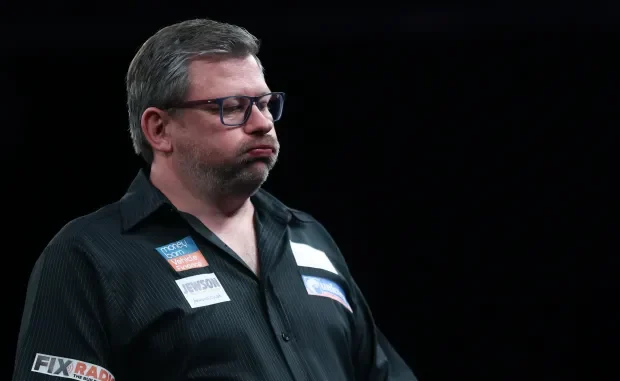
Under the pulsating lights of Alexandra Palace, where the air hums with the sharp crack of arrows hitting the board and the roar of a crowd hungry for legends, James Wade has long been the unflinching heartbeat of professional darts. Known as “The Machine” for his robotic precision and stoic gaze, the 42-year-old Englishman has carved a career that’s a testament to dominance without completion. Eleven major PDC titles adorn his shelf—World Matchplay, World Grand Prix, three UK Opens, European Championship, Premier League, and more—yet the one prize that defines immortality in this sport, the PDC World Darts Championship, remains a ghost in the oche. Four times he’s stormed to the semi-finals (in 2009, 2012, 2013, and 2022), only to watch the Sid Waddell Trophy slip through his fingers like a missed double. Now, as the 2025/26 Worlds rage on in London, Wade has laid bare a startling confession: the barrier isn’t skill, stamina, or strategy. It’s something far more human—a surprise “weakness” rooted in the soul-crushing pressure of the big stage.
Wade’s odyssey in darts reads like a saga of near-perfection. Bursting from the pubs of Basingstoke at age 14, he turned pro with the PDC in 2004, wasting no time in etching his name into history. By 2007, he’d claimed his first major, the World Matchplay, and followed it with the World Grand Prix, all while pioneering as the sport’s premier left-hander. His throws are poetry in motion: effortless 180s, laser-guided checkouts, and an average that once peaked him at world No. 2 in 2010. He’s the third-most decorated player ever, trailing only Phil Taylor and Michael van Gerwen, with 40 PDC titles under his belt. Yet, Ally Pally has been his personal crucible. “The World Championship remains an emotionally charged tournament for me,” Wade admitted in a recent interview, his voice steady but laced with the ache of what-ifs. Those semi-final heartbreaks—edged out by Adrian Lewis in 2012 after a nine-dart tease, or falling to Gary Anderson in 2013—have left scars that no amount of European Tour triumphs can erase.
But here’s the revelation that’s sending ripples through the darts world: Wade’s Achilles’ heel isn’t a technical glitch or a rival’s hot streak. It’s the invisible weight of expectation, amplified by his own unyielding quest for approval. “If I am completely honest, I have stopped worrying so much about pleasing so many people and doing more and more,” he confessed, peeling back layers of a mindset that’s haunted him for years. This admission cuts deep in a sport where mental steel separates champions from chasers. Wade, ever the introspective warrior, traces it back to the relentless scrutiny of Ally Pally’s cauldron. The crowds, the cameras, the ghosts of past failures—they pile on, turning his mechanical calm into a pressure cooker. It’s why, despite blistering form in floor events like the recent Players Championships where he sliced to the quarter-finals, the Worlds have become a Bermuda Triangle for his title dreams. “Now, I am just doing my thing,” he added, a quiet rebellion against the noise that’s defined his career.
This vulnerability isn’t born in isolation; it’s woven into Wade’s fabric as a man balancing the dartboard with fatherhood. With four children tugging at his priorities, the grind of endless travel—from New York’s Madison Square Garden to Dublin’s emerald greens—has taken its toll. A health scare earlier this year, where he was rushed to hospital mid-tournament in Leverkusen, served as a brutal wake-up call. “This is not an exaggeration… I knew I was ill, but I didn’t realise how ill I was,” he revealed, the memory still raw. That episode, coupled with bipolar challenges he’s openly battled, underscores how the mental load of chasing majors exacerbates his “weakness.” Yet, it’s also forged resilience. Wade’s resurgence this season—climbing to seventh in the PDC Order of Merit—shows a player unshackled, focusing on personal benchmarks over public acclaim. He’s questioned the “hyped up” state of modern darts, where prodigies like 18-year-old Luke Littler dazzle with raw talent but, in Wade’s eyes, sometimes lack the grind. “Luke Littler is brilliant, but lazy!” Wade quipped recently, half-jest, half-admonition, while tipping the teen for deeper runs despite tough draws.
As the Worlds progress, Wade’s opener against Japan’s Ryusei Azemoto on December 18 looms large—a clash of veteran poise versus youthful fire. Should he navigate it, the path to redemption sharpens. But this confession reframes his narrative: “The Machine” isn’t broken; he’s human, recalibrating under the weight of legacy. He’s vowed not to let family slip away in pursuit of one more shot, mooting retirement in four to seven years to sidestep the pitfalls of overstaying, like some peers who’ve lingered past their prime amid emotional U-turns. “I have stopped caring so much that people don’t know. I have realised it is not that important compared to what I am doing for myself and my family,” he said, a mantra that’s liberating him leg by leg.
In a field teeming with titans—van Gerwen’s predatory hunger, Gerwyn Price’s explosive power, and Littler’s prodigious spark—Wade’s candor stands out. It’s a reminder that greatness isn’t flawless; it’s forged in the fire of admitted frailties. Whether he conquers his weakness this Christmas, checking out the elusive world crown to “cement my legacy,” or bows out with head high, Wade’s story transcends scores. It’s about the courage to name the shadow that’s stalked you, then stepping up anyway. As arrows fly and crowds chant, “The Machine” whirs on—not invincible, but unbreakable in his honesty. In darts’ glittering arena, that’s the real bullseye.
Leave a Reply