
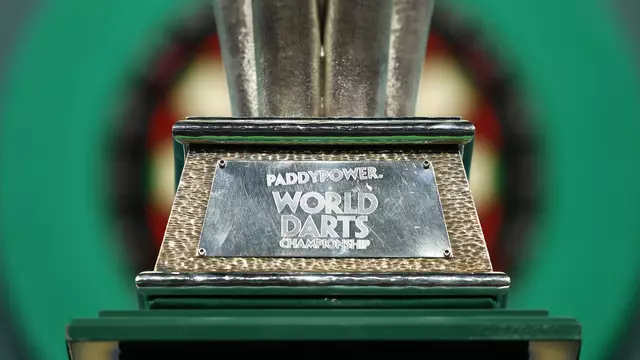
In the high-stakes arena of professional darts, where the sharp crack of arrows meeting board echoes like thunder and fortunes pivot on the flick of a wrist, few figures loom as large—or as enigmatic—as Gary Anderson. The Flying Scotsman, as he’s affectionately known, has etched his name into the sport’s pantheon with two world titles, a barrel chest of major honors, and a reputation for throwing with the ferocity of a Highland storm. Yet, as the 2025/26 PDC World Darts Championship ignites at London’s Alexandra Palace on December 15, Anderson finds himself at a crossroads that’s equal parts defiant and poignant. Even if he storms the Ally Pally to claim a third world crown—a feat that would cement his legacy alongside the immortals—he’s made it crystal clear: the grueling grind of the Premier League Darts holds no allure. “No. Even if I win the Worlds,” he declared flatly this week, his Edinburgh brogue cutting through the chatter like a well-aimed treble 20.
It’s a statement that ripples through the darting world, stirring debates in pubs from Musselburgh to Manchester. The Premier League, darts’ gladiatorial showcase, isn’t just a tournament; it’s a 17-night odyssey of jet-lagged showdowns across continents, from Cardiff’s raucous Motorpoint Arena to Berlin’s gleaming Uber Arena, culminating in a £1 million prize pot where the victor pockets £275,000. For the uninitiated, picture eight elite throwers locked in a weekly cage match: league points tallied, mini-tournaments crowning nightly kings, and egos clashing under blinding spotlights. It’s the PDC’s cash cow, broadcast to millions on Sky Sports, blending athletic precision with rock-star spectacle. But for Anderson, at 55, it’s a bridge too far—a relentless treadmill that clashes with his hard-won rhythm of selective brilliance.
Anderson’s darts odyssey is the stuff of legend, a tale of grit forged in the smoky pubs of Scotland before exploding onto the global stage. Born in 1970 in Musselburgh, he traded a life in construction for the oche in the early ’90s, grinding through the BDO ranks before defecting to the PDC in 2011—a move that raised eyebrows but proved prophetic. His breakthrough came in 2015, when he dismantled Phil Taylor in the World Grand Prix, but it was 2016 that redefined him: a nine-darter en route to UK Open glory, followed by a World Championship triumph where he averaged over 100 in the final against Adrian Lewis. “The Iceman,” they called him, for his unflappable cool under fire. He doubled down in 2018, lifting the Worlds again against Peter Wright in a Scottish civil war that had fans roaring. Yet, for all his firepower—180s like cannon blasts, checkouts that defy gravity—Anderson has always been selective, a connoisseur of majors over the marathon.
This philosophy crystallized in a candid sit-down earlier this week, amid the festive buzz of Edinburgh. Over pints in a cozy local, the two-time champ unpacked his mindset with the blunt humor that’s endeared him to fans. The Worlds, he admitted, still stirs the competitive beast within. Drawn against Adam Hunt in the opening round—a lad he knows from shared management days under the same stable—Anderson dismissed any complacency. “Adam is a good little player,” he said, a glint of respect in his eye. Hunt, the 27-year-old qualifier with a penchant for upsets, represents the new blood challenging the old guard. But Anderson’s expectations? Tempered, as always. “Ally Pally and Gary Anderson remain a special pairing,” he mused, evoking memories of past triumphs under the iconic venue’s chandeliers. “But walking away entirely? Not yet.” Retirement whispers have swirled for years, but he swatted them aside with a grin. “If I win the Worlds, maybe I have a year off.” A pause, then the kicker: “I’m still in the top 16. Don’t play everything. Miss things. It’s not bad, is it?”
That top-16 perch—currently hovering around No. 12 on the PDC Order of Merit—is no accident. Anderson’s strategy is surgical: cherry-pick the TV majors like the World Matchplay (where he reached the semis in 2024) and Players Championship Finals, while skipping the floor-slogging ProTour events that drain lesser souls. It’s a blueprint that’s kept him relevant without burnout, amassing over £2 million in career earnings. But the Premier League? That’s the beast he tamed twice—finishing runner-up in 2011 and 2013—but now views as a young man’s folly. The format, revamped in 2022 to its lean eight-player field, demands unwavering commitment: weekly travel, media scrums, and the psychological toll of constant exposure. For Anderson, who’s battled back injuries and the mental fog of form slumps, it’s a non-starter. “Talent without ambition is like a bird without wings,” he quipped, echoing a darts axiom that cuts both ways—his ambition is fierce, but laser-focused.
This stance underscores a broader tension in darts’ golden era. The sport is booming, with Luke Littler’s teenage wizardry drawing Gen Z crowds and global viewership spiking 30% year-over-year. The Worlds itself boasts a £2.5 million pot, double last season’s, with seeds like world No. 1 Luke Humphries and defending champ Michael van Gerwen eyeing the £500,000 top prize. Yet, as the field swells with talents like Josh Rock and Gian van Veen, veterans like Anderson embody the old-school ethos: quality over quantity. His peers feel the pull differently—Wright, his eternal rival, thrives on the Premier League’s chaos, while Humphries chases a triple crown. Anderson? He’s content plotting his Ally Pally assault, where a deep run could net £100,000 and a rankings boost without the league’s baggage.
Fans, though, ache for one last hurrah. Social media buzzes with pleas: #BringBackTheIceman trends on X, with clips of his 2016 nine-darter racking up millions of views. “Gary in the Prem would be electric,” one supporter posted, dreaming of a Scottish showdown with Littler. But Anderson’s resolve is ironclad, a reminder that legends don’t fade—they choose their finale. As the championship dawns, with its electric atmosphere of bagpipes, beer, and blistering averages, all eyes turn to the Flying Scotsman. Can he summon one more miracle, rewriting his story without bending to the Premier League’s siren call? In a sport where every leg is a gamble, Anderson’s gamble is on himself—selective, unyielding, and utterly Scottish.
For now, he preps in quiet determination, far from the league’s glare. Win or lose at Ally Pally, his legacy soars untouched. And if that third title comes? Expect a wry toast, not a league contract. After all, as Anderson might say, why chain a bird with wings?
Leave a Reply