
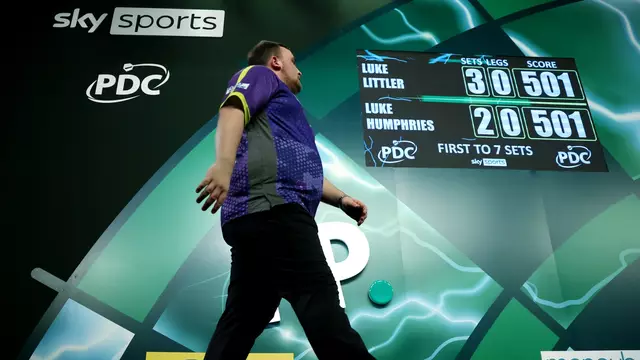
Under the glittering chandeliers of London’s Alexandra Palace, where the air hums with the electric buzz of anticipation and the sharp *thwack* of darts hitting sisal, the PDC World Darts Championship unfolds like a high-stakes symphony of precision and pandemonium. It’s December 2025, and as the tournament kicks off its grueling 32-leg odyssey toward a £500,000 prize, newcomers and die-hards alike find themselves glued to the screens, marveling at the likes of defending champion Luke Humphries and teenage sensation Luke Littler as they weave their way down from that peculiar starting score: 501. Not 500, mind you—the clean, even number that feels so intuitively right. Why 501? It’s a question that’s tripped up casual fans for generations, sparking late-night pub debates and viral social media threads. The answer, as it turns out, is a masterstroke of game design that injects chaos into order, ensuring every leg is a rollercoaster of strategy, blunders, and breathtaking finishes. Far from some arbitrary relic, this odd-numbered launchpad is the secret sauce that elevates darts from mere target practice to a psychological battlefield.
Picture the oche—the throwing line etched in tradition—where players like Humphries, with his unflappable cool, or Littler, the prodigy who’s already rewriting records at 18, step up to unleash their arsenal of tungsten-tipped fury. Each leg begins with both competitors pegged at 501, that defiant one tacked onto a tidy 500. The goal? Subtract your way to zero, but not just any zero. You must seal the deal on a double—be it the slender outer ring of any number segment or the bullseye’s seductive center. It’s a rule as old as the sport’s modern incarnation, born in the smoky taverns of 19th-century England, where archers honed their aim on cork targets scavenged from elm tree trunks. Those early boards, with their spiraling growth rings inspiring the segmented layout we know today, demanded ingenuity to keep games fair and fierce. Enter 501: a deliberate wrinkle designed to thwart the pros’ relentless pursuit of perfection.
The genius lies in the math, simple yet sly. Darts scoring is a tapestry of evens and odds—singles for the broad sectors, doubles for the edges that double the bounty, trebles for the inner rings that triple the joy. A double always yields an even score: double 20 for 40 points, double 16 for 32, even the outer bull for a crisp 25 (odd? Wait, no—the inner bull is 50, even; outer 25 is the exception, but it still fits the parity puzzle). Starting at an even 500 would let elite players laser-focus on the treble 20 bed, that golden wedge worth 60 points a pop. Rack up enough 180s—three treble 20s in a row—and you’d whittle down to zero without ever straying from that one slice of the board. “If the game started at 500, then players would simply aim for 20 in order to win without ever having to hit an odd number,” explains one darts aficionado, capturing the essence of the boredom that could ensue. A nine-darter—the holy grail of three darts finishing 501 in nine perfect throws—might become as routine as a coffee run, hit solely on 20s, diminishing its mythic status.
But crank it to 501, and suddenly parity rears its head. You’re odd to start, so to land on an even double for the win, you must hit at least one odd score along the way—perhaps a single 19 (19 points) or a wayward dart in the 5 or 7. It scatters your strategy like pins in a bowling alley upset. No more camping on the 20; now you’re dancing across the board, probing 18s, 16s, even the lowly 1 if desperation calls. This forced variety isn’t just tactical—it’s theatrical. Legs stretch and twist unpredictably, birthing those edge-of-your-seat moments where a player teeters on 32, eyeing double 16, only to bust with a single 18 and hand the advantage to their foe. “Starting with an odd number and finishing with a double means you have to get to an even number—so you have hit an odd number before your last dart. It makes things more difficult,” notes a veteran observer, whose words echo the frustration and fire this rule ignites. In the cauldron of Ally Pally, where crowds chant like ancient warriors, this quirk ensures no leg is a foregone conclusion, even against the gods of the game.
Delve deeper into darts’ lore, and you’ll find 501 isn’t the only oddball in the family. In softer, social settings—think amateur pub leagues or the cozy corners of a family game night—301 reigns supreme, a shorter sprint that demands a double to even *start* scoring. “FWIW, before the professional circuit started, the normal game was 301, double start, double finish—no score until you hit a double!!” recalls one old-timer, painting a picture of yesteryear’s rigor. That double-in, double-out gauntlet weeded out the casuals, but as darts professionalized in the mid-20th century under the PDC’s watchful eye, 501 emerged as the sweet spot: long enough for epics, punishing enough for parity. It sprouted from the same soil as the board itself—those elm trunks, harvested for their dense end-grain to grip errant darts, evolved into today’s sisal fibers from agave plants, but the spirit of challenge endures. Tournament formats tweak it—shorter 301 for qualifiers, marathon 1001 sets for finals—but 501 remains the heartbeat, pulsing through every World Championship showdown.
This year, as Humphries defends his crown against a field swollen with international flair—from Japan’s rising star Ryusei Goto to Germany’s Martin Schindler—the 501 rule feels more vital than ever. Littler, the Berlin-bred wonder who clinched the 2024 title at a mere 17, has spoken of how it sharpens his mental edge: the constant recalibration, the board-wide awareness, turning each throw into a chess move. Fans, too, revel in it; social feeds light up with clips of busted finishes, where a 501 opener spirals into a 15-dart nail-biter. It’s what separates darts from billiards’ straight lines or golf’s patient plods—a game where fortune favors the adaptable, and one rogue odd can crown a king or crush a contender.
Yet, for all its logic, 501’s charm is in its subtle subversion. It whispers that perfection is a myth, that even the straightest arrow curves under pressure. As the Ally Pally fog rolls in and pyrotechnics salute each walk-on, this odd starting gun levels the legends with the hopefuls, ensuring the sport’s soul—raw, rhythmic, relentlessly human—stays forever on target. Next time you watch a leg ignite, raise a glass to that extra one: it’s the spark that keeps the fire roaring.
Leave a Reply