
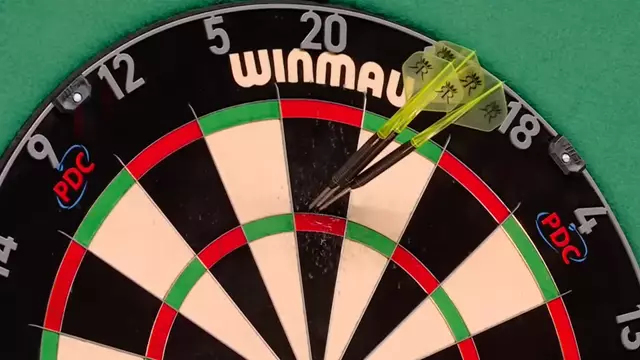
The electric atmosphere of London’s Alexandra Palace was in full swing during a gripping first-round encounter at the 2025/26 PDC World Darts Championship, where veteran Australian star Simon Whitlock faced off against England’s rising talent Connor Scutt. What started as a high-quality battle of precision and power quickly drew attention for an unexpected reason: the severe battering the dartboard endured throughout the match, leaving fans and viewers alike pointing out significant damage that raised questions about equipment durability on the biggest stage.
The contest itself was a rollercoaster, showcasing the best of darts drama. Scutt, known for his heavy scoring, raced into a commanding 2-0 lead in sets, putting the pressure on the 56-year-old Whitlock, a former World Championship finalist and longtime crowd favorite nicknamed “The Wizard.” But Whitlock, drawing on his vast experience at Ally Pally, mounted an inspiring comeback. He ignited the crowd with a spectacular 167 checkout on the bullseye to claim the third set, after Scutt had squandered four darts at a match-winning double. The momentum shifted further as Whitlock nearly landed an even rarer 170 finish but narrowly missed the bull, yet he still forced a deciding set by leveling at 2-2.
In the decider, Whitlock broke throw early to take the lead for the first time, sending waves of nostalgia through the venue as fans remembered his glory days. However, Scutt rediscovered his composure, reeling off three consecutive legs—including a crucial 89 checkout—to seal a hard-fought 3-2 victory and advance to the next round. It was a match filled with high averages, big finishes, and tense moments on doubles, embodying the unpredictable magic that makes the World Championship so captivating.
Yet, amid the on-stage heroics, eagle-eyed fans watching at home and in the arena couldn’t ignore the state of the dartboard. As the match progressed, particularly during the heavy-scoring exchanges, the board appeared increasingly ravaged. Known for his powerful throw and sharply pointed darts, Whitlock’s style seemed to exacerbate the issue, with darts embedding deeply and creating noticeable holes and wear in key areas like the treble 20 and bullseye regions. By the later sets, close-up camera shots revealed a pockmarked surface, with enlarged holes that some spectators worried could affect dart retention or even lead to more bounce-outs in subsequent games.
Social media buzzed with reactions as fans shared screenshots and clips, highlighting how the board had “taken an absolute battering.” Many expressed concern that the damage might compromise fairness, especially in a sport where consistency of equipment is crucial. “That board looks like it’s been through a war—huge holes everywhere!” one viewer posted, echoing a common sentiment. Others noted how the intense scoring from both players, combined with the pointed design of modern darts, had accelerated the wear far beyond the usual.
This isn’t the first time dartboard condition has sparked debate at major tournaments. Professional setups use high-quality sisal boards designed to self-heal to some extent, but under the relentless assault of top-level play—especially from power scorers—the fibers can break down quickly. In high-stakes events like the World Championship, boards are typically rotated or replaced between matches to maintain standards, but the visible deterioration in this encounter prompted questions about whether more frequent changes are needed during particularly punishing games.
Whitlock, reflecting on his performance post-match, remained philosophical despite the narrow defeat. He praised the quality of the contest and hinted at renewed confidence after overcoming recent challenges. Scutt, meanwhile, acknowledged the toughness of his opponent and the electric Ally Pally crowd that always elevates these battles. Neither player directly commented on the board’s condition, focusing instead on the thrilling nature of the tie.
The incident has reignited discussions within the darts community about equipment evolution. Some fans and analysts suggest exploring new board materials or point regulations to balance player styles with longevity, ensuring the focus remains on skill rather than external factors. Others argue it’s part of the sport’s raw appeal—darts is a game of precision under pressure, and boards bearing the scars of battle add to the authenticity.
As the tournament rolls on with bigger names and higher stakes, this early-round spectacle serves as a reminder of why the World Championship captivates millions: unpredictable comebacks, crowd fervor, and even the occasional spotlight on the humble dartboard itself. For Scutt, the win propels him forward with momentum; for Whitlock, it was a valiant display that reaffirmed his enduring passion. And for fans, it was another unforgettable chapter in the Ally Pally story, damage and all.
Leave a Reply