
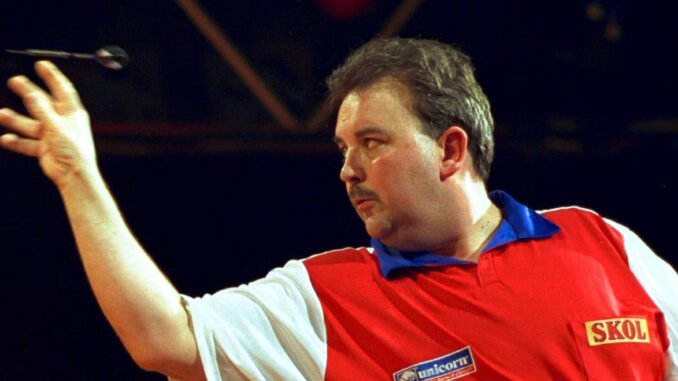
In the annals of darts history, few moments capture the imagination quite like the rare achievement of a 240-point visit. This extraordinary score, impossible on today’s standard boards, was once within reach during a brief experimental era in the early 1990s. At the heart of this fleeting innovation stood Phil Taylor, the undisputed king of the sport, whose precision and power allowed him to etch his name into an exclusive club of players who mastered the maximum under these unique rules.
Known affectionately as “The Power,” Taylor dominated darts for decades, claiming a staggering 16 World Championships and over 200 professional titles. His career is littered with records: the most televised nine-dart finishes at 11, the first player to hit two perfect legs in a single match, and an unrivaled consistency that made him the benchmark for greatness. Yet, one of his most intriguing feats came not from a standard treble 20 barrage but from a short-lived twist on the game itself.
Back in 1993, during the Skol UK Matchplay held at the Aquarius Club in Chesterfield, the tournament experimented with a revolutionary dartboard called the Quadro. Introduced just a year earlier by Harrows Darts Technology, this board featured an additional ring nestled between the treble and the double bull, creating a quadruple scoring zone. Suddenly, the familiar maximum of three treble 20s yielding 180 became obsolete. In its place, players could aim for quadruple 20s worth 80 points each, pushing the theoretical three-dart ceiling to an eye-watering 240.
The atmosphere in that Chesterfield venue must have been electric as top players adapted to this new reality. The Quadro board opened up thrilling possibilities, like potential eight-dart legs or a highest checkout of 210 via two quadruple 20s and a bullseye. But it also brought challenges—many players found the myriad new finishing combinations confusing and hard to memorize, leading to hesitation at crucial moments.
It was in this groundbreaking setting that Taylor faced off against the charismatic Scottish legend Jocky Wilson. As Taylor stepped to the oche, the crowd held its breath. With flawless rhythm, he unleashed three darts, each finding the narrow quadruple 20 bed. The referee’s call echoed through the hall: “Two-Hundred and Forty!” The arena erupted. This wasn’t just a high score; it was the absolute maximum, a perfect visit that showcased Taylor’s unparalleled accuracy and adaptability.
Taylor’s 240 is believed to be the second such score ever captured on television, following one by Wilson himself earlier in the event. Over the course of the tournament, a handful of others joined this elite group, including Shayne Burgess, Bob Anderson, and Peter Evison. Yet, Taylor’s effort stood out, a testament to his ability to thrive amid change. Ironically, while Wilson advanced to the final—only to fall 6-1 to Dennis Priestley—Taylor’s moment became the enduring highlight, a glimpse of what darts could have been.
The Quadro experiment didn’t last long. Despite the excitement of higher scores and faster games, players largely resisted the change, preferring the familiarity and tradition of the standard board. By the mid-1990s, the Quadro faded into obscurity, taking the 240 maximum with it. Today, even rising stars like Luke Littler, whose meteoric rise has revitalized the sport, or veterans like Michael van Gerwen, will never replicate this feat in professional competition. A modern recreation of the Quadro board has recently hit the market for enthusiasts to try at home, but the PDC has no plans to revive it officially.
Looking back, Taylor’s 240 symbolizes an era of bold innovation in darts, a time when the sport teetered on the edge of transformation. It reminds us why “The Power” is revered not just for his trophies, but for his mastery in any condition thrown at him. In a game defined by precision under pressure, that single visit in 1993 remains one of the rarest jewels in darts lore—a maximum score that time, and the return to tradition, rendered forever unattainable.
Leave a Reply