
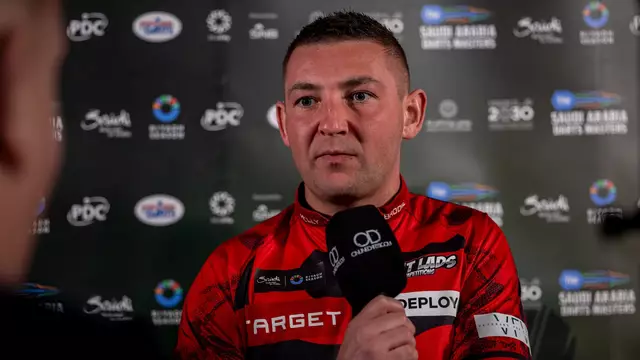
The **Saudi Arabia Darts Masters** continued to generate headlines beyond the oche as the Professional Darts Corporation (PDC) addressed controversy sparked by Nathan Aspinall’s candid assessment of the tournament’s crowd. The inaugural event in Riyadh, held at the 1,000-capacity Global Theatre, represented darts’ ambitious push into a new market, blending elite PDC talent with Asian Tour players in a fresh World Series format. Yet the subdued atmosphere—marked by no alcohol, minimal chanting, and attendees new to the sport—drew scrutiny, particularly after Aspinall’s post-match remarks following his dominant 6-1 first-round win over Lourence Ilagan.
Aspinall, the world No. 14 and a former UK Open champion, didn’t mince words about the differences from traditional darts venues. “It’s certainly different,” he said. “I’m not stupid. I feel like they were not all there of their own accord, shall we say, and it was quite a small venue.” He acknowledged the novelty, adding, “There is definitely a long way to go,” while emphasizing that growth takes time. Despite his reservations, Aspinall found positives in the experience. “But you know what, I enjoyed it,” he noted. “Whenever I looked out into the crowd, you could actually tell they were watching it.” He even laughed about cultural misunderstandings, recalling how spectators clapped enthusiastically after a single dart hit treble 20, even with two darts left in hand. On the potential for future events, he remained open-minded: “Everything needs to start somewhere and as long as people walk away from this week and say, ‘we really enjoyed the darts’ and the Saudi Arabian press really enjoy the darts there is no reason why not. I’ve enjoyed my time out here so far, there is worse places to be. I could be sat in Glossop in the snow, so hopefully we can be back again.”
The PDC swiftly responded to clarify the situation and defend the event’s legitimacy. In their statement, they explained that Aspinall “was reflecting on the fact that this was a first-of-its-kind darts event in the region, with many attendees experiencing live darts for the first time.” They stressed attendance details: “All spectators attended as ticket holders or guests, and we were delighted to see such strong interest in the PDC’s debut in Saudi Arabia.” Acknowledging natural variations, the organization added, “As with any new market, the atmosphere and crowd make-up can differ from long-established darts events such as those in the UK and Europe.”
This exchange highlighted the broader challenges and opportunities of expanding darts globally. The tournament featured unique elements, including players emerging from dramatic vortex entrances on stage rather than classic walk-ons, and the massive “Riyadh Season Bullseye” incentive—a record $100,000 for a nine-darter, potentially doubling to $200,000 with a follow-up bullseye hit. Day one delivered competitive fireworks: Man Lok Leung’s 6-3 upset over Danny Noppert marked the first PDC stage win in Saudi Arabia, while Luke Littler eased past Paul Lim 6-1, Luke Humphries won 6-2 against Ryusei Azemoto, Michael van Gerwen triumphed 6-1 over Nitin Kumar, Gerwyn Price whitewashed Alexis Toylo 6-0, and Stephen Bunting defeated Tomoya Goto 6-1. Nathan Aspinall advanced smoothly, setting up his quarter-final clash with Leung.
Contrasting views from players added depth to the narrative. Gerwyn Price praised the crowd’s focus, noting they were “fully focused, watching and engaged in the darts” and “itching for big things to happen.” Luke Littler described the vibe as “very different” and quieter than expected. These perspectives underscored how cultural and logistical factors—like the no-alcohol policy and novice attendees—shaped the experience, differing sharply from the raucous, fancy-dress-filled arenas of Ally Pally or the Premier League.
Aspinall’s later performance in the quarter-finals, a 6-4 win over Leung, saw him playfully engaging the still-quiet crowd, showing adaptability amid the discussion. The PDC’s statement aimed to refocus attention on the positives: genuine interest, strong turnout for a debut, and the sport’s growing international footprint. Saudi Arabia’s push into major events—hosting Formula 1, golf majors, and set for the 2034 World Cup—aligns with this darts venture, even if building a passionate, knowledgeable fanbase requires patience.
As the tournament progressed toward its climax, the crowd row served as a reminder of the hurdles in global sports expansion. Yet with top stars delivering high-quality action and incentives drawing attention, the Saudi Arabia Darts Masters offered a promising—if evolving—glimpse into darts’ future beyond its traditional heartlands. Whether this debut sparks lasting growth remains to be seen, but the honest dialogue from players like Aspinall and the PDC’s measured response illustrate a sport willing to navigate new territories while staying true to its core.
Leave a Reply