
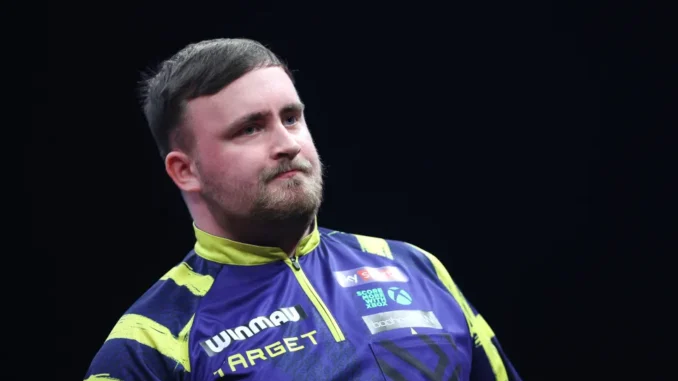
Luke Littler’s rapid rise to the top of professional darts has brought him trophies, fame and admiration — but it has also placed him under intense scrutiny from crowds around the world. At just 19 years old, the reigning world champion once again found himself at the centre of controversy during the Winmau World Masters, after clashing verbally with a disruptive spectator during a high-pressure match.
Littler produced a dominant performance on the oche, defeating Ross Smith 4–1 in a confident display that underlined his status as one of the game’s most feared talents. However, the match was overshadowed by persistent interruptions from a spectator positioned near the front of the crowd, whose comments repeatedly broke the players’ concentration.
Despite his commanding performance, Littler admitted afterwards that the behaviour had been hard to ignore. Speaking after the match, the teenager explained that he had been determined not to react, especially given how crucial the tournament is to his ambitions. “Obviously, it’s the tournament I’ve not won,” he said. “Like I said yesterday, just keep your head down and don’t react to anything.”
But as the comments continued throughout the contest, frustration began to show. Littler revealed that even his opponent had been left unimpressed by the heckling. “A few things in the crowd again at the very front,” Littler explained. “And even Ross said when we went off at 3–1, ‘he’s an idiot, that guy, whoever it was.’”
The situation escalated to the point where tournament security approached Littler during the match to ask what was being said from the stands. Still, the world champion chose not to let it affect his focus. “They came up to me and asked what he was saying,” he recalled. “But I’d won the set, so it didn’t really matter.”
That mental strength has become one of Littler’s defining traits. Since bursting onto the scene, he has shown an ability to thrive in hostile environments, often turning crowd pressure into motivation. However, this was not the first time in recent months that fan behaviour has drawn his attention.
During the World Darts Championship at Alexandra Palace, Littler faced a mixed reception from sections of the crowd and responded with a memorable on-stage retort after his win. On that occasion, he sarcastically thanked the booing fans, remarking that they were contributing to his prize money — a moment that quickly went viral and highlighted his growing confidence under pressure.
The World Masters incident felt different, though. Rather than playful defiance, Littler’s reaction carried a sharper edge, reflecting the growing intensity surrounding his presence in the sport. As the youngest world champion in darts history, expectations are enormous, and every appearance now comes with heightened attention.
Some within the darts community believe the reaction from certain fans is a response to Littler’s dominance. He has previously suggested that supporters may be growing tired of seeing the same players succeed, a comment that sparked debate about whether success inevitably attracts negativity.
On the board, however, Littler continues to let his darts do the talking. Against Smith, his scoring power and finishing were clinical, allowing him to control the match despite the distractions. The victory pushed him into the latter stages of the tournament, where the competition only becomes fiercer.
Awaiting him next is Josh Rock, in a quarter-final clash that promises fireworks between two of the most exciting talents of their generation. With other stars also making headlines — including sensational big-finishes elsewhere in the event — the World Masters has delivered drama on multiple fronts.
Yet much of the spotlight remains firmly on Littler. Whether facing roaring support or disruptive criticism, he continues to show maturity beyond his years. His message remains clear: reacting to negativity only gives it power.
“If I’m winning,” he said simply, “then it doesn’t really matter.”
As Littler’s career continues to accelerate, moments like these serve as reminders that success at the highest level brings challenges far beyond the oche. How he handles them may ultimately define not just his results, but his legacy in the sport.
Leave a Reply