
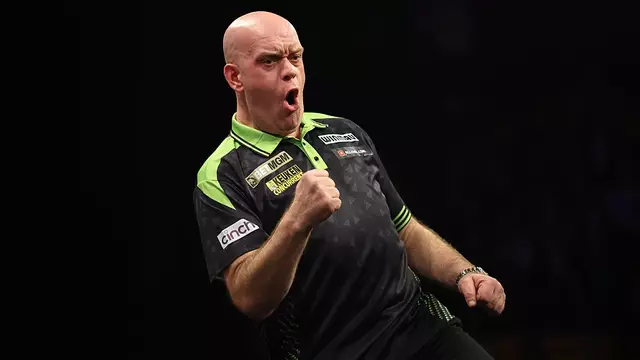
The electric atmosphere of the darts circuit is already crackling just seven days into the 2026 Premier League season, but an unexpected revelation from the sport’s top brass has fans and players alike buzzing with anticipation. Michael van Gerwen, the evergreen Dutch powerhouse, claimed victory on the opening night in Newcastle, setting the tone for what promises to be another thrilling showdown among the world’s elite throwers. Yet, amid the cheers and the clatter of arrows hitting the board, PDC Chief Executive Matt Porter dropped a bombshell: the iconic tournament’s format is set for a revamp down the line. It’s a bold admission that underscores the PDC’s commitment to evolution in a sport that’s as much about spectacle as it is about precision.
For the uninitiated, the Premier League Darts stands as the gladiatorial arena of the oche, a high-stakes weekly extravaganza that pits eight of the planet’s finest against one another in a relentless knockout gauntlet. Picture this: every Thursday night, the action unfolds in a different UK city, with players drawing lots to face off in quarter-finals, semi-finals, and a grand final—all best-of-11 legs under the glare of spotlights and roaring crowds. The structure ensures each competitor clashes with every other at least once in the initial eight weeks, building rivalries and narratives that keep viewers glued. Then, from weeks nine through 15, the cycle repeats, culminating in play-offs where the top four slug it out for glory. It’s a formula that’s delivered pulse-pounding moments, from Luke Littler’s meteoric rise last year to the nail-biting duels between veterans like Gerwyn Price and rising stars like Rob Cross. But as the season hits its stride—with sold-out arenas from Cardiff to Belfast—whispers of fatigue have begun to echo through the fanbase.
The core gripe? Repetition. As the weeks wear on, audiences find themselves witnessing the same explosive matchups recycled like a greatest-hits playlist on loop. That Littler versus Humphries showdown, the one that had social media ablaze last season? It might grace the semi-finals in Nottingham one week, only to resurface in Aberdeen the next. For die-hard supporters tuning in week after week from their armchairs, it’s a recipe for déjà vu. “That is the biggest criticism of it,” Porter candidly acknowledged in a recent interview, his voice carrying the measured tone of a leader navigating a tightrope. “There is a lot of repetition. But you’re looking at it through the eyes of somebody who’s perhaps watching it on TV every week.” He paints a vivid picture of the logistical tightrope: in a tour that crisscrosses the nation, satisfying every local crowd’s dream billing is no small feat. “If you’re in Nottingham, you want to see Luke Littler vs Luke Humphries,” he explained. “If you’re in Aberdeen, you might want to see the same, and if you’re in Brighton, you might want to see the same. It’s very difficult to turn around to people and say, ‘oh, sorry, you can’t see the biggest matchup in your city.'”
Yet, Porter’s optimism shines through like a perfectly aimed 180. Despite the murmurs, the numbers don’t lie—and they’re singing the PDC’s praises. Ticket sales are soaring, TV ratings are climbing, and engagement metrics across platforms are hitting new highs. “We will change it at some point, but at the moment you can only look at the numbers that are in front of you,” he asserted with conviction. “The live crowd and the TV audience, the numbers are telling us that the format is working. If people stop buying tickets or start changing the channel then it wouldn’t be working, but every metric is improving.” It’s a pragmatic stance, one that balances innovation with the tried-and-true. After all, this isn’t the first time the Premier League has danced with reinvention. Over its two-decade history, the event has undergone at least half a dozen overhauls—tweaking player counts, altering knockout structures, and even experimenting with mini-tournaments to inject fresh drama. “It’s not a format that will keep forever because we never keep any format forever in the Premier League,” Porter reflected. “The format must have changed half a dozen times in the 20 years of the event. But at the moment, it’s still the right format, we believe, for what we’ve got.”
This early-season nod to change feels like a masterstroke in transparency, especially as the 2026 lineup—featuring heavyweights like Humphries, the reigning world champion, and the prodigious Littler, now a household name—gears up for uncharted territory. Van Gerwen’s triumphant start in Newcastle wasn’t just a win; it was a reminder of the depth in this field, with underdogs like Peter Wright and Damon Heta lurking, ready to upset the apple cart. Fans, ever the passionate lot, have flooded forums and broadcasts with ideas: perhaps expanding to 10 or 12 players to dilute the repeats, or introducing seeded draws that guarantee marquee clashes without the full recycle. Porter’s words suggest the PDC is listening, even if the scalpel won’t touch the current blueprint just yet.
As the tour rolls on to its next stop, the air is thick with possibility. Darts, once a pub pastime, has ballooned into a global phenomenon, drawing millions to screens and stadia alike. The Premier League remains its crown jewel, a whirlwind of speed, skill, and sheer audacity where a single leg can swing empires. Porter’s assurance of evolution ensures that this jewel will only sparkle brighter. For now, though, the focus sharpens on the arrows flying true—and the stories yet to unfold. With every bullseye, the question lingers: what fresh twist awaits when the PDC finally pulls the trigger? One thing’s certain: in the high-octane world of professional darts, standing still is never an option. The season is young, the stakes are sky-high, and the oche calls for more.
Leave a Reply