
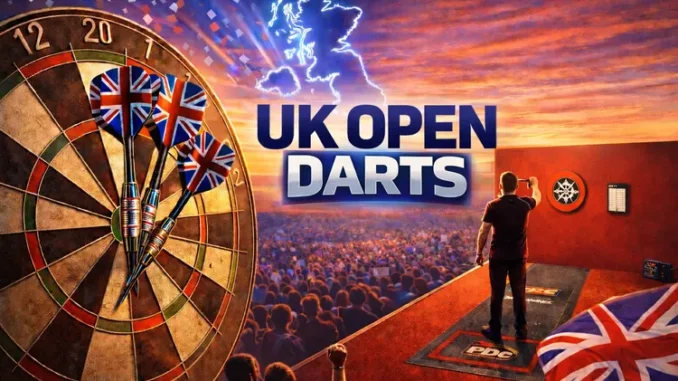
The excitement is building for the 2026 UK Open, a tournament that lives up to its nickname as the “FA Cup of Darts.” This event, renowned for its raw unpredictability and heart-pounding upsets, brings together professionals, rising stars, and amateur hopefuls in a no-holds-barred clash where seeding means nothing and every throw could rewrite the script. Set against the lively backdrop of Butlin’s Resort in Minehead, England, the action unfolds over three intense days from March 6 to 8, drawing in crowds eager to witness darts at its most democratic and dramatic.
Kicking off on Friday, March 6, the tournament dives straight into the fray with the early rounds. The opening day typically features a whirlwind of matches across multiple boards, starting with the first round in the afternoon and progressing through to the fourth round by evening. This setup allows lower-ranked players and qualifiers to make their mark early, often leading to shocking eliminations of big names right out of the gate. Saturday, March 7, ramps up the intensity with the fifth and sixth rounds, narrowing the field to the elite few who survive the chaos. By Sunday, March 8, the stakes reach fever pitch with the quarterfinals, semifinals, and the grand final all played out on the main stage, culminating in a champion hoisting the trophy amid roaring applause. With sessions split between afternoon and evening to accommodate the packed schedule, fans can expect non-stop darts from around 11 a.m. to late night, ensuring no moment is wasted.
At the heart of the UK Open’s appeal is its unique format, which levels the playing field in a way few other tournaments do. All 160 participants enter unseeded, meaning there’s no protection for top players—no easy paths or favorable brackets. Instead, the competition unfolds through an incremental entry system based on the PDC Order of Merit. The lowest-ranked Tour Card holders (positions 97-128) and all qualifiers start in the first round, battling in best-of-11 leg matches. As rounds progress, higher-ranked players join the mix: ranks 65-96 in round two, 33-64 in round three, and the top 32—including powerhouses like Luke Littler and Luke Humphries—in round four. From round four onward, matches extend to best-of-19 legs, with semifinals and the final stretching to best-of-21 for that extra layer of endurance testing. What truly sets it apart is the open draw conducted live on stage after each round starting from the third, adding an element of lottery-like suspense. One poor performance, and even a favorite could face a nightmare matchup next.
This year’s field is a testament to the tournament’s inclusivity, blending established titans with fresh talent hungry for breakthroughs. The core consists of all 128 PDC Tour Card holders, led by world number one Luke Littler, the defending champion who stormed to victory in 2025 with an emphatic 11-2 demolition of James Wade in the final. Littler, still riding high from his recent triumphs, enters in the fourth round alongside other heavyweights like Luke Humphries, Gerwyn Price, Michael van Gerwen, and Jonny Clayton. But the magic lies in the underdogs: eight spots go to top performers from the 2025 Development Tour, including promising youngsters like Jamai van den Herik, Ryan Branley, James Beeton, Jenson Walker, Jannis Barkhausen, Patrik Williams, Nathan Potter, and Henry Coates. Another eight come from the Challenge Tour, featuring veterans and comeback stories such as Ted Evetts, Michael Unterbuchner, Jack Tweddell, Sam Spivey, Scott Waites, Scott Campbell, Danny van Trijp, and Graham Hall. Rounding out the lineup are 16 amateur qualifiers who earned their berths through grueling regional events—names like Jack Todd, Clive Langford, Kyle Gilding, Callum Francis, Simon Stevenson, Graham Usher, Aden Kirk, Samuel Whittaker, Neil Wild, Sean Ryan, Daniel Lee, Oliver King, Callum Goffin, Ron Meulenkamp, Lewis Pearse, and Jake Eichen. These players, often from local leagues, embody the spirit of the event, where a pub dart enthusiast could theoretically topple a pro in a Cinderella story.
The draw process amplifies this volatility. For the first round, the 32 lowest-ranked Tour Card holders are paired against the 32 qualifiers (the eight Development Tour, eight Challenge Tour, and 16 amateurs), creating immediate opportunities for surprises. From there, it’s all open: after round three, draws are pulled publicly, ensuring no one knows their next opponent until the moment arrives. This has led to legendary moments in past editions, like unheralded players knocking out multiple seeds in succession. In 2026, with the field so stacked, early clashes could see emerging talents like Gian van Veen or Wessel Nijman facing off against seasoned pros, setting the stage for epic narratives.
As for predictions, the buzz among darts insiders points to a fierce battle at the top. Luke Littler emerges as the clear favorite, with many highlighting his unmatched dominance in best-of-19 formats and his motivation to defend his crown. One expert notes that Littler’s ability to perform under any draw makes him “immune to the chaos,” positioning him as the outright pick to lift the trophy again. However, Luke Humphries is hot on his heels, praised for his consistent high-level play and seen as the primary challenger who could dethrone the young sensation. Gerwyn Price also garners strong support, with observers pointing to his recent form and hunger for another major title as reasons he could go all the way. Dark horses abound: Gian van Veen is tipped for a deep run, thanks to his explosive scoring power, while Jonny Clayton’s experience and Wessel Nijman’s youthful energy could spark upsets. Other names like Michael van Gerwen, Nathan Aspinall, Krzysztof Ratajski, Gabriel Clemens, Luke Woodhouse, and Kevin Doets are mentioned as potential spoilers, capable of stringing together wins in this format. One analyst sums it up: “In a tournament like this, it’s not just about skill—it’s about who handles the pressure of the unknown best.”
With a massive £750,000 prize fund—including £120,000 for the winner—the 2026 UK Open isn’t just about prestige; it’s a life-changer for many. As the darts world converges on Minehead, expect the unexpected: tears, triumphs, and tales that will echo through the sport for years. Whether it’s Littler cementing his legacy or an underdog stealing the show, this edition promises to be unforgettable.
Leave a Reply