
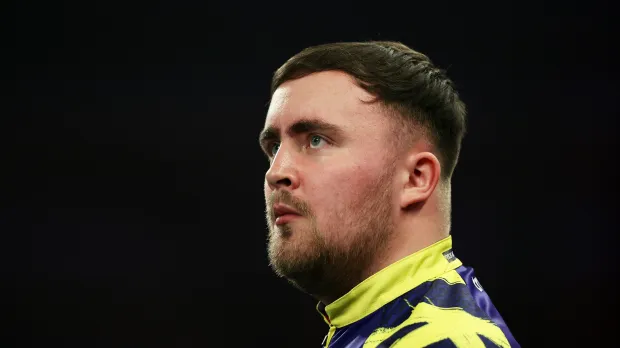
Luke Littler, the teenage sensation who has taken the darts world by storm, remains one of the most formidable players on the PDC circuit. At just 19, he has already claimed multiple major titles, including back-to-back World Championship triumphs, and consistently tops the world rankings with blistering averages, pinpoint accuracy, and an unflappable demeanor under pressure. Yet, even a player of Littler’s caliber has vulnerabilities, and darts experts have pinpointed what they believe is the one subtle flaw that determined rivals could potentially turn into a decisive advantage.
Darts commentator and content creator Phill Barrs recently shared his insight ahead of the UK Open, suggesting that Littler’s near-perfect game has a small but noticeable “chink in his armour.” According to Barrs, this weakness emerges specifically when the crowd turns hostile against him. “There is a slight chink in the armour in my opinion and I’m not saying that there should be, but there is when he’s finding it difficult to deal with hostile crowds,” Barrs explained. He elaborated that while Littler is exceptional in most scenarios—often thriving on crowd energy—he struggles to maintain his composure when sections of the audience boo or jeer him relentlessly.
Barrs pointed to specific instances where this dynamic has played out. “They were on his back in Belfast and you could see he had the raging hump with it,” he noted, referring to a recent Premier League night in Northern Ireland where Littler appeared visibly frustrated amid crowd hostility. Similar moments have occurred on the European Tour and during the World Cup of Darts, particularly in venues where local support heavily favors his opponent. Barrs emphasized that Littler is still young and learning on the job, adapting to the unique pressures of being a global superstar. “He’s finding it difficult to deal with hostile crowds now… get how young he is and he’s not had to do this. So he is learning on the job,” he added.
The commentator described the potential edge as slim but real: “It’s 99 at the moment, but that 1% that if you can turn the crowd against him, perhaps you could get at him.” In essence, the strategy for rivals isn’t about outscoring Littler in pure darting terms—few can match his ceiling—but about creating an environment where the atmosphere works against him. Hostile crowds can disrupt rhythm, amplify mistakes on key doubles, and shift momentum in tight matches. Barrs stressed that crowd behavior in darts is unlikely to change, so players like Littler must evolve to handle it fully. “But in my opinion we’re never gonna change that so the players have to learn how to deal with it.”
This observation aligns with recent performances where Littler has shown flashes of irritation when booed, such as during parts of the Premier League campaign. In one notable match, he appeared distracted and less clinical when jeers rang out, contributing to a rare defeat. Former pro Matt Edgar echoed similar thoughts, questioning if hostile crowd interaction might represent Littler’s “kryptonite” at this stage of his career, especially after a Belfast loss where boos seemed to affect his focus.
Despite this perceived vulnerability, Littler has tools to counter it. He is known for feeding off adversity, often responding to heckles by showboating or raising his game to silence doubters. His ability to wind up crowds when they’re against him has become part of his persona, turning potential negativity into extra motivation. Yet Barrs and others argue that until he fully masters remaining unruffled in truly toxic atmospheres, that tiny 1% window exists for elite opponents to exploit—perhaps by playing mind games to rile the audience or capitalizing on any momentary lapse.
As the UK Open unfolds at Butlin’s Minehead, where raucous crowds and high stakes amplify every emotion, this topic has added intrigue to Littler’s title defense. The event’s format—best-of-19 legs in later rounds—gives opponents more time to build pressure and potentially turn the crowd dynamic in their favor. Littler enters as the favorite, having dominated much of 2026 outside some Premier League inconsistencies, but rivals will be watching closely for signs of frustration if the support swings against him.
Ultimately, Littler’s dominance stems from his extraordinary talent, work ethic, and mental strength. The “chink” identified is minor and likely temporary as he matures. For now, though, it serves as a fascinating reminder that even the most seemingly invincible players have areas to improve. In a sport where psychology and atmosphere play huge roles, exploiting that subtle vulnerability could be the difference between a routine win and a major upset. As Barrs put it, adapting to hostile crowds is the final piece Littler needs to reach true invincibility.
Leave a Reply