
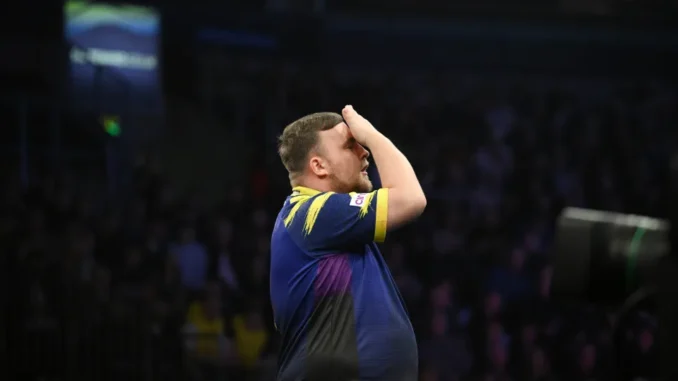
In the electrifying arena of professional darts, where every arrow can rewrite history and legends are forged under blinding lights, Luke Littler continues to cast a long shadow over the PDC tour. The 19-year-old phenom from England has just defended his UK Open title in Minehead with a hard-fought 11-7 victory against James Wade in the final, etching his name alongside only three other icons—Raymond van Barneveld, Phil Taylor, and Michael van Gerwen—as the fourth player ever to successfully retain the trophy. It was a tournament that showcased not just raw talent, but an ironclad resilience that has the entire darts world buzzing.
Yet beneath the celebrations, a voice of caution has emerged from one of the game’s most respected figures. Three-time world champion John Part, now a sharp-eyed analyst and commentator, has delivered a pointed assessment that serves as both praise and a chilling wake-up call for Littler’s rivals. While acknowledging the youngster’s extraordinary ability to close out matches, Part warns that Littler’s current form carries an ominous edge for the chasing pack.
“It is ominous in that sense that he is winning everything anyway,” Part observed. “He is not playing his very best, not consistently.”
Throughout the high-octane week in Minehead, Littler encountered stretches where his rhythm faltered and his darts appeared uncharacteristically loose. There were moments when precision gave way to something less polished, yet time and again, the teenage sensation rose to the occasion when the pressure peaked. Part, drawing on decades of elite competition, highlighted this duality with a mix of admiration and concern.
“He is managing games well in terms of getting the job done,” he explained. “I really admire that he’s throwing the darts when needed. But he just looks sloppy far too often as well.”
This “B-game” dominance, as Part describes it, is what truly sets alarm bells ringing. Most players on tour would kill for the level Littler displays on an off day. The Canadian legend points out that when the young star eventually strings together consistent peak performances, the gap between him and the rest of the field could become insurmountable. For now, though, these imperfect victories are revealing cracks—cracks that ambitious opponents might exploit if they dare to pounce.
Littler’s route to the title was anything but a procession. He battled through a gauntlet of heavy hitters, including Damon Heta, Kevin Doets, Gary Anderson, Danny Noppert, and a particularly tense quarter-final clash with Josh Rock. The Northern Irishman even seized the early advantage against Littler, briefly threatening to pull off a seismic upset. “So, I am thinking even when he played Josh and I don’t even know how Josh got ahead in that match but that could have really been fatal,” Part noted, underscoring how close the young Englishman came to a rare stumble.
Even in the final against Wade—a player enjoying a formidable resurgence—Littler had to dig deep. Wade, snubbed from this year’s Premier League despite strong form, channeled that perceived slight into fierce motivation. Part suggested the setback may have lit a fire under “The Machine,” turning disappointment into drive. “He is definitely on course,” the analyst remarked of Wade. “I think he had a little bit of a case to get in the Premier League… If he had got in the Premier League, would he be doing all this now? It’s sort of like the response, the indignity, the outrage, whatever he’s feeling inside has been a motivational factor.”
As impressive as Littler’s triumph remains, Part believes these narrower escapes are planting seeds in the minds of his foes. Opponents who once felt annihilated are now walking away convinced they can push the world number one to the brink. “These players who he is doing it against, they are going to remember the next time and they’re going to be eager for another chance to walk into him because they’re not getting just completely slaughtered,” Part said. In an ideal world for a dominant champion, rivals would be granted almost no realistic finishing opportunities—nothing beyond desperate 161 shots or similar long-range miracles.
The real danger, according to the three-time world champion, lies in Littler’s unshakable momentum. Without a significant setback to bruise his confidence, the prodigy’s belief in his own destiny will only swell. “Although he isn’t doing that, he is still winning, so we have to wait and see which way it’s going to go,” Part warned. “The problem is if someone doesn’t get into him and do some damage and really actually bother his confidence, his confidence is going to get even higher. He will be thinking that he is not even playing his best and he is winning all these things.”
It’s a message laced with urgency for the entire PDC circuit. In a sport where mental toughness can trump perfect technique, Littler’s ability to win ugly is transforming him from a prodigy into a seemingly inevitable force. Rivals must now find ways to disrupt his rhythm, capitalize on those sloppy patches, and land a psychological blow before his aura becomes unbreakable. The UK Open has once again proven that Littler thrives under scrutiny, but Part’s analysis reminds everyone that true greatness is tested not just by titles won, but by the challengers who refuse to yield.
As the darts caravan rolls toward the next major showdowns, the spotlight intensifies. Wade’s resurgence hints at deeper competition ahead, while Littler’s growing collection of silverware continues to rewrite the record books at a breathtaking pace. Yet the Canadian icon’s words linger like a shadow over the oche: the time for rivals to strike is now. If they heed the call and “do some damage,” the narrative of darts’ golden generation could take a dramatic twist. If not, Luke Littler may soon stand alone at the summit, confidence soaring higher than any dart has ever flown. The stage is set for an epic chapter in a sport that thrives on drama—and right now, the young Englishman holds every advantage, sloppy or not.
Leave a Reply