
In the captivating and often unpredictable realm of professional darts, where players hone their craft through countless hours of practice to group three arrows within the tiniest scoring segments, certain moments transcend scoring altogether and etch themselves into the sport’s folklore. One such extraordinary occurrence is the **Triple Robin Hood**—a visually stunning yet statistically improbable feat where a player’s three darts stack perfectly atop one another, each subsequent arrow embedding directly into the flight (the plastic fins) of the previous one, forming a single protruding chain that resembles the legendary archer Robin Hood splitting arrows with pinpoint precision.
For more than a decade, this rare spectacle had only been witnessed once on live television. John Bowles, a determined qualifier who made his mark at major PDC events, achieved the historic Triple Robin Hood during the 2013 PDC World Darts Championship at the iconic Alexandra Palace. His throw, captured under the intense glare of the tournament lights, quickly became the stuff of legend. Replays circulated widely among fans, commentators marveled at the physics-defying alignment, and Bowles’ name was forever linked to one of darts’ most bizarre and memorable anomalies. A single Robin Hood—where one dart lodges into the back of another—is already uncommon enough to draw gasps and cheers from the crowd. Doubling or tripling that effect requires an almost supernatural combination of velocity, angle, spin, and sheer luck, making the triple version feel like a statistical unicorn in a sport built on precision.
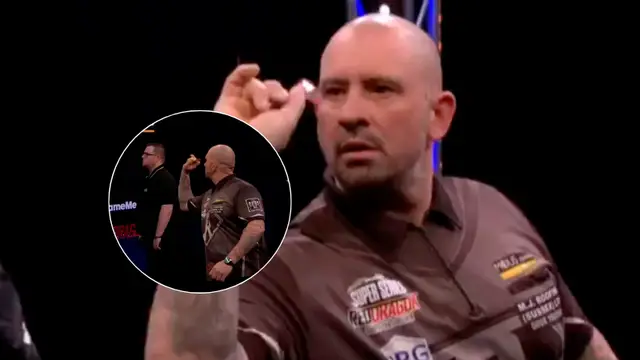
That long-standing exclusivity came to an end in April 2024 during the MODUS Super Series, a dynamic tournament format that pits talented players against each other in fast-paced group stages and has produced its share of viral moments. English dartist Rob Collins, then 45 years old and competing with the experience of a seasoned campaigner, faced Adam Lipscombe in a closely contested match. Collins ultimately emerged victorious with a 4-3 scoreline, but it was not the win itself that stole the headlines. In the fourth leg, with the score at 2-1 in his favor, Collins stepped up to the oche and delivered a throw that would stun everyone watching.
His first dart sailed true, landing neatly in the treble 20 bed and setting what appeared to be a promising scoring visit. The second dart followed with professional rhythm—only to strike with uncanny accuracy, not into the board, but directly into the flight of the first dart, lodging firmly and creating a classic Robin Hood. Undeterred, or perhaps unaware in the heat of the moment, Collins released his third and final dart of the turn. To the astonishment of players, officials, and spectators alike, it flew straight and true, embedding itself perfectly into the flight of the second arrow. All three darts now formed a single, intertwined column jutting out from the board like a miniature sculpture.
The scoring outcome was anticlimactic: just 60 points registered instead of a potential 180 maximum. Yet the aesthetic triumph far outweighed any numerical disappointment. The commentary team captured the sheer disbelief in real time. One voice exclaimed, “Oh my words. I don’t think I’ve ever seen a double Robin Hood.” His partner elevated the call instantly: “It’s the triple Robin Hood.” The MODUS Super Series social media account amplified the excitement, posting the clip with the caption: “OH MY GOD!! WHAT HAVE WE JUST SEEN?! ‘IT’S A *TRIPLE* ROBIN HOOD!!! WHAT ARE THE CHANCES?!”
Fans flooded online platforms with reactions ranging from stunned admiration to humorous suggestions. Some proposed that such a rare alignment deserved special recognition—perhaps treating it as a full 180 or awarding bonus points for its entertainment value. Others joked about the astronomical odds, likening it to a genie granting a perfect throw only to deliver something even more whimsical. The video spread rapidly, drawing millions of views and reigniting debates about the rarest throws in darts history.
What elevates the Triple Robin Hood beyond mere novelty is the intricate physics at play. Darts must maintain consistent speed and rotation while the flights provide just enough resistance for the subsequent arrows to penetrate without deflecting wildly. Elite players train relentlessly to achieve tight groupings, but stacking three in perfect succession—even accidentally—remains vanishingly rare under competitive pressure. Bowles held the solitary televised honor for over ten years, cementing Collins as only the second player to accomplish the feat on broadcast television.
Interestingly, the skill required has been demonstrated intentionally in non-competitive settings. Former world champion Rob Cross once crafted a Triple Robin Hood deliberately in under 20 seconds during a challenge, highlighting how modern throwing techniques and equipment have pushed the boundaries of accuracy. Yet in live matches, where adrenaline, crowd noise, and match stakes come into play, the feat retains its mythical status.
Incidents like this underscore darts’ enduring appeal as a sport that blends elite athleticism with delightful unpredictability. While nine-dart finishes and high-scoring legs represent technical perfection, quirky anomalies such as the Triple Robin Hood remind audiences that human endeavor—and a touch of chaos—can produce unforgettable visuals. Collins, far from frustrated by the lost points, joined Bowles in an exclusive club of two, their names now forever associated with one of the most spectacular “failures” the game has ever seen.
As professional darts continues to grow in popularity, with packed arenas, global broadcasts, and a new generation of stars emerging, fans eagerly await whether a third player will eventually join this elite group. Will another accidental masterpiece surface during a Premier League night or a World Championship thriller? Or will Bowles and Collins remain the sole custodians of this peculiar immortality? In a game measured in fractions of an inch, where triumph and peculiarity often walk hand in hand, the Triple Robin Hood stands as a shining example of darts’ beautiful, chaotic charm—one that continues to captivate newcomers and lifelong enthusiasts alike.
The moment also sparks broader reflection on the sport’s evolution. From its humble pub roots to today’s polished, high-definition productions, darts thrives on these human stories. Whether it’s a dramatic comeback, a record-breaking score, or a freak alignment that defies explanation, each throw carries the potential for magic. Rob Collins’ Triple Robin Hood in that MODUS Super Series clash against Adam Lipscombe may not have boosted his points tally significantly, but it added a vibrant chapter to the rich tapestry of professional darts, proving once again that sometimes the most memorable throws are the ones that go gloriously, perfectly wrong.
Leave a Reply