
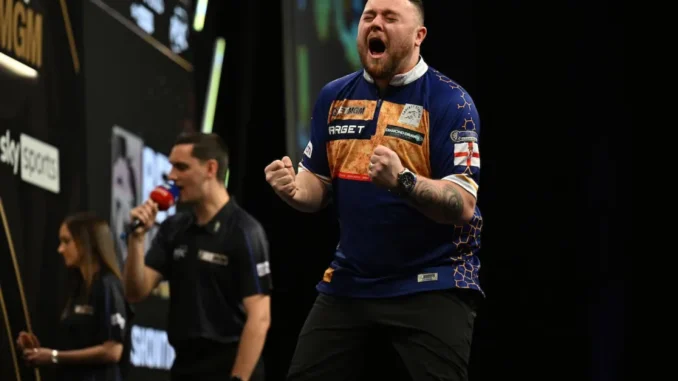
In the high-pressure cauldron of the Premier League Darts, where every leg feels like a heavyweight title fight under the glare of the lights and the roar of passionate fans, few moments capture the raw human side of the sport quite like the emotional release of a long-awaited breakthrough. On a dramatic night in Berlin, Northern Ireland’s Josh Rock finally shattered his Premier League duck, defeating league leader Jonny Clayton 6-3 in the quarter-finals and sparking scenes of pure relief that saw the 24-year-old Antrim ace break down in tears on the oche.
Rock, the world number seven making his debut in the elite eight-man competition, had endured a nightmare start to the 2026 campaign. Seven straight defeats had left him rock bottom of the table, scoreless and staring down the barrel of unwanted history. Whispers of equalling or even surpassing infamous winless streaks loomed large—Stephen Bunting’s eight-game losing run from the opening nights of the previous season, and the more daunting nine-match barren spell suffered by Glen Durrant in 2021 that ultimately led to an early exit. One more loss in the German capital would have edged him perilously closer to those unwanted records, piling even greater pressure on the talented youngster who had shown so much promise elsewhere on the PDC circuit.
But on night eight at the Uber Arena, Rock delivered when it mattered most. He started brightly with a 180 and held his throw in the opening leg. Although both players struggled for consistency—Rock finishing with a modest average of 89.22, far from his explosive best—he found rhythm at the doubles when it counted, converting six out of 14 attempts on the outer ring. A crucial break in leg six, powered by back-to-back visits of 140 and 180 followed by a double 10, swung the momentum decisively. He then sealed the victory in leg nine with a double 16 on his first match dart, collapsing to his knees in celebration as the weight of weeks of frustration lifted in an instant.
The emotion poured out immediately. Rock dropped to the floor, overcome by the moment, before rising with tears streaming down his face. It was a visceral display of vulnerability rarely seen so openly on the professional darts stage, reminding everyone that behind the precision and bravado lie real athletes carrying immense mental burdens. Clayton, the table-topping Welshman who had been in imperious form, sportingly congratulated the victor amid the raw scenes.
Speaking afterwards, Rock laid bare the depth of his relief: “I showed my emotions on stage. It was relief – and that’s an understatement. I am up there to try and win as best as I can. It hasn’t happened in the last seven weeks, so very relieved I got the first win. Yes, Jonny didn’t play up to scratch, I didn’t play up to scratch. But I was trying too hard to win because I wanted to win more than him – and I proved it in the end.”
The victory earned Rock his first points of the Premier League season and halted the slide that had seen him suffer heavy losses, including a 6-3 semi-final defeat to Michael van Gerwen in a previous week and crowd jeers during tough nights on the road, such as in Dublin. At 24, Rock has already established himself as one of the rising stars of darts. A former UK Open semi-finalist and consistent performer on the ProTour, he possesses the explosive scoring power and big-match temperament that had many tipping him for a strong Premier League debut. Yet the unique intensity of the league format—weekly travel, high stakes, and direct elimination pressure—proved a steep learning curve, testing his resilience like never before.
Earlier in the campaign, Rock had spoken candidly about adjusting to life in the spotlight, at one point even attributing a poor performance to an unfortunate soap incident in the venue toilets that left his hands numb and his grip compromised. He adapted quickly with practical solutions like carrying chalk and wax, showcasing the professionalism that underpins his game. Supporters and fellow players, including Durrant who had endured similar torment, offered public sympathy, with some admitting the psychological toll of repeated defeats could leave even the strongest competitors “crying” at night.
Though Rock’s quarter-final heroics ended there—he fell 6-3 to van Gerwen in the semis—the night belonged to the Northern Irishman’s breakthrough. Meanwhile, Luke Littler continued his dominance, defeating Michael van Gerwen 6-4 in the final with a spectacular 170 “big fish” checkout to claim back-to-back nightly wins and reclaim top spot on the league table. Gerwyn Price also impressed with a 6-1 thrashing of Gian van Veen, who had missed the previous week’s event in Dublin while recovering from kidney stone surgery.
For Rock, the Berlin win represents far more than three points on the board. It is a psychological lifeline, proof that the hard work and belief could yield results even on an off night. In a sport where confidence can evaporate as quickly as a missed double, this emotional release could be the catalyst for a stronger second half of the campaign. The Premier League is unforgiving, but it also rewards fighters who refuse to buckle.
As the roadshow rolls on to new venues, Rock will carry the memory of dropping to his knees in Berlin—a moment of catharsis that silenced the doubters and reminded fans why they fall in love with darts. It is not always the highest averages or flashy 180s that define a player’s character; sometimes it is the quiet (or in this case, tearful) determination to keep showing up and believing when the results refuse to come. Josh Rock has taken his first step, avoided the record books for all the wrong reasons, and now looks ahead with renewed fire. The oche awaits, and for the Antrim ace, the best may yet be to come.
Leave a Reply