
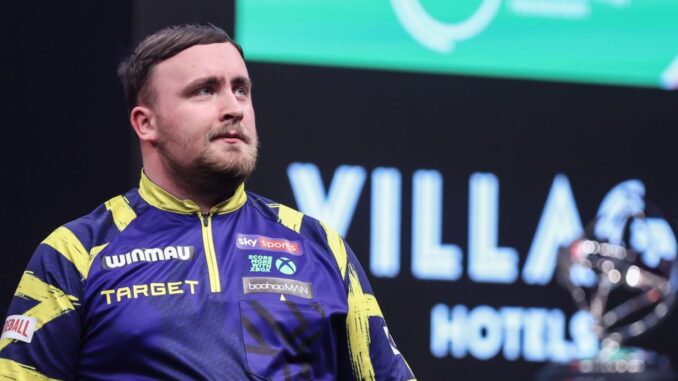
LUKE LITTLER has taken the darts world by storm like few players before him, but behind the glittering trophies and record-breaking paydays lurks a shadow that could derail even the most prodigious talent. At just 19 years old, the Warrington sensation known as ‘The Nuke’ is already World No.1 and the youngest back-to-back World Champion in history. Yet his biggest threat isn’t a rival with a sharper throw or a more experienced pedigree—it’s the very thing that has propelled him to stardom: money itself.
In a whirlwind two-year stretch, Littler has claimed an astonishing twelve major titles, amassing a staggering £2,961,000 on the Order of Merit. That puts him a commanding £1,754,500 ahead of his closest pursuer, fellow star Luke Humphries. The teenager’s dominance is undeniable. He has rewritten the script for what a modern darts career can look like, surging from teenage qualifier to global icon faster than anyone could have imagined. With two World Championship crowns already secured, he sits just fourteen titles shy of matching the legendary Phil Taylor’s record of sixteen—a feat once thought untouchable. Fans and pundits alike have begun whispering about a new era where Littler could redefine greatness for a generation.
But as the prizes pile up and the bank balance swells, a former professional has issued a stark warning about the invisible enemy now circling the young champion. Speaking candidly, he pinpointed the one factor that could blunt Littler’s extraordinary edge: the seductive pull of financial security. “I think the biggest thing that’s going to impact on Littler’s dominance is how much money he wants,” the ex-pro explained. “How much money does he need to live, or how much money do you earn to keep your hunger to want to keep winning? There has to be a motivation at some point or another.”
The observation cuts to the heart of a dilemma faced by many young superstars across sports. For Littler, the transformation has been meteoric. Two years ago, he was bursting onto the scene as an 18-year-old sensation; today, he stands on the brink of becoming the first player in darts history to hit the £3 million mark on the Order of Merit. Luxury cars, sponsorship deals, and a lifestyle far removed from the grind of earlier generations are now within easy reach. The former player drew a personal contrast to highlight the shift: “For the likes of myself, there was never enough money around for us to say. Don’t get me wrong, I’m in a better position in life now than before in my darting career by a long shot. But I’m not in a position to be going and buying Porsches and Ferraris where Luke is. You don’t have to buy them when you get that good, they give them to you.”
This isn’t mere speculation—it’s a genuine concern rooted in the psychology of elite performance. Hunger fuels champions, and when the financial pressure eases, that fire can sometimes dim. The ex-pro continued: “But the fact of the matter is, I think, could he win 16 world titles? I think he’s now saying: well, I’m two closer than I was two years ago. I’m on two and can I catch him. Will he have the hunger? For Phil, the money was never the issue, it was always the title, always the accolade that he liked. If Luke [Littler] can stay like that, I think he can stay in the game an awful long time.”
Phil Taylor, the undisputed king of darts for decades, built his empire on an insatiable drive for silverware rather than paycheques. In an era when prize money was far more modest, every title mattered on a visceral level. Littler, by contrast, has already earned more in two seasons than many veterans accumulated over entire careers. The question now hanging over the sport is whether that same raw ambition can survive the comforts of success. Will the teenager who once practised relentlessly in his bedroom maintain that same ferocious focus when the world is at his feet and the endorsements keep rolling in?
Littler’s journey has captivated millions. His boyish charm, lightning-fast scoring, and unflappable composure under the bright lights have made him the face of a booming sport. Crowds chant his name, social media explodes with every 180, and tournaments sell out just to catch a glimpse of the phenomenon. Yet the very success that has elevated him also brings new pressures. Travel demands, sponsorship obligations, and the weight of expectations from an adoring public can all chip away at the singular focus required to stay at the summit.
For now, Littler shows no signs of slowing down. His recent performances continue to dazzle, and his lead on the Order of Merit grows with every deep run. But the warning serves as a timely reminder that even the most gifted athletes must guard against complacency. The oche is unforgiving; one slip in motivation can open the door for hungry challengers eager to dethrone the king.
As darts enters a golden age of talent and television deals, Littler’s story is far from finished. Whether money becomes his greatest ally or his stealthiest foe remains to be seen. One thing is certain: the eyes of the sporting world are fixed on the teenager who has already achieved so much, wondering if he possesses the rare inner fire to chase immortality long after the millions have been secured. The coming years will reveal if ‘The Nuke’ can keep exploding onto the biggest stages—or if the quiet threat of comfort proves too powerful even for him.
Leave a Reply