
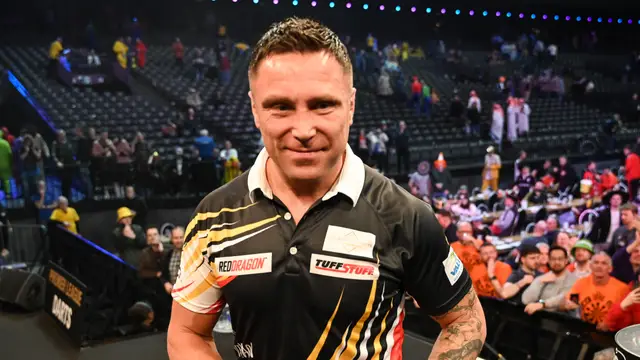
In the high-octane world of professional darts, where every leg, every checkout, and every point can define a season, Gerwyn Price has unleashed a blistering critique of a proposed shake-up to the Premier League format that could reshape the competition’s very foundations. The Welsh star, known for his fiery passion both on and off the oche, didn’t hold back as he branded the idea of reviving Premier League Challengers “totally unfair,” warning it would introduce chaos rather than solutions in an already demanding schedule.
The controversy erupted after a dramatic night of upheaval in Dublin during Night Seven of the Premier League Darts. With the tournament’s unique structure—eight elite players battling weekly across arenas worldwide for crucial league points—already testing the limits of endurance, Gian van Veen was forced to withdraw at the last minute due to a bout of kidney stones. The result? An entire quarter-final was scrapped, leaving fans disappointed and players navigating an uneven playing field. Van Veen bounced back for Night Eight in Berlin’s Mercedes-Benz Arena, only to be dismantled 6-1 by Price himself in a ruthless display of the Iceman’s firepower. Yet even in victory, Price’s mind was on bigger structural issues looming over the sport he loves.
Speaking candidly, Price pulled no punches on the suggestion of reintroducing one-night challengers—local heroes or rising talents granted a shot at glory against the established stars. “I think that would be totally unfair,” he declared. “When you had the challengers, it was a good idea but unfair to the players that are playing the challengers.” He painted a vivid picture of the inconsistencies that would follow: “Every player is a different standard, and one person could play Fallon Sherrock, someone could play Chris Dobey, someone could play Luke Humphries, like I did.” For Price, a world No. 8 with a history of dominating major stages, the proposal isn’t just flawed—it’s a recipe for imbalance in a league where precision and consistency are everything.
But Price’s frustration runs deeper than one potential tweak. He acknowledged the Premier League’s current setup, with its repetitive nightly format of best-of-11 legs in a knockout-style race, has its own shortcomings. “I think if you’re looking at the problems with the format, at the minute where it is probably a little bit repetitive and if someone is ill, then there’s no way of trying to get those points back,” he explained. “If they miss a week, somebody gets gifted points, which is a little bit unfair but I’m not sure what they’re going to do about it.” It’s a raw admission from a player who thrives on the big-stage pressure but craves fairness in a competition that crowns the ultimate darts champion after months of grueling travel and high-stakes matches.
The Premier League Darts has long been the glittering crown jewel of the PDC calendar, pitting the world’s top eight against one another in a points-based marathon that culminates in dramatic Play-Offs. Nights like the recent Berlin showdown showcase the sport’s electric atmosphere—packed arenas, roaring crowds, and nail-biting finishes under bright lights. Yet injuries and illnesses have repeatedly tested its resilience. Price isn’t alone in highlighting the dilemma. Former Lakeside world champion Mark Webster, a voice of experience in the darts community, echoed the concerns, stressing that no fix comes without trade-offs. “I get the idea, but I just don’t know how you do it,” Webster noted. “Who you get and obviously the players are going to be of a different level to say Gian [when he pulled out in Dublin]. It’s not an equal contest anyway so it’s tricky.”
Webster delved into the history, recalling how similar disruptions have altered careers. “It happened last year and it’s happened a couple of times this year and it could be pivotal come the Play-Offs, so you don’t know how it’s going to pan out,” he said. He pointed to a stark example from the previous season when Michael van Gerwen was handed a 6-0 defeat due to his inability to compete in Berlin, ultimately costing the Dutch superstar a spot in the prestigious Play-Offs. “In an ideal scenario, you want to see all the players play in the opening quarter-finals and if you get a reserve in it does get that player fine-tuned,” Webster added. Yet he was blunt about player psychology: “There’s an argument some people say the player would rather play but that’s rubbish. They’ll take the bye any day of the week in the Premier League and take two points. I don’t know what the answer is. From a crowd point of view, they want to see someone, but the player would think ‘I’ve got that bit of luck, I want to run with it’.”
This debate strikes at the heart of what makes the Premier League so compelling—and so unforgiving. Challengers once delivered unforgettable moments, with underdogs thrilling partisan home crowds and injecting fresh drama into the mix. But as Price and Webster illustrate, reviving them risks tilting the scales in unpredictable ways, especially when the difference between a top seed and a wildcard could swing entire legs or even seasons. With the league table tightening and every point carrying massive weight toward those coveted Play-Off spots at the O2 Arena, the stakes couldn’t be higher.
Price’s outburst comes at a pivotal time, as the PDC grapples with maintaining the event’s integrity amid the physical toll on its stars. The Iceman, a former champion who has lit up the circuit with his explosive style and unyielding competitiveness, has always been vocal about the demands of the road. His comments underscore a broader truth: darts is a sport of razor-sharp focus, where the smallest variables—like an opponent’s unfamiliar style or a forfeited match—can cascade into league-altering consequences. Fans, meanwhile, crave the spectacle, the upsets, and the relentless action that keeps arenas buzzing from Dublin to Berlin and beyond.
As the Premier League barrels toward its climax, Price’s words serve as a timely reminder that evolution in format must prioritize equity above all. Whether the PDC finds a seamless solution remains to be seen, but one thing is clear: in a competition that rewards the sharpest minds and steadiest hands, fairness isn’t just a preference—it’s the foundation that keeps the drama authentic and the rivalries fierce. The Iceman has spoken, and the darts world is listening.
Leave a Reply