
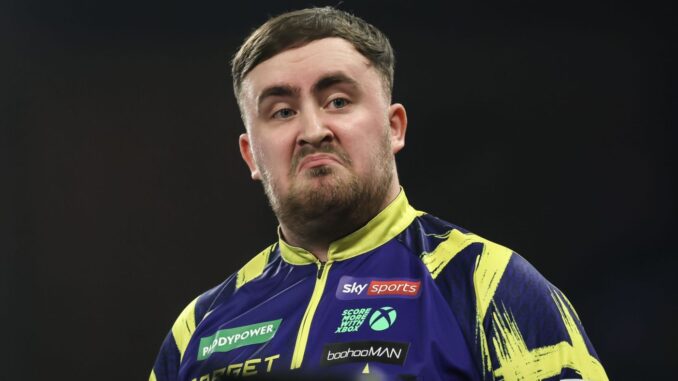
Darts legend Phil Taylor has offered a firm and thoughtful piece of advice to teenage sensation Luke Littler, urging the rising star to distance himself from social media as he continues to deal with the pressures of rapid fame. The message may sound simple, but it reflects a deeper concern about the challenges young athletes face in an era where online noise can be just as intense as the competition itself.
Taylor, whose dominance in darts spanned decades, knows better than most what it takes to remain focused at the highest level. His success was built not only on remarkable skill but also on an unwavering ability to concentrate, block out distractions, and stay mentally sharp under pressure. Looking at Littler’s incredible rise, Taylor sees immense talent, but also a young player navigating a level of attention that can easily become overwhelming if not managed carefully.
Littler’s journey to the top has been nothing short of extraordinary. Still in his teenage years, he has already achieved feats that many professionals spend entire careers chasing. His fearless approach, natural scoring power, and composure on big stages have made him one of the sport’s biggest attractions. However, with that success comes a new reality—constant scrutiny, high expectations, and a never-ending stream of opinions from fans and critics alike.
This is where Taylor’s concern lies. Social media, while offering players a direct connection to fans, also exposes them to relentless commentary. Every performance is dissected, every missed opportunity highlighted, and every result debated in real time. For an experienced player, this might be manageable, but for someone as young as Littler, it can quickly become a distraction that chips away at focus and confidence.
Taylor’s advice was direct and unmistakable. He urged Littler to “get off social media,” stressing that reading comments or engaging with online discussions can do more harm than good. The constant temptation to check reactions, respond to criticism, or even absorb praise can create a mental clutter that interferes with preparation and performance. In a sport like darts, where concentration is everything, even a small lapse in focus can make the difference between winning and losing.
The warning highlights a broader issue in modern sport. Athletes today operate in an environment where their lives are constantly visible. Social media has blurred the lines between personal and professional spaces, making it harder to switch off. For young stars like Littler, who have grown up in a digital world, stepping back is not always easy. Yet, as Taylor suggests, it may be necessary for long-term success.
Littler’s rapid ascent has placed him in situations that demand both physical skill and mental resilience. Competing in front of packed arenas, dealing with passionate and sometimes hostile crowds, and carrying the weight of expectation are all part of his current reality. Adding the noise of social media into that mix can intensify the pressure, making it even more important to maintain clarity and focus.
Taylor’s perspective is shaped by a different era, one where players were not subjected to constant online scrutiny. While that may seem like an advantage, it also means his achievements were built without the distractions that modern athletes face. His advice, therefore, carries a certain weight—it comes from someone who understands the value of simplicity and the importance of keeping attention firmly on the game.
For Littler, the challenge is finding the right balance. Social media is not entirely negative; it offers opportunities for engagement, brand building, and connecting with supporters around the world. However, without careful management, it can become overwhelming. The key, as Taylor implies, is control—deciding when and how to engage, rather than allowing it to dictate emotions or focus.
There is also the psychological aspect to consider. Negative comments can linger in the mind, even when surrounded by positive feedback. A single critical remark can overshadow dozens of supportive ones, affecting confidence and mindset. For a player competing at the highest level, maintaining belief is crucial, and unnecessary exposure to criticism can undermine that.
At the same time, the expectations placed on Littler continue to grow. Each tournament brings new challenges, and each performance is watched closely by fans and analysts. The spotlight is intense, and managing it effectively is just as important as hitting targets on the board. Taylor’s advice is aimed at helping Littler navigate this phase of his career without losing sight of what has made him successful.
The issue is not unique to darts. Across all sports, athletes are increasingly aware of the impact social media can have on their mental well-being. Many have chosen to step back, limit their usage, or hand over account management to professionals. These decisions are often driven by a desire to protect focus and maintain a healthy mindset.
For Littler, adopting a similar approach could prove beneficial. By reducing his exposure to online noise, he can create a more controlled environment, one where his attention is directed toward training, preparation, and performance. It is a strategy that aligns with the habits of many successful athletes, who prioritize routine and mental clarity.
Taylor’s message also serves as a reminder that success is not just about talent. It requires discipline, awareness, and the ability to adapt to changing circumstances. Littler has already demonstrated the qualities needed to excel, but maintaining that level over time will depend on how well he manages the challenges that come with fame.
There is a sense that this advice comes from a place of genuine concern. Taylor recognizes the potential in Littler and wants to see him succeed, not just in the short term but throughout a long and successful career. By encouraging him to step away from distractions, he is offering a path that could help sustain that success.
As Littler continues to compete on the biggest stages, the attention around him will only increase. The noise, both in arenas and online, will remain a constant presence. Learning to navigate that environment is part of his journey, and the decisions he makes now could shape his future in the sport.
In the end, the message is clear. In a world filled with opinions, reactions, and constant updates, sometimes the best move is to step back. For Luke Littler, listening to the advice of Phil Taylor could be a crucial step in maintaining focus, protecting his mindset, and continuing his remarkable rise at the top of darts.
Leave a Reply