
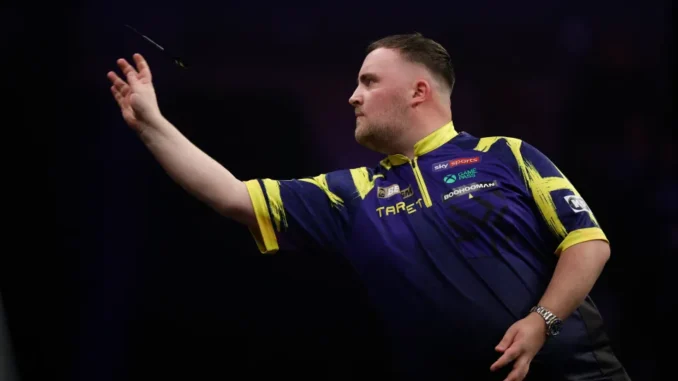
The electric atmosphere inside Liverpool’s M&S Bank Arena took on an edge of hostility as one of darts’ brightest young stars, Luke Littler, stepped onto the Premier League stage to a chorus of boos. What should have been another showcase of elite darts quickly turned into a charged encounter between player and crowd, highlighting the intense emotions that can spill over when sport, identity, and rivalry collide.
From the moment Littler’s walk-on music began, the tone inside the arena shifted. The Liverpool crowd, known for its passion and strong sporting loyalties, made their feelings clear almost instantly. Boos rang out loudly, echoing across the venue before a dart had even been thrown. The reaction wasn’t random—it was deeply rooted in football culture. Littler is an outspoken supporter of Manchester United, and in a city fiercely loyal to Liverpool FC, that allegiance was enough to turn him into the night’s villain.
The jeering intensified as Littler made his way to the oche, but what stood out most was his response—or rather, his lack of one. There was no visible frustration, no attempt to engage with the crowd. Instead, he remained composed, focused entirely on the task ahead. His body language suggested a player determined to block out the noise and let his performance speak for itself.
This wasn’t the first time Littler had faced such treatment. In recent weeks, the teenage sensation has experienced a noticeable shift in how crowds react to him. Earlier in the season, he was widely embraced as darts’ newest golden boy, a prodigy whose rise captivated fans across the sport. However, as his profile has grown, so too has the scrutiny. The Liverpool reception marked yet another night where admiration gave way to hostility, signaling a changing dynamic between the player and the public.
Part of this shift can be traced to on-stage moments that have sparked debate among fans. A recent incident involving Gian van Veen drew criticism, with some observers questioning Littler’s conduct during the match. While opinions remain divided, the episode added fuel to a narrative that is beginning to follow him from venue to venue. For some, he is still the fearless young talent taking the sport by storm. For others, he is evolving into a more polarizing figure—someone capable of drawing both admiration and criticism in equal measure.
Liverpool, with its deep-rooted sporting identity, proved to be the perfect stage for that tension to play out. The crowd’s reaction wasn’t just about darts; it was about rivalry, pride, and the emotional connections fans bring into arenas. Littler’s association with Manchester United made him an easy target, and the atmosphere reflected that from start to finish.
Yet, amid the noise and negativity, Littler delivered a performance that underlined exactly why he remains one of the most exciting players in the game. Facing world-class opposition in Luke Humphries, he produced a display of remarkable composure and precision. His scoring was relentless, his finishing clinical, and his control unwavering. The scoreboard told a convincing story as he powered to a 6–2 victory, silencing much of the crowd in the process.
As the match progressed, there was a noticeable shift inside the arena. The early hostility began to fade, replaced by a reluctant appreciation for the quality on display. Even in a setting where the crowd had clearly picked a side, Littler’s performance demanded respect. By the closing stages, the narrative had subtly changed—from one dominated by boos to one centered on brilliance.
Moments like this highlight the unique nature of darts as a sport. The close proximity between players and fans creates an atmosphere unlike almost any other, where crowd reactions can directly influence the energy of a match. While that intensity is part of what makes the Premier League so compelling, it also brings challenges. Players must not only contend with their opponents but also with the emotional currents flowing through the arena.
For Littler, navigating that environment is becoming an increasingly important part of his journey. At just 19, he is learning how to handle not only the pressures of elite competition but also the realities of being a high-profile figure in a sport that thrives on crowd interaction. The ability to remain focused under such conditions speaks volumes about his mental strength and maturity.
There is also a broader conversation emerging within darts about fan behavior. While passionate support is encouraged, there is a growing recognition that excessive hostility can cross a line. Some voices within the sport have suggested that players should avoid reacting to negative crowds, emphasizing that engagement can sometimes escalate situations rather than calm them. Littler’s approach in Liverpool—staying composed and letting his darts do the talking—may well serve as a blueprint.
Looking ahead, it seems likely that Littler will continue to encounter mixed receptions, particularly in cities where rivalries run deep. His identity, both as a player and as a personality, ensures that he will rarely go unnoticed. Whether cheered or booed, he commands attention, and that in itself is a mark of his growing influence within the sport.
What Liverpool ultimately demonstrated is that Littler is entering a new phase of his career. He is no longer just the exciting newcomer capturing hearts with his talent. He is becoming a central figure in the drama of modern darts—a player whose presence can shape the atmosphere of an entire arena.
And perhaps most importantly, he is proving that he can thrive in that role. The boos that greeted him could have unsettled a less experienced player. Instead, they seemed to sharpen his focus, driving him to deliver a performance of the highest quality. It is a trait shared by many of sport’s great competitors—the ability to turn adversity into motivation.
As the Premier League season continues to build toward its climax, Littler’s journey will remain one of its most compelling storylines. Every appearance now carries an added layer of intrigue: how will the crowd react, and how will he respond? If Liverpool is any indication, the answers are likely to be just as dramatic as the matches themselves.
In the end, the noise inside the arena may have been loud, but Littler’s darts spoke louder.
Leave a Reply