
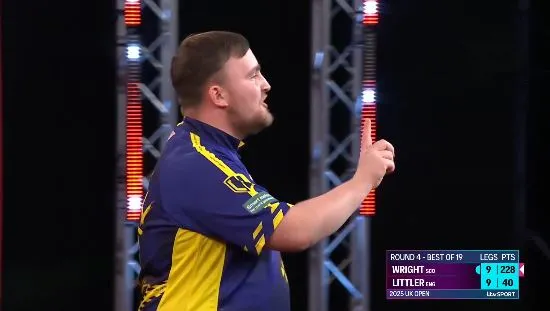
The rise of Luke Littler has been one of the most talked-about stories in modern darts, and with that rise has come the kind of attention that can both inspire and challenge a young athlete. During a gripping encounter at the UK Open against Peter Wright, Littler experienced both sides of that spotlight—thrilling support and audible hostility. Yet it was his composed performance and a sharp three-word message afterward that left a lasting impression.
The UK Open has always held a unique place in darts. Known for its open draw and unpredictable matchups, it often produces high-drama contests, and this clash between Littler and Wright lived up to that reputation. From the outset, it was clear that the match would be fiercely competitive. Wright, a two-time world champion, brought his trademark flair and experience, while Littler entered with confidence built on his remarkable recent form.
As the match unfolded, both players traded blows in a tense back-and-forth battle. Wright’s ability to hit big finishes kept him within touching distance, while Littler’s scoring power ensured he remained a constant threat. The quality on display was exactly what fans expect from top-level darts, but the atmosphere inside the venue began to take on a life of its own.
Sections of the crowd started directing boos toward Littler, creating a noticeably hostile environment. In darts, crowd interaction is part of the culture, but when it turns negative, it can test even the most seasoned professionals. For a teenager still relatively new to the biggest stages, it was a moment that could have unsettled him.
Instead, Littler responded in the way champions often do—by focusing entirely on his game. His composure stood out as he continued to find crucial trebles and execute key finishes under pressure. While the noise around him grew, his concentration appeared unshaken. Each visit to the oche was approached with the same calm intensity, a sign of mental strength that belies his age.
The match itself ebbed and flowed, with neither player able to fully seize control for long stretches. Wright’s experience showed in moments of pressure, as he punished any slight mistakes. Yet Littler’s resilience kept him in the contest, refusing to let the occasion overwhelm him. It was this balance of skill and determination that ultimately saw him edge over the line in a hard-fought victory.
However, it wasn’t just the result that people were talking about afterward—it was Littler’s reaction to the crowd.
When asked about the boos, he delivered a brief but pointed response, summing up his feelings in just three words: “I don’t care.” The simplicity of the message carried a powerful tone. It was not an emotional outburst or a defensive explanation, but rather a clear statement of his mindset. For Littler, the focus remains on winning matches, regardless of the reception he receives.
That response has since sparked widespread discussion. Some view it as a sign of maturity and confidence—a young player refusing to be distracted by external factors. Others see it as a bold, even defiant stance that could further polarize opinion among fans. Either way, it reflects a personality that is unafraid to stand firm under pressure.
This is not the first time Littler has encountered a mixed reception from crowds. As his profile has grown, so too has the intensity of reactions to him. In some venues, he is cheered as a prodigy rewriting the rules; in others, he finds himself cast as the antagonist, facing jeers and whistles. It is a dynamic that many top athletes experience, and how they handle it often becomes a defining aspect of their careers.
For Littler, the ability to channel that energy into performance is becoming a hallmark of his game. Against Wright, the hostile atmosphere could have disrupted his rhythm, but instead, it seemed to sharpen his focus. Moments of adversity often reveal a player’s true character, and in this case, Littler demonstrated that he possesses the mental toughness required to compete at the highest level.
Wright, for his part, played a significant role in making the contest so memorable. The Scottish veteran brought his usual blend of creativity and precision, pushing Littler to the limit. Even in defeat, his performance served as a reminder of his enduring quality and his ability to challenge the sport’s brightest talents.
The crowd’s involvement added another layer to the spectacle. Darts has long been celebrated for its lively and interactive audiences, but the line between support and disruption is an ongoing topic of debate. Booing, while not uncommon, raises questions about sportsmanship and its impact on players. Some argue that it enhances the drama, while others believe it detracts from the spirit of competition.
Littler’s response suggests that he is prepared to accept this aspect of the sport as part of the package. Rather than seeking to change the crowd’s behavior, he appears focused on controlling what he can—his own performance. It is an approach that many successful athletes adopt, recognizing that external factors are often beyond their influence.
There is also a broader narrative at play. Littler’s rapid rise has placed him at the center of darts’ evolving landscape. As a young star achieving remarkable success, he inevitably attracts both admiration and resistance. Fans are drawn to compelling stories, and the contrast between support and opposition only adds to his growing profile.
Moments like the UK Open clash with Wright contribute to that narrative. They showcase not only his technical ability but also his personality and resilience. The three-word message, while simple, encapsulates a mindset that could serve him well throughout his career.
Looking ahead, it seems likely that Littler will continue to encounter similar situations. High expectations, intense atmospheres, and vocal crowds are all part of life at the top of professional darts. How he navigates these challenges will play a crucial role in shaping his legacy.
For now, his approach is clear. He is focused on winning, on improving, and on maintaining the level of performance that has brought him so much success at such a young age. The boos, the cheers, and everything in between are secondary.
In the end, the match against Wright will be remembered for more than just the scoreline. It was a test of skill, composure, and character. Littler passed that test, not only by securing victory but by showing that he can thrive in difficult conditions.
And with a simple “I don’t care,” he sent a message—not just to the fans in attendance, but to the wider darts world—that he is ready for whatever comes next.
Leave a Reply