
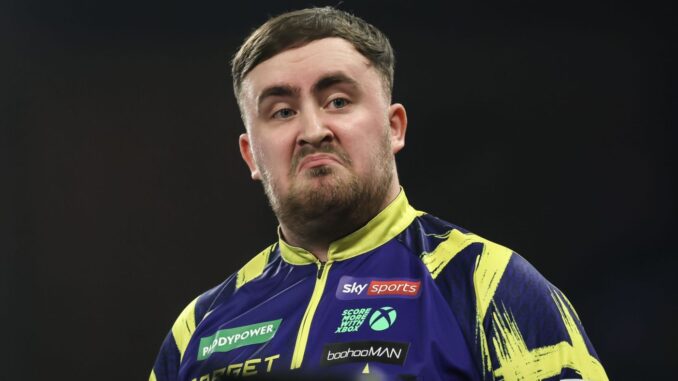
The ongoing tension between darts sensation Luke Littler and sections of the crowd has taken centre stage in the sport once again, after senior figures in darts moved to address the growing controversy surrounding the teenage star’s on-stage relationship with fans.
Littler, who has rapidly become one of the biggest names in the game despite still being at the very start of his professional career, has found himself at the centre of a row that continues to divide opinion. While many supporters admire his confidence, talent and emotional intensity on stage, others have reacted negatively to elements of his behaviour during matches, leading to repeated episodes of booing and hostile crowd reactions in major tournaments.
As the Premier League Darts season has unfolded, the atmosphere around Littler’s matches has become increasingly intense. In several cities across the UK and Europe, he has been met with loud jeering at key moments, particularly when he is preparing to throw or after scoring heavily. Despite this, he has maintained his composure on many occasions and continued to perform at an exceptionally high level, reinforcing his reputation as one of the most gifted young players the sport has ever seen.
The situation has now prompted a response from the leadership of the Professional Darts Corporation, with chief executive Matt Porter offering a detailed view on what has been happening and how it should be understood within the wider context of the sport.
Porter made clear that Littler’s relationship with the crowd is not one-sided, and that his own personality on stage plays a role in how fans respond to him. He suggested that the teenager has often embraced the energy of the arena, even using it as motivation during matches.
Luke has always enjoyed interacting with the crowd and I don’t think he minds it too much to a level, Porter explained. Obviously if you’re going to wind the crowd up a little bit, as he has done in the past, then you have to expect them to react to that. And often when Luke’s done that, he’s had a smile on his face and it’s been something he’s thrived on.
Those comments highlight a key part of Littler’s rise in professional darts. Unlike some players who prefer to remain emotionally neutral on stage, he has developed a more expressive style, reacting openly to big finishes, emotional moments and crowd reactions. For many fans, this has added entertainment value and made him one of the most watchable figures in the sport. For others, however, it has occasionally been seen as provocative, especially when tensions inside the arena are already high.
Porter went on to explain that crowd behaviour in darts is rarely random and often follows patterns influenced by previous events. He noted that once a particular reaction begins to emerge, it can quickly spread across different venues, as audiences replicate what they have seen elsewhere.
Darts crowds can tend to follow patterns, he said. They copy what they see the week before. So once you get on a bit of a run of having a certain reaction from the crowd, you need to do something to reverse that.
This observation reflects a long-standing feature of professional darts, where the relationship between players and spectators is unusually interactive compared to many other sports. The close proximity of fans to the stage, combined with the relaxed atmosphere of many venues, often leads to vocal engagement that can shift dramatically depending on the narrative of a match or a player’s recent form.
The issue of crowd hostility is not new to the sport, and Porter was quick to reference previous examples of players who have experienced similar treatment before eventually turning the situation around. One of the most notable cases is Gerwyn Price, who endured significant booing earlier in his career but later managed to reshape his relationship with fans through both improved performances and a more measured presence during matches.
The Gerwyn Price example shows that perception can change completely, Porter said. He has turned things around with the crowds, and that proves it can be done.
For Littler, the comparison is particularly relevant as he navigates the early stages of what is expected to be a long and highly successful career. Despite the negativity he has sometimes faced, his performances have remained consistently strong, and he has already collected major titles and high-profile wins that have established him as a genuine contender at the very top level of the sport.
However, the emotional side of his game continues to draw attention. On several occasions, Littler has responded directly to crowd reactions, whether through facial expressions, gestures or brief exchanges during matches. While some supporters see this as part of his competitive edge, others believe it risks escalating tensions in already charged environments.
The situation reached wider attention during recent major tournaments where boos were heard during key matches, prompting discussions about whether the young star is being unfairly targeted or whether his own behaviour contributes to the atmosphere. Littler himself has previously insisted that he does not allow external noise to affect his focus, maintaining that he remains committed to playing his natural game regardless of crowd reaction.
I don’t regret anything, he said when asked about his approach to dealing with hostile receptions, reinforcing the idea that he is not prepared to alter his personality on stage.
Despite the ongoing debate, there is little doubt that Littler’s presence has significantly increased interest in darts. Television audiences have risen during events he participates in, and arenas regularly sell out when he is competing. His rise has brought new attention to the sport, particularly from younger fans who see him as a relatable and exciting figure in a traditionally experienced-heavy field.
Still, with increased attention comes increased scrutiny. Every reaction he makes is analysed, every match is discussed in detail, and every interaction with the crowd becomes part of a wider narrative surrounding his career. This level of visibility is something he will continue to experience as his profile grows.
Porter acknowledged that managing this balance will be important going forward, both for Littler and for the sport as a whole. While he emphasised that crowd interaction is part of what makes darts unique, he also suggested that maintaining respect between players and fans is essential for the long-term health of the game.
If he can shrug it off and treat it like water off a duck’s back, then he’ll be alright with it, Porter said. But at the same time, there may come a point where a different approach is needed.
As the Premier League season continues, all eyes will remain on Littler not only for his performances at the oche, but also for how he handles the growing emotional dynamic between himself and the crowd. With pressure increasing and expectations rising, his ability to manage both his game and the atmosphere around him may prove just as important as his scoring power.
For now, the teenager remains at the heart of the darts world’s biggest talking point, with his journey continuing to captivate fans, divide opinion and shape the future conversation around modern professional darts.
Leave a Reply