
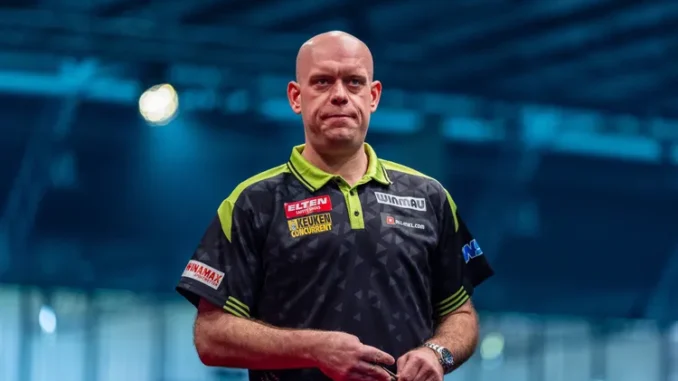
Wayne Mardle has delivered a blunt assessment of Michael van Gerwen’s current form, raising concerns about what he sees as a growing weakness in the Dutch star’s game: his inability to consistently win matches when he is not playing at his absolute best.
The Sky Sports pundit and former professional darts player did not question Van Gerwen’s elite ability or his proven record as one of the greatest players in the sport’s history. Instead, his focus was on what happens when the three-time world champion is not operating at peak performance, and whether that second level of performance is still strong enough to dominate top-tier opposition.
At the heart of Mardle’s analysis is a simple but significant point about consistency in modern darts. In a sport where margins are increasingly fine and matches are often decided by a handful of crucial legs, being able to win even when not at your best has become essential. According to Mardle, that is where Van Gerwen is currently under pressure.
“My concern or maybe his concern for himself is his B-game doesn’t win,” Mardle said, summing up what he believes is a key issue in the Dutchman’s recent performances.
In darts terminology, a player’s A-game refers to their peak level, where scoring, finishing, and rhythm all align perfectly. Van Gerwen’s A-game has historically been among the most destructive in the sport, capable of overwhelming opponents with relentless scoring bursts and clinical checkouts. His B-game, however, is the level he produces when things are not flowing perfectly but he is still expected to compete and win matches.
Mardle’s concern is that this secondary level is no longer reliable enough to carry Van Gerwen through tough matches against the world’s best players. Where once even a below-par performance from the Dutchman could still be enough to secure victory, the increasing depth of talent in professional darts now means any drop in quality can be punished.
Van Gerwen has spent more than a decade at the very top of the sport, establishing himself as one of the most successful players in darts history. His list of achievements includes multiple World Championship titles, Premier League triumphs, and victories at major televised events such as the World Matchplay and World Grand Prix. At his peak, he was widely regarded as the most dominant force in the game.
During those peak years, Van Gerwen’s intensity and scoring power often left opponents struggling to keep up. He was known for rapid scoring runs, high averages, and an aggressive playing style that put constant pressure on whoever stood opposite him at the oche. For long stretches, his dominance made him the player everyone else had to beat.
However, as the sport has evolved, so too has the level of competition. A new generation of players has emerged, while established rivals have raised their standards. The overall quality in professional darts has become significantly more competitive, meaning that even slight dips in form can now decide matches.
It is in this context that Mardle’s comments carry weight. He is not suggesting that Van Gerwen is no longer an elite player, but rather that the margin for error has become much smaller. When Van Gerwen is at his best, he remains capable of beating anyone in the world. The concern is what happens when he is not.
“There’s no B-game,” Mardle has previously suggested in discussions about top-level consistency, a sentiment that reflects his belief that modern darts increasingly demands high-level performance in every match, not just occasional brilliance.
For Van Gerwen, this raises an important challenge. Even though he continues to reach later stages of major tournaments and remains a dangerous opponent on any stage, questions persist about whether he can maintain the same level of dominance he once held. Matches that would previously have been routine victories are now more competitive, with opponents more capable of capitalising on any dip in performance.
Mardle’s assessment also highlights how crucial mental resilience and adaptability have become in today’s game. It is no longer enough for top players to rely on bursts of brilliance; they must also find ways to win when their rhythm is slightly off. This is often what separates champions from contenders over the course of long tournaments.
Van Gerwen’s ability to recover during matches remains one of his strengths, and his experience at the highest level means he is never to be written off. He has repeatedly shown in his career that he can respond to setbacks with dominant spells of scoring. However, the scrutiny from pundits like Mardle reflects a broader conversation about whether those responses are as consistent as they once were.
The Dutchman’s competitive fire and winning mentality are still widely respected across the sport. Even in periods where his form has been questioned, he remains a major threat in any event he enters. Opponents are fully aware that facing Van Gerwen, regardless of form, still requires a high level of performance.
But the modern darts landscape has changed significantly. With increased prize money, deeper fields, and more frequent tournaments, players are under constant pressure to perform at a high standard. The days when a top player could rely on reputation or occasional brilliance to carry them through matches are long gone.
In that environment, Mardle’s concern about Van Gerwen’s B-game becomes particularly relevant. It is not about isolated performances, but about sustainability over time. Can he still win consistently when not at his very best, or does he now need to be closer to peak level more often to secure victories?
These are the questions that now surround one of darts’ most successful ever players. While Van Gerwen’s legacy is already secure, his ongoing career continues to be shaped by how he adapts to this new level of competition.
For now, he remains firmly among the sport’s elite, capable of producing world-class darts and winning major titles. But as Mardle’s comments suggest, the difference between winning and losing at the top level is becoming increasingly defined by consistency rather than occasional brilliance.
And in that respect, the debate around Van Gerwen’s B-game is likely to continue as the sport moves forward.
Leave a Reply