
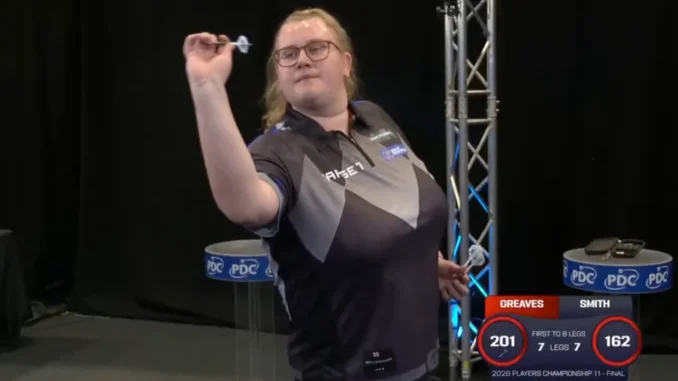
It was a moment that spoke louder than any statistic or record. As Beau Greaves stepped up for her live television interview, fresh from one of the most extraordinary victories the sport has ever seen, the emotions simply took over. Her voice trembled, her eyes filled with tears, and for a few seconds, she couldn’t find the words.
The 22-year-old had just achieved something no woman had ever done before—win a ranking title on the PDC ProTour. It was a historic breakthrough, not just for her career, but for darts as a whole. Yet in that moment, standing under the bright lights with microphones in front of her, Greaves wasn’t thinking about history books. She was just overwhelmed.
“I don’t know why I’m crying so much,” she admitted, pausing as she tried to compose herself. “I’m just really happy… so proud.”
Those few words, delivered through tears, captured everything. The pressure, the journey, the doubts, the expectations—all of it came pouring out at once. It was raw, real, and completely unforgettable.
Greaves’ path to that defining moment had been anything but straightforward. While many champions can point to a relatively smooth run through a tournament, hers was a gauntlet of elite opposition. She didn’t just win—she conquered some of the biggest names in the sport, proving beyond any doubt that she belonged at the very top level.
One of the standout performances came in the semi-finals, where she faced Gary Anderson, a two-time world champion known for his scoring power and experience. Few expected the match to be one-sided, but Greaves produced a stunning display, racing to a dominant victory. During that match, she delivered a moment of pure brilliance—a 170 checkout, the highest possible finish in darts, often referred to as the “Big Fish.” It wasn’t just a highlight; it was a statement.
Earlier in the tournament, she had also overcome Rob Cross, another former world champion. That victory required composure and precision, as Cross is known for thriving under pressure. Greaves handled it all with a calmness that belied her age.
Waiting for her in the final was yet another huge challenge: Michael Smith, one of the most dangerous players in the game and a former world champion. The final lived up to expectations, delivering a tense, high-quality contest that swung back and forth. Neither player was willing to give ground, and every leg felt crucial.
As the match reached its climax, the tension inside the arena was almost unbearable. It came down to a deciding leg, the kind of moment that defines careers. Greaves, however, showed incredible composure. With the title on the line, she produced a brilliant 142 checkout to seal an 8–7 victory.
That final dart didn’t just win her the match—it secured her place in history.
What made the achievement even more remarkable was the context behind it. Greaves has long been regarded as one of the brightest talents in darts, having already dominated the women’s game with multiple world titles. Her consistency, scoring ability, and mental strength had set her apart from her peers.
But stepping into the PDC ProTour environment is a completely different challenge. Week in, week out, players face the very best in the world, often in quick-fire matches where there is no room for error. For many, the transition can be difficult. For Greaves, it became an opportunity.
This victory didn’t come out of nowhere—it was the result of years of hard work and gradual progress. Yet even with her talent, there had been moments of frustration along the way. She has openly spoken about periods where she felt her performances weren’t matching her expectations, where things just didn’t click.
That’s part of what made her emotional reaction so powerful. It wasn’t just about winning a trophy; it was about overcoming those internal battles. It was about proving something to herself as much as to anyone else.
In her interview, you could see the relief as much as the joy. The tears weren’t just from happiness—they were from everything it had taken to get there.
Beyond her personal achievement, the significance of the moment extends far wider. For years, there has been discussion about the role of women in darts and the opportunities available to compete at the highest level. While there have been trailblazers before her, no one had managed to break through in this way on the PDC ProTour.
Greaves’ victory changes the conversation. It shows that the gap is not insurmountable, that with the right combination of skill, determination, and opportunity, history can be rewritten.
Her performance throughout the tournament also silenced any lingering doubts. Beating one top player can sometimes be dismissed as a one-off. Beating several world champions in succession, and then winning a final of that intensity, leaves no room for debate.
She didn’t just participate—she dominated when it mattered most.
Off the stage, Greaves remains grounded, something that has endeared her to fans. There is no sense of arrogance or entitlement, just a genuine love for the game and a desire to keep improving. That humility was on full display during her interview, where she seemed almost surprised by the scale of her own achievement.
It’s that combination of talent and authenticity that makes her such a compelling figure. Fans don’t just admire her ability—they connect with her story.
Looking ahead, this could be just the beginning of a new chapter. With a ranking title now to her name, Greaves is likely to gain entry into more major tournaments, where she will have further opportunities to test herself against the very best.
If this performance is anything to go by, she won’t just be making up the numbers. She’ll be a genuine contender.
For now, though, the defining image remains that emotional interview. A young champion, overwhelmed by what she had achieved, trying to find the words to describe a moment that probably felt beyond words.
In a sport built on precision and composure, it was a reminder of the human side of competition. Behind every dart thrown is a story of effort, sacrifice, and belief.
And on that unforgettable night, Beau Greaves didn’t just make history—she showed exactly what it means.
Leave a Reply