
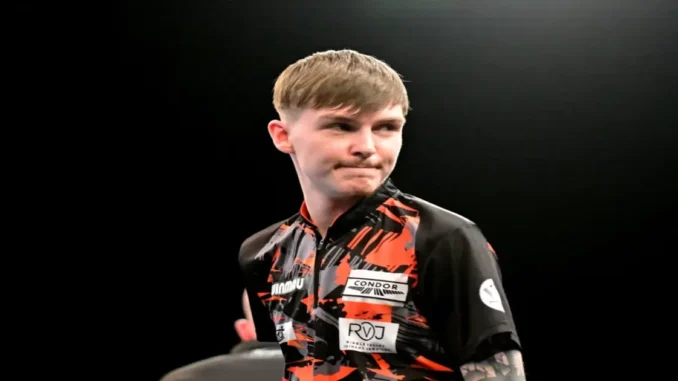
A frustrating and unexpected travel issue has forced Bradley Brooks to withdraw from a crucial ProTour double header, dealing a significant setback to his season at a time when every opportunity matters. The incident, which unfolded at the airport just moments before boarding, highlights how factors off the oche can have a major impact on a professional player’s campaign.
Brooks had been scheduled to compete in back-to-back Players Championship events on the Professional Darts Corporation ProTour, tournaments that play a vital role in shaping a player’s ranking and overall trajectory. These events are particularly important for players looking to build momentum, accumulate prize money, and strengthen their position on the Order of Merit. For Brooks, the double header represented a valuable chance to gain ground during a season that has already presented its fair share of challenges.
The 26-year-old arrived at the airport expecting a routine journey. By all accounts, the early stages of the process went smoothly. He checked in without issue, dropped off his luggage, and progressed through the usual procedures without any sign of trouble. It was only when he reached the boarding gate that the situation took a sudden and unexpected turn.
At that point, Brooks was informed that he would not be allowed to board his flight due to a problem with his passport. Although the document had not yet reached its expiration date, it did not meet specific travel requirements related to its overall validity. Under current regulations, passports must satisfy certain conditions beyond simply being in date, and in this case, Brooks’ document fell short of those criteria.
The timing of the discovery made the situation even more frustrating. Having already completed check-in and surrendered his luggage, Brooks was effectively stopped at the final hurdle, leaving no realistic opportunity to resolve the issue in time for his flight. What had initially seemed like a straightforward trip quickly turned into a costly disruption, forcing him to withdraw from both scheduled events.
Reflecting on the situation, Brooks acknowledged that the responsibility ultimately lay with him. He admitted that he should have been more aware of the specific passport rules and requirements, recognizing that such details are part of the preparation needed at the professional level. At the same time, the late stage at which the issue was flagged added to his disappointment, as there had been no earlier indication that anything was wrong.
The consequences of missing the ProTour double header are significant. Each Players Championship event offers players the chance to earn prize money that contributes directly to the PDC Order of Merit. This ranking system is central to a player’s career, determining qualification for major tournaments and influencing seeding positions. By missing two events in quick succession, Brooks not only loses potential earnings but also the opportunity to build momentum at a crucial point in the season.
For a player in Brooks’ position, these missed chances can have a ripple effect. The ProTour calendar is highly competitive, and consistent participation is often key to maintaining or improving ranking positions. When opportunities are lost, rivals can capitalize, making it even harder to close the gap later in the season.
This setback comes at a time when Brooks has been working to re-establish himself as a consistent force on the circuit. Earlier in his career, he was widely regarded as one of the sport’s most promising young talents, achieving notable success and capturing attention with his performances. Those early achievements suggested a bright future, but the transition to sustained success at the highest level has proven to be a demanding challenge.
Like many players navigating the competitive landscape of professional darts, Brooks has experienced fluctuations in form. The 2026 season has been a mixed one, with moments of promise interspersed with periods of inconsistency. The ProTour double header in Germany offered an opportunity to build rhythm and confidence, making his absence all the more frustrating.
The broader context of the ProTour underscores just how important these events are. Featuring large fields of players competing over multiple days, they provide a platform for both established stars and emerging talents to earn crucial ranking points. Strong performances in these tournaments often serve as a springboard for success in televised events, while missed opportunities can set players back in a tightly contested field.
While Brooks’ withdrawal is a personal disappointment, the events themselves continue with a full complement of competitors, each aiming to make the most of the opportunity. In such a competitive environment, the absence of any player creates space for others to step forward, further emphasizing the importance of being present and prepared for every event.
Looking ahead, Brooks will need to regroup quickly and ensure that similar issues do not arise again. In professional sport, preparation extends beyond practice and performance; it includes managing the logistical and administrative aspects that come with competing on an international stage. Attention to detail in these areas is essential, as this incident has clearly demonstrated.
Despite the setback, there is still time for Brooks to turn his season around. The darts calendar offers numerous events, providing ongoing opportunities to recover lost ground. A strong run in upcoming tournaments could help offset the impact of this missed double header, particularly if he can rediscover the form that once marked him out as a rising star.
Ultimately, the incident serves as a reminder of how unpredictable professional sport can be. While much of the focus is rightly placed on what happens during matches, moments like this highlight the importance of everything that happens behind the scenes. For Bradley Brooks, a technical issue has resulted in a costly withdrawal, but it also offers a lesson that could prove valuable in the long term.
As he looks to move forward, the challenge will be to channel the frustration of this experience into renewed focus and determination. With the right response, this setback could become a turning point rather than a defining moment, allowing him to return to competition with greater awareness and a strengthened resolve to make every opportunity count.
Leave a Reply