
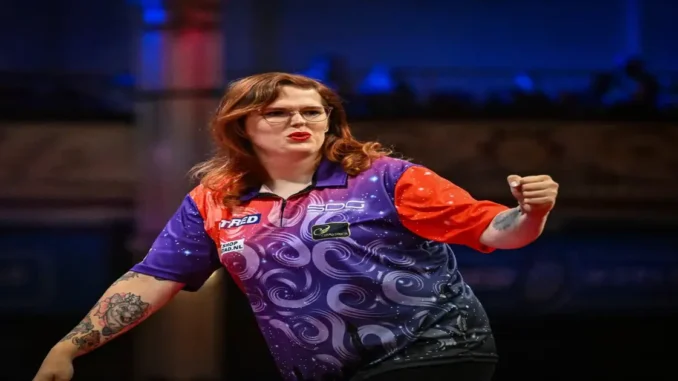
The debate surrounding inclusion and fairness in professional darts has intensified following a controversial rule change, with Noa-Lynn van Leuven delivering a powerful and emotional response to a decision she says has “changed everything” and left her career dreams “shattered.” The Dutch player, who has been a trailblazer in the sport, did not hold back in expressing her frustration, describing the ruling as “cruel” and deeply damaging on both a personal and professional level.
The decision in question comes from the Darts Regulation Authority, which recently introduced updated eligibility rules preventing transgender women from competing in women’s-only events. The policy change followed a formal review and has immediate implications for players like Van Leuven, who had been competing in the women’s circuit and building a strong presence in the game.
For Van Leuven, the timing and impact of the decision have been particularly difficult to process. She revealed that she learned about the ruling just a day before it was made public, leaving her with almost no time to prepare for the consequences. “It changed everything,” she said, capturing the abrupt shift in her career trajectory. What had once been a clear path forward suddenly became uncertain, with opportunities she had worked hard to earn effectively taken away overnight.
The emotional weight of the situation has been profound. Van Leuven explained that the ruling stirred deeply personal feelings, bringing back memories of earlier struggles with acceptance. “It brings up childhood memories of people not accepting me,” she shared, highlighting how the issue extends far beyond sport. For her, this is not simply about competition or eligibility, but about identity, belonging, and the right to pursue her passion on equal terms.
Her frustration is also rooted in the sense that her progress has been halted without warning. Having established herself as a competitive figure in women’s darts, she now finds that pathway closed. “Apparently, I just got retired — not by choice,” she said, summing up the feeling of being pushed out of a space where she had been striving to succeed.
Van Leuven’s journey in darts has been marked by determination and breakthrough moments. Since stepping onto the women’s circuit, she has achieved notable success, winning titles and earning recognition as a serious competitor. Her rise was seen by many as a significant step for representation in the sport, culminating in her becoming one of the first transgender women to compete at the highest levels of professional darts.
That progress, however, has been sharply interrupted. While she remains eligible to compete in open events under the Professional Darts Corporation structure, the loss of access to women’s competitions represents a major setback. Those events had provided not only a platform for competition but also a pathway to further opportunities, including qualification for major tournaments and increased visibility.
The reasoning behind the rule change has centered on questions of fairness. The governing body concluded that biological differences between male and female athletes could create competitive advantages, even in a sport like darts that is not traditionally associated with physical strength. Factors such as limb length, muscle composition, and coordination were cited as potentially influential when combined.
Van Leuven has strongly challenged this perspective. She argues that darts is fundamentally a game of skill, precision, and mental strength, where physical differences play a far less decisive role than in many other sports. In her view, the ruling does not reflect the reality of competition at the oche and instead unfairly excludes transgender players who are fully capable of competing on equal terms.
“This isn’t just about me,” she said, making it clear that she sees the issue as part of a broader pattern affecting transgender athletes. She described the decision as “another huge hit for the trans community,” expressing concern about the wider implications for inclusion in sport. Her comments have added to an ongoing global debate, as different sports grapple with how to balance fairness and participation.
The response to the ruling has been mixed. Some within the darts community believe the policy is necessary to protect the integrity of women’s competition, while others see it as a step backward that undermines efforts toward inclusivity. The discussion reflects a wider conversation taking place across multiple sports, where governing bodies are facing increasing pressure to define clear and consistent policies.
For Van Leuven, however, the debate is not abstract — it is immediate and deeply personal. The sense of loss she describes is tied to years of effort, training, and commitment. Darts had become more than just a sport; it was a pathway to personal growth and professional achievement. Having that pathway restricted has forced her to reconsider her future in the game.
Despite the setback, she has made it clear that she is not ready to walk away. “I’m not done,” she insisted, signaling her determination to continue competing and pursuing her ambitions. While the options available to her may now be more limited, she is exploring opportunities in open competitions and alternative events where she can still test herself against strong opposition.
Her resilience is a defining part of her story. Before reaching the professional stage, Van Leuven faced challenges that shaped her journey, both personally and athletically. Darts became a source of focus and purpose, offering a platform to rebuild confidence and pursue new goals. That background makes her current situation even more poignant, but it also underlines her capacity to adapt and push forward.
The coming months will be crucial in determining what the next chapter looks like. Adjusting to the new reality will not be easy, but Van Leuven’s determination suggests that she will continue to fight for her place in the sport. Whether through competition, advocacy, or both, she remains a significant figure in the conversation around inclusion in darts.
More broadly, her case is likely to remain part of a larger and ongoing debate. As sports organizations continue to refine their policies, stories like hers will shape how those decisions are understood and received. The balance between fairness and inclusion is complex, and there are no simple answers.
For now, the immediate impact is clear. A player who had been building momentum and breaking new ground has seen her career path dramatically altered. The disappointment is evident, but so too is the resolve to continue.
While the ruling may have “changed everything,” as she put it, it has not taken away her determination. In a sport where mental strength and focus are essential, those qualities may yet prove decisive — not just in competition, but in navigating the challenges that lie ahead.
Leave a Reply